- Animals
- ›Chordates
- ›Vertebrates
- ›Birds
- ›Rollers, Kingfishers, and Allies
- ›Kingfishers
- ›Tree Kingfishers
- ›Todiramphus
On eBird ↗
Forest Kingfisher
Live sightings near you, the range map, bar charts of when it is seen, and Macaulay Library photos and recordings.
Forest Kingfisher
Todiramphus macleayii
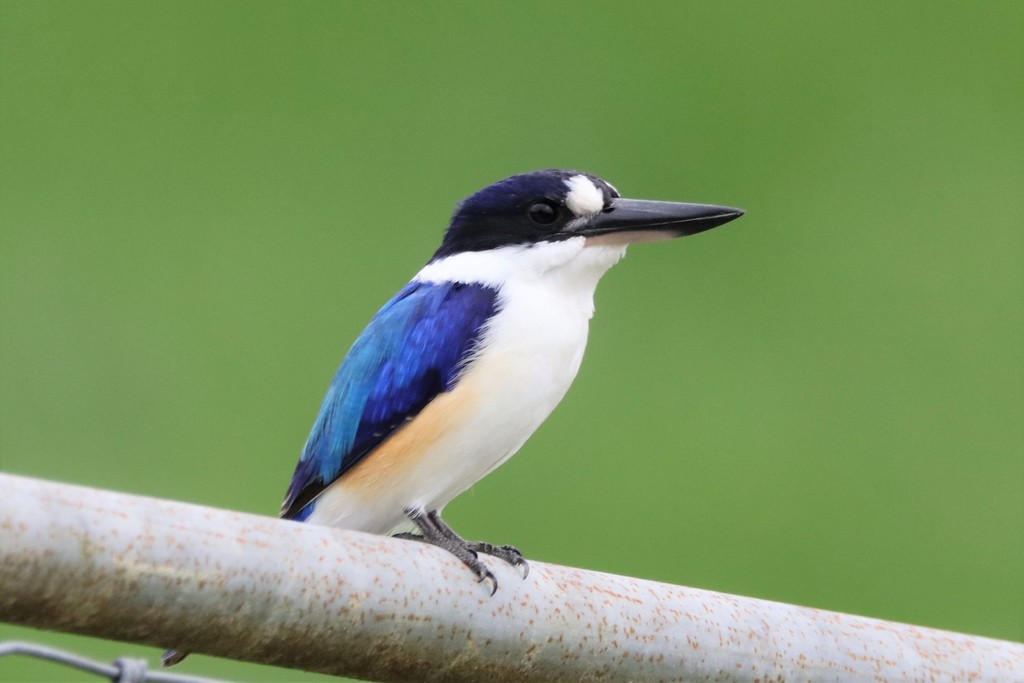
The forest kingfisher (Todiramphus macleayii), also known as the Macleay's or blue kingfisher, is a species of kingfisher in the subfamily Halcyoninae, also known as tree kingfishers. It is a predominantly blue and white bird. It is found in Indonesia, New Guinea and coastal eastern and northern Australia. Like many other kingfishers, it hunts invertebrates and small frogs and lizards.
From the article Forest kingfisher on Wikipedia (CC BY-SA), quoted section by section
Description
The forest kingfisher measures 21.5–25.5 cm (8.5–10.0 in) in length and the male weighs 32–43 g (1.1–1.5 oz) while the female weighs 29–44 g (1.0–1.6 oz). It has blue wings, head and tail with white breast, abdomen and nape. It has a white patch in front of the eyes and a black band stretching from the bill, through the eyes to the ear coverts. A white patch is visible on the wings in flight. The female is distinguished by a blue rather than white nape. The iris is dark brown and the legs and feet dark grey. Immature birds are duller with a blackish crown. The call is a shrill t-reek, repeated regularly, most often in the early morning.
Range & habitat
The forest kingfisher is native to Indonesia, Papua New Guinea, the Solomon Islands, and Australia, where it is found on or near the Australian coastline from Port Stephens in New South Wales northwards to Cape York and westwards across the Top End. It is a summer visitor in the southern parts of its range in New South Wales and southern Queensland; elsewhere it is resident all year round. As its name suggests, it inhabits subtropical or tropical dry forest, subtropical or tropical moist lowland forest, and subtropical or tropical mangrove forest and Melaleuca swampland.
Wikipedia: “Distribution and habitat”
What it does
The forest kingfisher hunts invertebrates, such as bugs, beetles, grasshoppers, spiders, dragonflies, cicadas, ants, adult and larval butterflies, and worms, as well as small fish, frogs and tadpoles, lizards, and snakes. The forest kingfisher watches from a high perch, dives to the ground or water to seize its prey (sally-pouncing), then returns directly to the perch. It often kills prey by hitting it against a branch after seizing it.
Wikipedia: “Feeding”
Listen
Looking for field recordings…
Where it lives
Recorded sightings
—
geo-referenced records in GBIF, from museums, herbaria and field observers.
Drag the globe to turn it. Dots are where records exist, not a range map; darker means more records.
In the stacks
Searching the stacks…
Every page naming Todiramphus macleayii in the Biodiversity Heritage Library →
This page is assembled live from iNaturalist, GBIF, Wikipedia, the Source Library and the Internet Archive. It is not yet part of the hand-edited codex. iNaturalist taxon 2481.