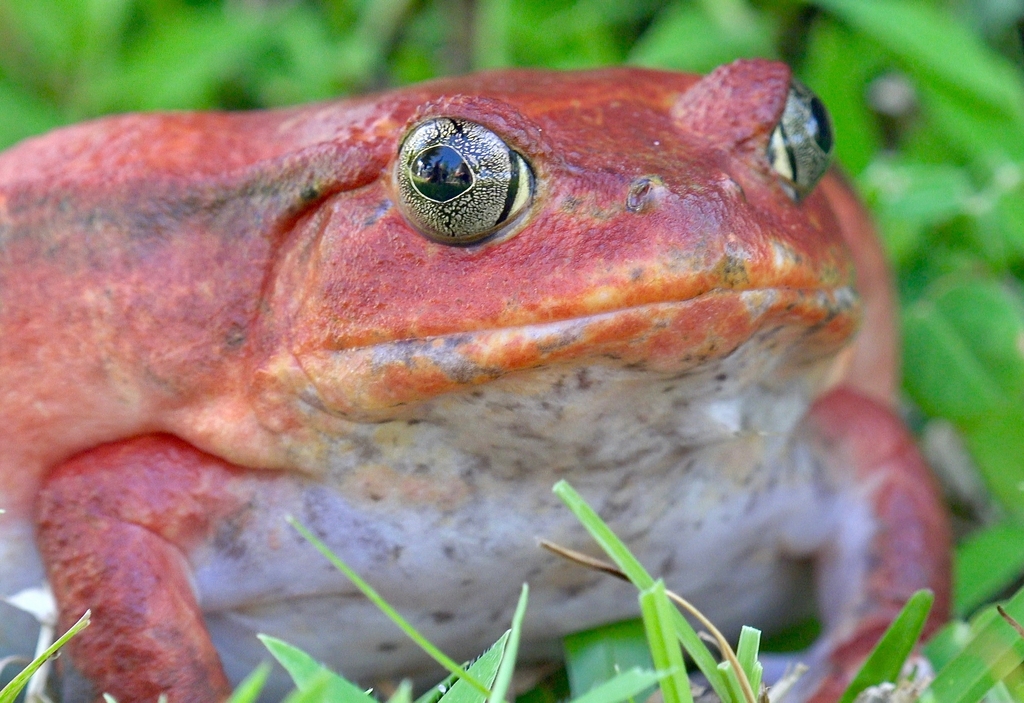
Tomato Frog
Dyscophus antongilii
The Madagascar tomato frog or crapaud rouge de Madagascar (Dyscophus antongilii) is a species of frog in the family Microhylidae.
From the article Dyscophus antongilii on Wikipedia (CC BY-SA), quoted section by section
Description
Females are much larger than males, reaching up to 10.5 cm and 230 g in weight (6.5 cm and 41 g for males). Tomato frogs live up to their name by possessing a vibrant, orange-red colour. Females have brighter tones of red or orange on their back, with a pale undersurface. Some individuals also have black spots on the throat. It is thought that the brilliant colours of the tomato frog act as a warning to potential predators that these frogs are toxic; a white substance secreted from the skin acts as a glue to deter predators (such as colubrid snakes) and can produce an allergic reaction in humans.
Range & habitat
Endemic to Madagascar, tomato frogs are found in the northeast of the island around Antongil Bay (from which they gain their specific name, antongilii), and south to Andevoranto. The exact distribution of this species is unclear however, due to confusion with the closely related D. guineti. The tomato frog breeds in shallow pools, swamps and areas of slow-moving water. These frogs are found from sea level to elevations of around 200 metres. Its natural habitats are subtropical or tropical moist lowland forests, rivers, swamps, freshwater marshes, intermittent freshwater marshes, arable land, plantations, rural gardens, urban areas, heavily degraded former forest, ponds, and canals and ditches.
Wikipedia: “Habitat and distribution”
What it does
Tomato frogs breed in February to March following heavy rainfall; the sounds of males calling to attract females can be heard around small water bodies in the dark Malagasy night. Following copulation, females will lay a clutch of 1,000 to 1,500 eggs on the surface of the water. Tadpoles hatch from these small black and white eggs about 36 hours later; they are only around six millimetres long and feed by filter-feeding. Tadpoles undergo metamorphosis into yellow juveniles and this stage is completed around 45 days after the eggs were laid. Ambushing potential prey, adult tomato frogs feed on small invertebrates, such as beetles, mosquitoes, and flies. When threatened, these frogs can inflate themselves, giving the appearance of greater size.
Wikipedia: “Life cycle and ecology”
Listen
Looking for field recordings…
Where it lives
Recorded sightings
—
geo-referenced records in GBIF, from museums, herbaria and field observers.
Drag the globe to turn it. Dots are where records exist, not a range map; darker means more records.
In the stacks
Searching the stacks…
Every page naming Dyscophus antongilii in the Biodiversity Heritage Library →
This page is assembled live from iNaturalist, GBIF, Wikipedia, the Source Library and the Internet Archive. It is not yet part of the hand-edited codex. iNaturalist taxon 25154.