- Animals
- ›Chordates
- ›Vertebrates
- ›Amphibians
- ›Frogs and Toads
- ›Narrow-mouthed Frogs
- ›American Narrow-mouthed and Sheep Frogs
- ›Hypopachus
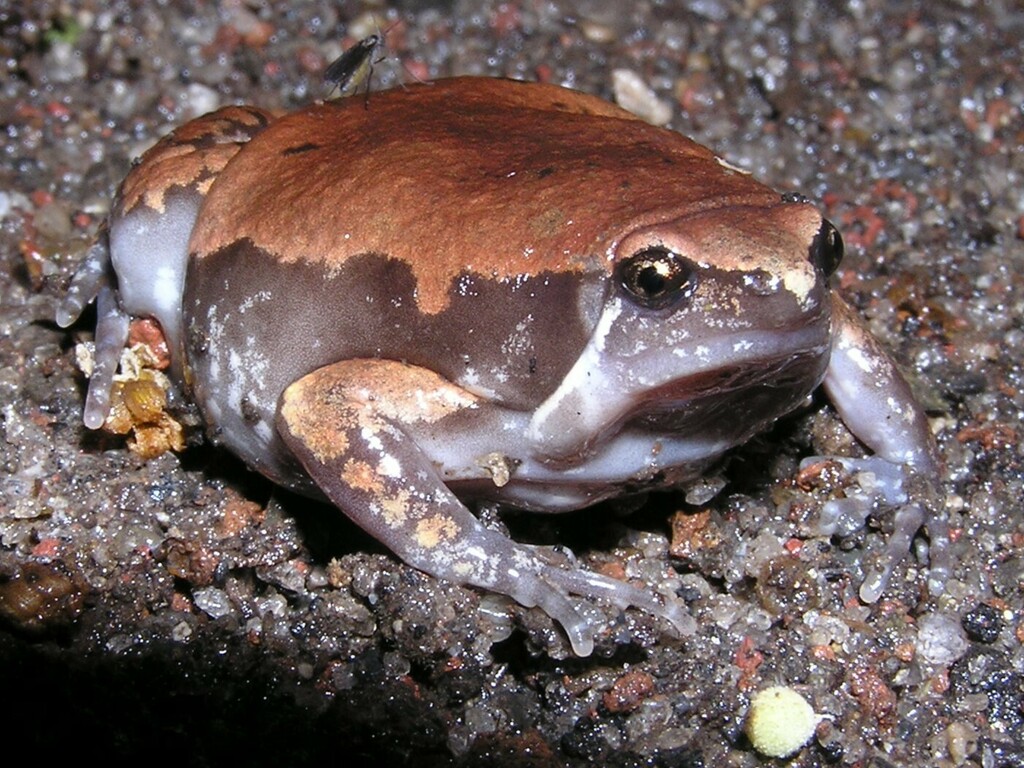
Sheep Frog
Hypopachus variolosus
The northern sheep frog (Hypopachus variolosus) is native to Central America, Mexico, and extreme south Texas, United States. It occurs in the lowlands from Sonora, Mexico, to northern Costa Rica on the Pacific coast, and south Texas to Honduras on the Gulf of Mexico and Caribbean coasts. The sheep frog inhabits semiarid thornscrub, savannas, pasturelands, and open woodlands, as well as more humid, moist forest in the canyons, basins, foothills, and lower elevations of mountains slopes. It is a fossorial, burrowing frog that is seldom seen on the surface except at night after heavy rains when they emerge to breed. The sheep frog gets its name from its distinctive call that resembles a sheep's bleat. It is a diet specialist primarily feeding on termites and ants.
The sheep frog is a small, stout frog with short legs, ranging about 2.5-3.8 cm, with females growing larger than the males. The dorsal color ranges from tan, to reddish-tan, to various shades of brown with irregular black flecks or spots, which may be extensive on some individuals, or absent on others. An orange, red, or yellowish mid-dorsal stripe, running from the snout to the vent is present on some specimens, but may by absent, vague, or fragmented on others. It is a common species in some areas of its range, but it is uncommon in the US and listed as a threatened species in the state of Texas.
From the article Northern sheep frog on Wikipedia (CC BY-SA), quoted section by section
Description
The sheep frog is a relatively small frog, 2.5-3.8 cm, with rare individuals exceeding 4 cm. Males average 3.3 mm and females average 3.8 mm.
Range & habitat
The sheep frog ranges through parts of Central America and Mexico, generally in lower elevation coastal areas below 1600 m, reaching its northernmost limit in far south Texas, US. On the Pacific coast it occurs from northwest Costa Rica, into western Nicaragua, north through western Mexico including the Balsas basin, into Sinaloa, and adjacent areas of extreme southern Sonora and Chihuahua. In Honduras and Guatemala it ranges across continent to the Atlantic (Caribbean Sea) coast, north into Belize and throughout the Yucatán Peninsula, up the coast to Nuevo León and Tamaulipas, Mexico, and adjacent areas of south Texas, US. Several areas within the range, such as southern Belize and northern Sinaloa lack records, suggesting possible gaps in the distribution. Conversely, relatively informal records available on internet web sites suggest the range extents significantly further into interior regions of southern Mexico than previously known. In the US, it occurs on the southern coast of Texas in at least 16 counties, from the lower Rio Grande Valley northward as far as Goliad County north of Corpus Christi. Some older maps indicate a distributional gap in northern Tamaulipas, Mexico, suggesting the Texas population is isolated from populations in southern Tamaulipas and Nuevo León. However, a few sparse records have appeared in recent years filling portions of that gap.
Wikipedia: “Distribution”
What it does
Diet: Sheep frogs are diet specialist, feeding largely on termites and ants (Hymenoptera), although some minute flies (Diptera) and other insects are occasionally consumed as well. Habitat: Hypopachus variolosus is known to occur in a variety habitats, most frequently reported from semiarid thornscrub and savanna environments. It also occurs in drier open woodlands, as well as more humid canyons, basins, foothills and premontane forest up to 1000–1200 meters (ca. 1600 m. maximum). Disturbed areas such as pasturelands, irrigation ditches, and vacant lots are also occupied. One author wrote that it is absent from undisturbed moist lowland forest in southern Mexico and Central America. In Texas, it is restricted to the semiarid thornscrub and grasslands of the Tamaulipan mezquital ecoregion. Sheep frogs are secretive and largely fossorial, known to live in the cavities of hollowed out root systems of trees and shrubs, mammal burrows, and pack rat nest. It is capable of burrowing backwards with its hind feet into loose soils, just below the surface during wet periods, and up to a meter in dry seasons. It emerges after heavy rains to breed and occasionally forage at night, and may be found under rocks, logs and fallen palm trees, and other surface debris while soils remain wet. Reproduction: Sheep frogs deposit their eggs between March and September or October. …
Wikipedia: “Ecology and natural history”
In human culture
Hypopachus is derived from two compounded Greek words: hypo = under, beneath, lesser; and pachos = thickness, implying fat or thick. The specific epithet variolosus is derived from the Latin word vario or variola = to variegate or variegated; and osus = full of or prone to, referencing the markings on the frogs belly. The standardized common names of sheep frog (singular) for the species Hypopachus variolosus, and sheep frogs (plural) for the genus Hypopachus, have long been established and are in wide usage. However, on Wikipedia, a previously established article on the genus Hypopachus has monopolized the common name sheep frogs and does not recognize the singular and plural forms of the same name (e.g. sheep frog, sheep frogs) as two separate pages, so the name northern sheep frog, which has some limited usage, has been applied here. Some other names used early in the 20th century, before the establishment of standardized common names include, Mexican narrow-mouthed toad, Taylor's toad, and Brownsville narrow-mouthed toad.
Wikipedia: “Etymology and nomenclature”
Listen
Looking for field recordings…
Where it lives
Recorded sightings
—
geo-referenced records in GBIF, from museums, herbaria and field observers.
Drag the globe to turn it. Dots are where records exist, not a range map; darker means more records.
In the stacks
Searching the stacks…
Every page naming Hypopachus variolosus in the Biodiversity Heritage Library →
This page is assembled live from iNaturalist, GBIF, Wikipedia, the Source Library and the Internet Archive. It is not yet part of the hand-edited codex. iNaturalist taxon 25185.