- Animals
- ›Chordates
- ›Vertebrates
- ›Amphibians
- ›Frogs and Toads
- ›Australian Ground Frogs
- ›Australian Ground Frogs
- ›Crinia
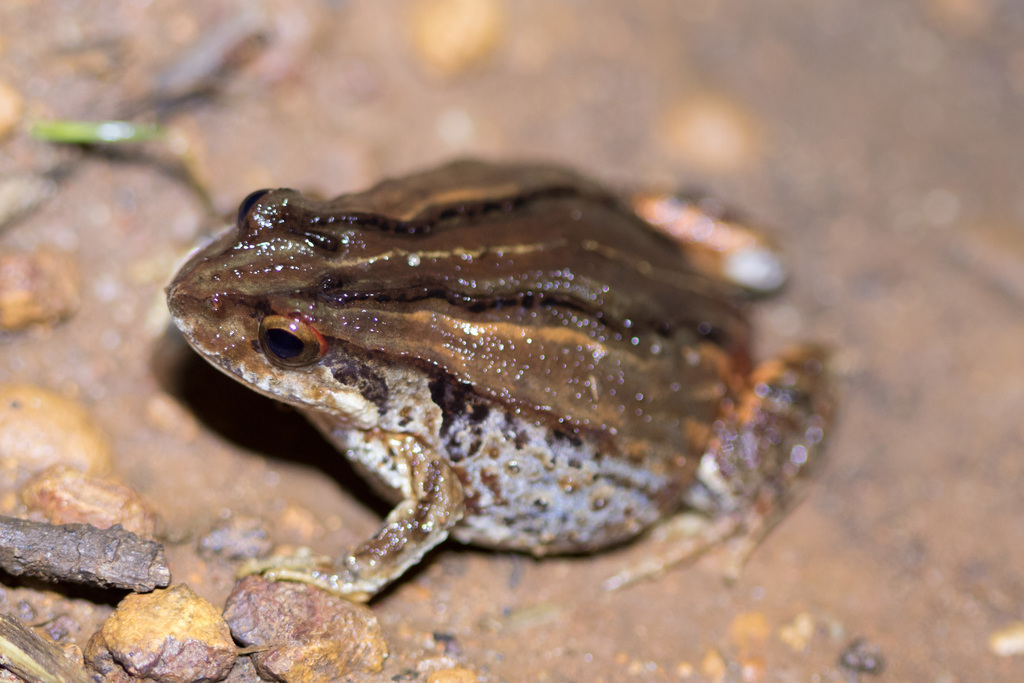
Quacking Froglet
Crinia georgiana
The quacking frog (Crinia georgiana), also known as the red-thighed froglet due to its legs tending to be bright red, is a species of frog from the Myobatrachidae family and is in a clad with five other species. The frog is well known for the sound it produces which resembles a quack. It has up to 11 notes and can change the notes in their call. It has larger testes compared to other frogs within the genus and has started to be used in experiments. This frog is found in southwest Australia. It is found in ponds, pools, and other moisture filled areas.
These frogs engage in polyandry and can result in multiple paternity of its offspring.
From the article Quacking frog on Wikipedia (CC BY-SA), quoted section by section
Description
Crinia georgiana is a short or squat froglet that appears flattened and has a large head and short limbs. Characteristic of its family, this frog has long and unwebbed fingers and toes. The dorsal skin can be smooth, but it is usually bumpy or tubercular, while the underside is finely granular. The genus is polymorphic, however, meaning there is great variation in colour and texture of the skin within each species. In addition, some individuals may have a backside with skin folds, while others do not. Its colouring ranges from orange to brown to almost black on its back and may include brown marbling or brown stripes on either side of its back, which aid in camouflage. The belly of males is dirty-grey, while females have a bright white abdomen; both have a white spot at the base of each limb. The groin and anterior and posterior surfaces of the thigh are bright red and the upper eyelids are either red or golden. Its hands are pale in colour. These traits are characteristic of the quacking frog and make it easily distinguishable from other species. Tadpoles are golden in colour and their tail is transparent. Crinia georgiana is unique compared to other species in the same genus as the testes' mass is significantly larger. …
Range & habitat
Because water is essential to this species, it is confined to areas of the coastal plains and forests where water is abundant particularly in winter, when breeding occurs. It is often found in shallow water near sandstone settlements or in marshy bogs. In addition, the quacking frog is known to live amongst vegetation or in habitats that result from the activity of humans such as agricultural lands and rural gardens where water is likely to be plentiful.
Wikipedia: “Habitat”
What it does
In general, the diet of a frog is largely made up of insects, although mites, snails, earthworms, spiders, and other small animals are also consumed. Smaller frogs risk being eaten by larger frogs, as cannibalism is not uncommon. While larger frogs will sometimes feed on fish, it does not appear that this is prevalent among Crinia georgiana. Occasionally, grass, seeds, petals, and other vegetation will be found in the stomachs of frogs, but this is assumed to be accidental. In other words, the frog eats the plants only because other prey was resting on it. Most frogs catch their prey via a flick of their tongue. The tongue is coated in a sticky secretion, which allows for the adhesion of the prey to the tongue. The catch is then taken into the mouth and swallowed right away, as frogs do not chew their food and many do not even have teeth. Members of Crinia do have vomerine teeth, which are pairs of teeth-like plates on the roof of the mouth that slant inward, but they appear to be rather unimportant. Once the food is in the stomach, the stomach compresses and abdominal muscles aid in digestion and expulsion of waste.
Wikipedia: “Diet and feeding habits”
In human culture
Quacking frogs are also called red-thighed froglets. Quacking frogs were first located near Albany; thus, they were named after King George Sound.
Wikipedia: “Etymology”
Listen
Looking for field recordings…
Where it lives
Recorded sightings
—
geo-referenced records in GBIF, from museums, herbaria and field observers.
Drag the globe to turn it. Dots are where records exist, not a range map; darker means more records.
In the stacks
Searching the stacks…
Every page naming Crinia georgiana in the Biodiversity Heritage Library →
This page is assembled live from iNaturalist, GBIF, Wikipedia, the Source Library and the Internet Archive. It is not yet part of the hand-edited codex. iNaturalist taxon 25232.