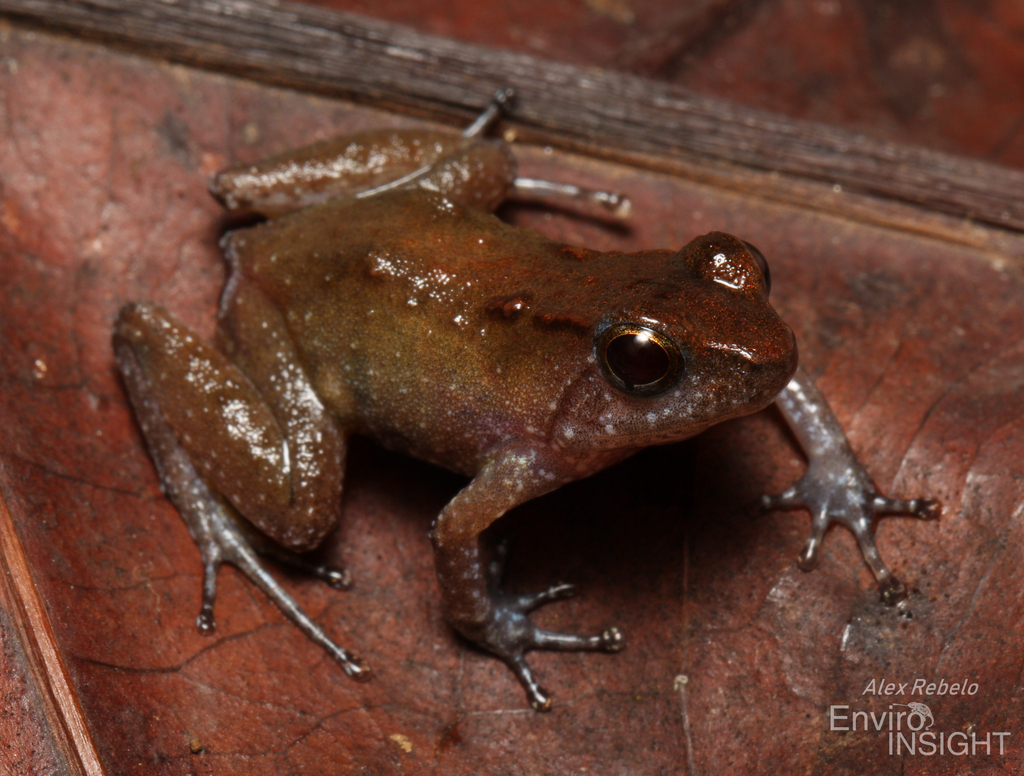
Tokba River Frog
Phrynobatrachus tokba
Phrynobatrachus tokba is a species of frog in the family Phrynobatrachidae. It is found in West Africa from Ghana westward to Côte d'Ivoire, Liberia, Guinea, Sierra Leone, and Guinea-Bissau. Common names Tokba river frog, Tokba puddle frog, and—when referring to the formerly recognized Phrynobatrachus alticola, forest river frog—have been proposed for it.
From the article Phrynobatrachus tokba on Wikipedia (CC BY-SA), quoted section by section
Description
Males grow to 15 mm (0.6 in) and females to 18 mm (0.7 in) in snout–vent length. The fingers and toes lack terminal discs and interdigital webbing. The dorsum is smooth to slightly warty, with three pairs of scapular warts, sometimes fusing into ridges. Coloration is variable; the dorsum is brown with or without red or green stripes or bands, or it is green or copper-red. The venter is white and may have grey marbling. Males have a smooth, grey throat. The male advertisement call consists of one to few "krck"-sounds.
Range & habitat
Phrynobatrachus tokba is primarily associated with degraded and open parts of primary forest, secondary forests with a broken canopy, and heavily degraded former forest (farm bush), but it can also occur in moist savanna and montane grassland during the rainy season. It occurs at elevations less than 1,600 m (5,200 ft) above sea level. It is a diurnal species found in leaf litter or grass tufts, sometimes sleeping on low vegetation at night. Development is direct (i.e., there is no free-living larval stage), and up to 25 eggs are deposited on the ground, with the larvae developing in a gelatinous mass. Phrynobatrachus tokba is a very common species. It is somewhat adaptable, but changes that lead to a near-complete opening of the landscape (agricultural expansion, logging, and human settlements) are a threat to it. It is probably present in many protected areas.
== References ==
Wikipedia: “Habitat and conservation”
Listen
Looking for field recordings…
Where it lives
Recorded sightings
—
geo-referenced records in GBIF, from museums, herbaria and field observers.
Drag the globe to turn it. Dots are where records exist, not a range map; darker means more records.
In the stacks
Searching the stacks…
Every page naming Phrynobatrachus tokba in the Biodiversity Heritage Library →
This page is assembled live from iNaturalist, GBIF, Wikipedia, the Source Library and the Internet Archive. It is not yet part of the hand-edited codex. iNaturalist taxon 25340.