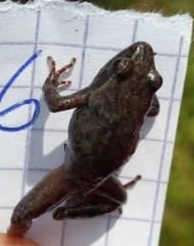
Vissoke River Frog
Phrynobatrachus bequaerti
Phrynobatrachus bequaerti is a species of frog in the family Phrynobatrachidae. It is found in the mountains of north-western Burundi, eastern Democratic Republic of the Congo, and western Rwanda. The specific name bequaerti honours Joseph Charles Bequaert, a Belgian botanist, entomologist, and malacologist and who collected the holotype from Mount Vissoke. Common name Vissoke river frog has been coined for this species.
From the article Phrynobatrachus bequaerti on Wikipedia (CC BY-SA), quoted section by section
Description
Specimens in the type series measure 12–25 mm (0.5–1.0 in) in snout–vent length; the largest specimens are all females. The snout is rounded. The tympanum is very distinct. The fingers have no webbing whereas the toes are about one-third webbed; the tips of the digits are slightly dilated. Skin has many small but prominent spiny tubercles. The dorsum is uniform brown, except for chocolate-brown vertebral stripe present in about half of individuals. The lower parts vary from almost immaculate white to having few drown spots to dusky mottling or vermiculation.
Range & habitat
Phrynobatrachus bequaerti lives in montane forests, grasslands, and wetlands at elevations of 2,400–3,000 m (7,900–9,800 ft) above sea level. Breeding presumably takes place in swamps. It seems to be common in suitable habitat, although populations appear to be declining, and only a single specimen was found from the Nyungwe Forest National Park during surveys in 2010–2011. The species is suffering from habitat loss and degradation caused by expanding agriculture, grazing of livestock, timber extraction, and expanding human settlements. It is recorded from the Virunga National Park (Democratic Republic of Congo) and the Volcanoes National Park (Rwanda).
== References ==
Wikipedia: “Habitat and conservation”
Listen
Looking for field recordings…
Where it lives
Recorded sightings
—
geo-referenced records in GBIF, from museums, herbaria and field observers.
Drag the globe to turn it. Dots are where records exist, not a range map; darker means more records.
In the stacks
Searching the stacks…
Every page naming Phrynobatrachus bequaerti in the Biodiversity Heritage Library →
This page is assembled live from iNaturalist, GBIF, Wikipedia, the Source Library and the Internet Archive. It is not yet part of the hand-edited codex. iNaturalist taxon 25404.