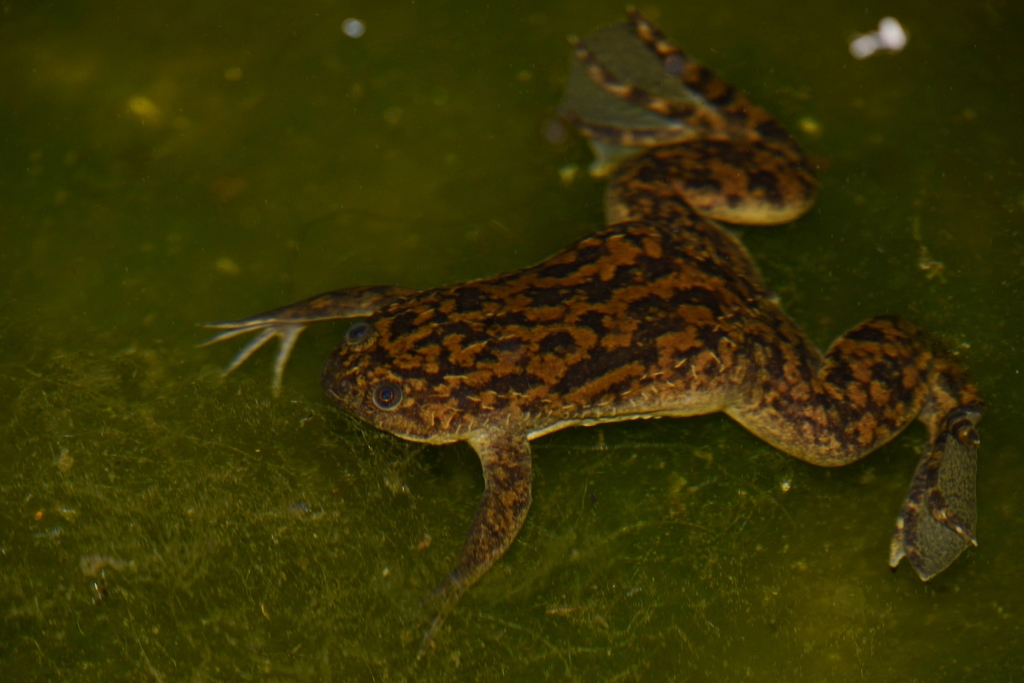
African Clawed Frog
Xenopus laevis
The African clawed frog (Xenopus laevis), also known as simply xenopus, African clawed toad, African claw-toed frog or the platanna) is a species of African aquatic frog of the family Pipidae. Its name is derived from the short black claws on its feet. The word Xenopus means 'strange foot' and laevis means 'smooth'.
The species is found throughout much of Sub-Saharan Africa (Nigeria and Sudan to South Africa), and in isolated, introduced populations in North America, South America, Europe, and Asia. All species of the family Pipidae are tongueless, toothless and completely aquatic. They use their hands to shove food in their mouths and down their throats and a hyobranchial pump to draw or suck things in their mouth. Pipidae have powerful legs for swimming and lunging after food. They also use the claws on their feet to tear pieces of large food. They have no external eardrums, but instead subcutaneous cartilaginous disks that serve the same function. They use their sensitive fingers and sense of smell to find food. Pipidae are scavengers and will eat almost anything living, dying, or dead and any type of organic waste.
From the article African clawed frog on Wikipedia (CC BY-SA), quoted section by section
Description
These frogs are plentiful in ponds and rivers within the south-eastern portion of Sub-Saharan Africa. They are aquatic and are often a mottled greenish-grey-brown in color, sometimes with yellowish botches, and with a pale white-cream belly. African clawed frogs have been frequently sold as pets, and are sometimes misidentified as African dwarf frogs. Albino clawed frogs are common and sold as animals for laboratories. Amphibians reproduce by fertilizing eggs outside of the female's body (see frog reproduction). Of the seven amplexus modes (positions in which frogs mate), these frogs are found breeding in inguinal amplexus, where the male clasps the female in front of the female's back legs until eggs are laid, and the male fertilizes the egg mass with the release of sperm. African clawed frogs are highly adaptable and will lay their eggs whenever conditions allow it. During wet rainy seasons they will travel to other ponds or puddles of water to search for food and new ponds. During times of drought, the clawed frogs can burrow themselves into the mud, becoming dormant for up to a year. Xenopus laevis have been known to survive 15 or more years in the wild and 25–30 years in captivity. …
What it does
African clawed frogs are fully aquatic and will rarely leave the water except to migrate to new water bodies during droughts or other disturbances. Clawed frogs have powerful legs that help them move quickly both underwater and on land. Feral clawed frogs in South Wales have been found to travel up to 2 kilometres (1.2 mi) between locations. The feet of Xenopus species have three black claws on the last three digits. These claws are used to rip apart food and scratch predators. Clawed frogs are carnivores and will eat both living and dead prey, including fish, tadpoles, crustaceans, annelids, arthropods, and more. Clawed frogs will try to consume anything that is able to fit into their mouths. Being aquatic, clawed frogs use their sense of smell and their lateral line to detect prey rather than eyesight like other frogs. However, clawed frogs can still see using their eyes and will stalk prey or watch predators by sticking their heads out of the water. Clawed frogs will dig through substrate to unearth worms and other food. Unlike other frogs, they have no tongue to extend to catch food, so clawed frogs use their hands to grab food and shovel it into their mouths. These frogs are particularly cannibalistic; the stomach contents of feral clawed frogs in California have revealed large amounts of the frog's larvae. …
Wikipedia: “Behaviour”
Listen
Looking for field recordings…
Where it lives
Recorded sightings
—
geo-referenced records in GBIF, from museums, herbaria and field observers.
Drag the globe to turn it. Dots are where records exist, not a range map; darker means more records.
In the stacks
Searching the stacks…
Every page naming Xenopus laevis in the Biodiversity Heritage Library →
This page is assembled live from iNaturalist, GBIF, Wikipedia, the Source Library and the Internet Archive. It is not yet part of the hand-edited codex. iNaturalist taxon 25457.