- Animals
- ›Chordates
- ›Vertebrates
- ›Birds
- ›Rollers, Kingfishers, and Allies
- ›Kingfishers
- ›Water Kingfishers
- ›Megaceryle
On eBird ↗
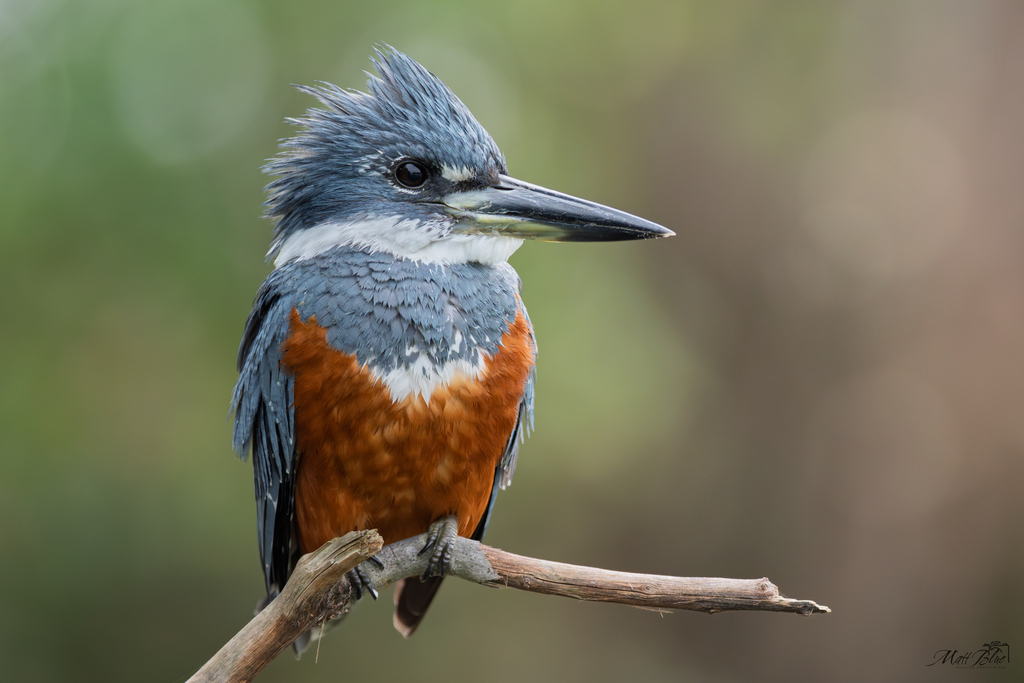
Ringed Kingfisher
Live sightings near you, the range map, bar charts of when it is seen, and Macaulay Library photos and recordings.
Ringed Kingfisher
Megaceryle torquata
The ringed kingfisher (Megaceryle torquata) is a large, conspicuous, and noisy kingfisher bird commonly found along the lower Rio Grande Valley in southeasternmost Texas in the United States through Central America to Tierra del Fuego in South America.
From the article Ringed kingfisher on Wikipedia (CC BY-SA), quoted section by section
Description
Megaceryle torquata is a Neotropical kingfisher that lives in habitats ranging between the US and Mexico. In 1888, the species was first discovered in the US, while the first ringed kingfisher nest was found in 1970. They are commonly seen along the Rio Grande and in water bodies in southern Texas. Their distribution is increasing and expanding northwards.
Measurement. The wings of adult males range between 184.9 and 211.1 mm (7.28 and 8.31 in), with an average of 196.3 mm (7.73 in). Their tails range from 110.0–129.0 mm (4.33–5.08 in), and their bills measure 74.9–94 mm (2.95–3.70 in). Female wings are from 185.0-210.1 mm, and their tails measure 111.5–132.1 mm (4.39–5.20 in) and possess bills measuring 75.9–90.9 mm (2.99–3.58 in). Individuals can weigh between 305 and 341 g (10.8 and 12.0 oz). Such measurements prove that the species do not differ sexually in terms of size.
Identification. Ringed kingfishers have dark-brown irises that are consistent among all age groups. They have straight bills that are longer than their heads, along with curved culmens and tomial serrations. The lower mandible appears to have some yellowish colorations. They possess syndactyl feet with olive-green or yellowish toes and black claws. A large crest appears between the base of their bills and necks. Several individuals have a white collar located around the neck.
Plumage. …
Range & habitat
Ringed kingfishers are seen in freshwater habitats, tropical and temperate marine shorelines, and several islands, such as Coiba Island. Breeding occurs in aquatic regions with the support of aquatic animals, including fish-populated areas for nesting burrows. Nests can be found farther away from water. Habitats are near waterbodies that include streams, rivers, ponds, lakes, estuaries, and marine habitats. Habitats with clear water and less vegetation are preferred to easily access prey.
Wikipedia: “Habitat”
What it does
Female and male ringed kingfishers incubate their eggs while performing other duties equally. Short foraging breaks are taken during late afternoon since incubation periods are long. Each individual takes turns during the morning. Incubating birds are capable of finding prey by regurgitating their undigested food to attract flies in their burrows.
Wikipedia: “Parental behavior”
Listen
Looking for field recordings…
Where it lives
Recorded sightings
—
geo-referenced records in GBIF, from museums, herbaria and field observers.
Drag the globe to turn it. Dots are where records exist, not a range map; darker means more records.
In the stacks
Searching the stacks…
Every page naming Megaceryle torquata in the Biodiversity Heritage Library →
This page is assembled live from iNaturalist, GBIF, Wikipedia, the Source Library and the Internet Archive. It is not yet part of the hand-edited codex. iNaturalist taxon 2552.