- Animals
- ›Echinoderms
- ›Sea Stars and Brittle Stars
- ›Sea Stars
- ›Valvatacean Sea Stars
- ›Valvatidan Sea Stars
- ›Cushion Stars, Carpet Stars, and Allies
- ›Asterina
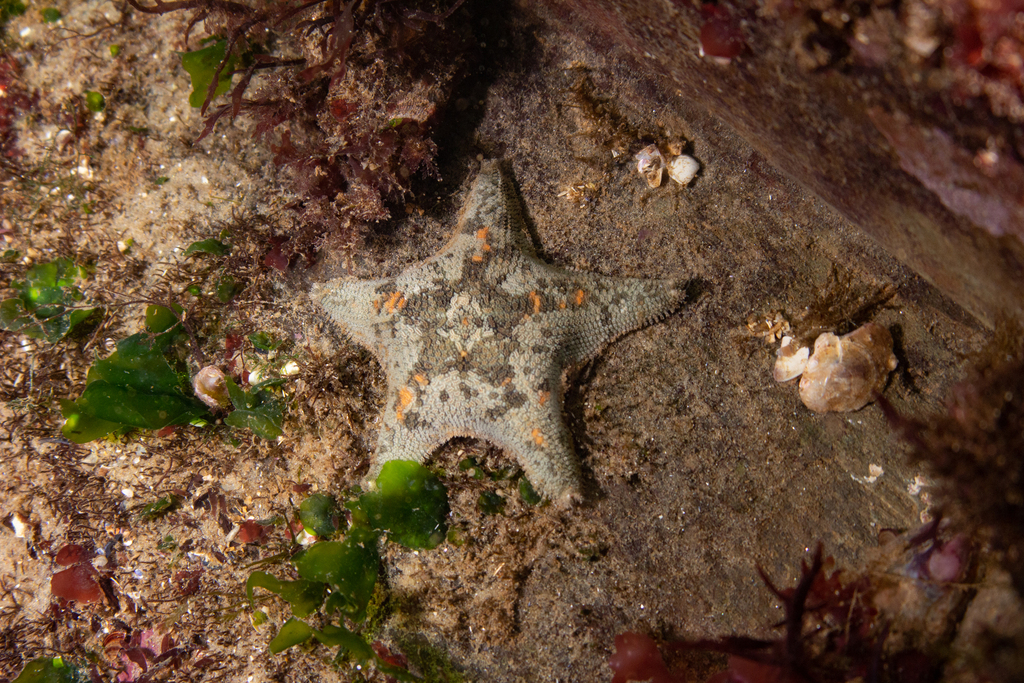
Namibian Cushionstar
Asterina stellifera
Asterina stellifera is one of thirty species of small bat star in the genus Asterina. It is mainly found on the east coast of South America, ranging from Cabo Frio, Brazil to Mar del Plata, Argentina. In the past decades, their numbers have depleted and are currently abundant only in the southern limit of its former range. Due to this decline, it is on Brazil’s endangered species list. It has a slow growth rate and relatively long lifespan. A. stellifera is an omnivorous generalist predator, and modifies the abundance of other invertebrates and algae in subtidal marine communities.
From the article Asterina stellifera on Wikipedia (CC BY-SA), quoted section by section
Description
This type of sea star grows five arms and can reach up to 80.0 millimetres (3.15 in) in length, though most stay around 50 millimetres (2.0 in). The size is found to vary with depth, larger sea stars are found deeper while smaller ones are usually found in shallow waters. The can be found in a variety of colors, mainly white and brownish, but also can be an orange-red color. All sea stars have tube feet that are controlled by hydraulic pressure. They can be found arranged in grooves along the arms. Tube feet are used to move around, they can attach to all different surfaces, feeding by passing food along the arms and to the mouth which is located at the center of the organism and for respiration. Sea stars do not have gills or lungs for respiration, they rely on their tube feet and papules, or skin gills, to take oxygen out of the surrounding water and move it into their bodies.
Wikipedia: “Anatomy”
What it does
Asterina stellifera has a defined annual and synchronous reproductive cycle. This cycle is affected by seawater temperature and day-length, they increase chances of fertilization by controlling gametogenesis (a process in which one cell splits to form four more cells). Reproduction is also regulated by planktonic food supply. A. stellifera can reproduce asexually by breaking apart into smaller parts and regrowing the missing limb. This explains why Asterina can be found living with less than five arms. Asterian sea stars also reproduce through dispersal of eggs. At the beginning of reproduction, many starfish belonging to the asteroid species form aggregations, nothing has been researched for A. stellifera but it can be assumed they would also mate like this. It is known that other Asterina species deposit up to 1000 eggs in a specific location in the process of reproduction. They mainly deposit underneath large rocks or corals. Scientists have also found that several males will surround one female during reproduction. From this, we can infer that A. stellifera would do this, but it has not yet been researched fully.
Wikipedia: “Reproduction”
Where it lives
Recorded sightings
—
geo-referenced records in GBIF, from museums, herbaria and field observers.
Drag the globe to turn it. Dots are where records exist, not a range map; darker means more records.
In the stacks
Searching the stacks…
Every page naming Asterina stellifera in the Biodiversity Heritage Library →
This page is assembled live from iNaturalist, GBIF, Wikipedia, the Source Library and the Internet Archive. It is not yet part of the hand-edited codex. iNaturalist taxon 255849.