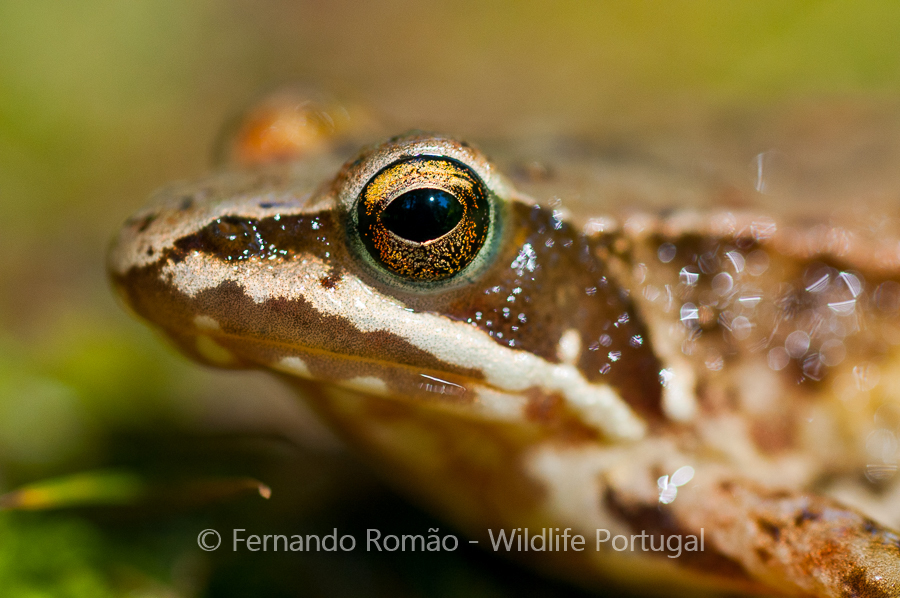
Iberian Frog
Rana iberica
The Iberian frog (Rana iberica), also known as Iberian stream frog, is a species of frog in the family Ranidae found in Portugal and Spain. Its natural habitats are rivers, mountain streams and swamps. It is threatened by habitat loss, introduced species, climate change, water contamination, and increased ultraviolet radiation.
From the article Iberian frog on Wikipedia (CC BY-SA), quoted section by section
Description
The Iberian frog can grow to about 7 cm (2.8 in) in length but a more normal size is 5 cm (2.0 in). Females tend to be larger than males. The tympanum can be seen just behind the eye and is about half its size in diameter. From the side of the head to the groin is a distinct ridge, the dorsolateral fold, which distinguishes this species from the common frog. The skin is smooth with fine granulations. The colour is very variable, being mainly olive, reddish or greyish-brown, sometimes with darker markings. A dark streak runs between the nostril and the eye, and a thin, white line marks the upper lip. The hind legs are sometimes barred with dark brown. The hind feet are more completely webbed than the common frog. The underside is pale, sometimes with darker spots, but the centre of the throat is not spotted. The Iberian frog has a distinctive call, which is generally produced at night. It sounds like "rao-rao-rao" and is issued at a rate of about three calls per second.
Range & habitat
The Iberian frog is endemic to Portugal and north-western and central Spain. It is a mountain species and has been recorded at altitudes up to 2,425 m (7,956 ft). It is present in the northern half of Portugal and in Spain it is found in the region of Galicia, in west León and in north-west Zamora, with separate populations in mountainous regions in central Spain. It favours slow-moving streams and rivers with overhanging vegetation, ponds, and glacial lakes. It shares parts of its range with the agile frog (Rana dalmatina), Perez's frog (P. perezi) and the common frog (R. temporaria).
Wikipedia: “Distribution and habitat”
Listen
Looking for field recordings…
Where it lives
Recorded sightings
—
geo-referenced records in GBIF, from museums, herbaria and field observers.
Drag the globe to turn it. Dots are where records exist, not a range map; darker means more records.
In the stacks
Searching the stacks…
Every page naming Rana iberica in the Biodiversity Heritage Library →
This page is assembled live from iNaturalist, GBIF, Wikipedia, the Source Library and the Internet Archive. It is not yet part of the hand-edited codex. iNaturalist taxon 25665.