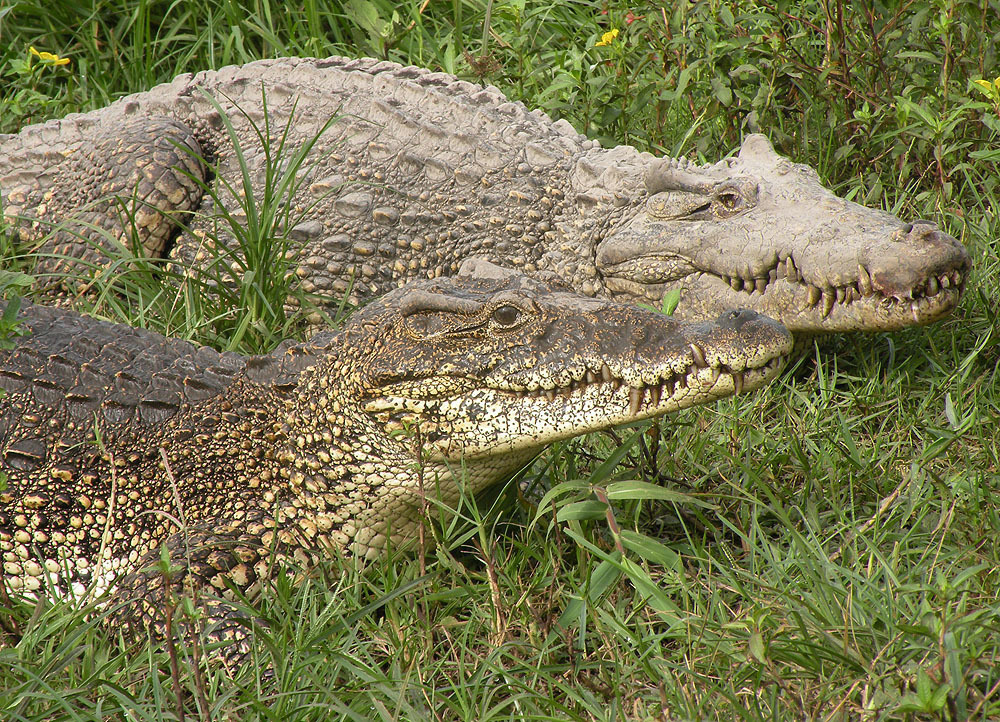
Cuban Crocodile
Crocodylus rhombifer
The Cuban crocodile (Crocodylus rhombifer) is a small-medium species of crocodile endemic to Cuba. Typical length is 2.1–2.3 m (6 ft 11 in – 7 ft 7 in) and typical weight 70–80 kg (150–180 lb). Large males can reach as much as 3.5 m (11 ft) in length and weigh more than 215 kg (474 lb).
The Cuban crocodile is of interest to biologists for its unique physical and behavioral traits. Long- and strong-legged, it is the most terrestrial of extant crocodiles. Its preferred habitat comprises freshwater and brackish water environments, such as mangrove swamps, coastal lagoons, estuaries, marshes, floodplains, and river deltas. There, the adults feed on fish, turtles and small mammals, while the young eat invertebrates and smaller fish. Mating occurs between May and July. Captive animals have displayed cooperative hunting behavior, and can be taught tricks, suggesting intelligence.
From the article Cuban crocodile on Wikipedia (CC BY-SA), quoted section by section
Description
The Cuban crocodile has numerous characteristics that set it apart from other crocodilians, such as its brighter adult colors, rougher, more 'pebbled' scales, and long, strong legs. The species is the most heavily armored extant member of its genus. This is a small to mid-sized crocodilian. Typical adults were found to have measured 2.1–2.73 m (6 ft 11 in – 8 ft 11 in) in length and weighed 70–120 kg (150–260 lb). Large males can reach as much as 3.5 m (11 ft) in length and weigh 215 kg (474 lb) or more. Three individuals measuring 1.87–2.46 m (6 ft 2 in – 8 ft 1 in) and weighing 30–65 kg (66–143 lb) had a bite force of 1,392–3,127 N (313–703 lbf).
Wikipedia: “Characteristics”
Range & habitat
Today, the Cuban crocodile can only be found in Cuba's Zapata Swamp, where it is highly endangered. It formerly ranged elsewhere in the Caribbean; fossils of this species have been found in the Cayman Islands, The Bahamas and Hispaniola (the Dominican Republic). The Cuban crocodile appears to favor freshwater habitat such as swamps, marshes, and rivers and rarely swims in saltwater.
Wikipedia: “Distribution and habitat”
What it does
The Cuban crocodile has been observed to display peculiar behavior not observed in other crocodilians, and is also considered to be the most morphologically and behaviorally distinct of any of the Crocodylus species. A colony of this species has exhibited what is strongly suspected to be pack-hunting behavior, which may explain the predation of prehistoric megafauna that coexisted with this species, such as giant Caribbean sloths and giant West Indian tortoises. It is also the most terrestrial crocodile, with reduced webbing between digits on the hind feet and no webbing on the front feet. It exhibits highly intelligent behavior unusual for crocodilians.
Hunting and diet. Small fish, arthropods, and crustaceans make up the diet of young Cuban crocodiles. Adults of the species feed mostly upon small mammals, fish, and turtles. They have blunt rear teeth, which aid in crushing the shells of their turtle prey. Cuban crocodiles also demonstrate the jumping feeding technique seen in other crocodilians, such as the American alligator. By thrusting with their powerful tails, they can leap from the water and snatch small arboreal animals from overhanging branches. They can also run anywhere between 15 and 22 mph (24 and 35 km/h), using a gait similar to a gallop, which allows for more quick and aggressive movements. …
Wikipedia: “Behavior and ecology”
Where it lives
Recorded sightings
—
geo-referenced records in GBIF, from museums, herbaria and field observers.
Drag the globe to turn it. Dots are where records exist, not a range map; darker means more records.
In the stacks
Searching the stacks…
Every page naming Crocodylus rhombifer in the Biodiversity Heritage Library →
This page is assembled live from iNaturalist, GBIF, Wikipedia, the Source Library and the Internet Archive. It is not yet part of the hand-edited codex. iNaturalist taxon 26061.