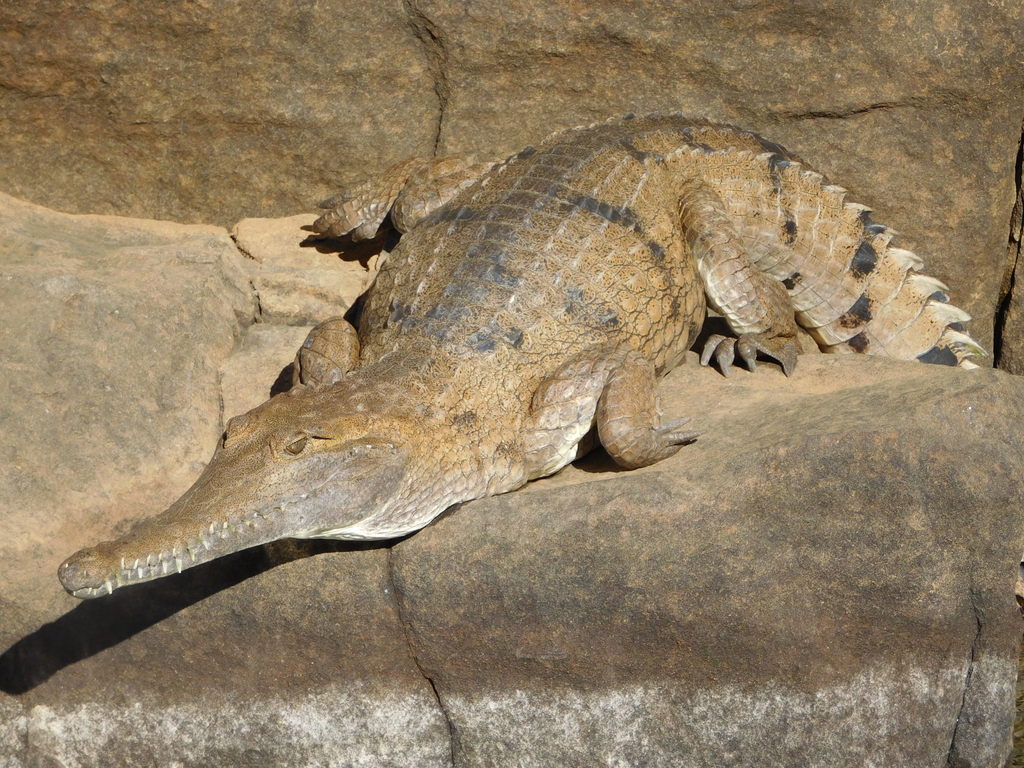
Freshwater Crocodile
Crocodylus johnstoni
The freshwater crocodile (Crocodylus johnstoni), also known commonly as the Australian freshwater crocodile, Johnstone's crocodile, Johnstone river crocodile and the freshie, is a species of crocodile native to the northern regions of Australia. Unlike its much larger Australian relative, the saltwater crocodile, the freshwater crocodile is not known as a man-eater, although it only bites in self-defence, and brief, nonfatal attacks have occurred, apparently the result of mistaken identity.
From the article Freshwater crocodile on Wikipedia (CC BY-SA), quoted section by section
Description
The freshwater crocodile is a relatively small crocodilian. Typically, males can grow to a total length (including tail) of 2.3–3.0 m (7.5–9.8 ft) if a dominant male, although there are reported specimens of 4 metres in length (see below), while females reach a maximum size of 2.1 m (6.9 ft). Males commonly weigh around 70 kg (150 lb), with large specimens up to 100 kg (220 lb) or more, against the female weight of 40 kg (88 lb). In areas such as Lake Argyle and Katherine Gorge, a handful of confirmed 4-metre (13-foot) individuals exist. This species is shy and has a slenderer snout and slightly smaller teeth than the dangerous saltwater crocodile. The body colour is light brown with darker bands on the body and tail. These bands tend to be broken up near the neck. Some individuals possess distinct bands or speckling on the snout. Body scales are relatively large, with wide, close-knit, armoured plates on the back. Rounded, pebbly scales cover the flanks and outsides of the legs.
Range & habitat
Freshwater crocodiles are found in Western Australia, Queensland, and the Northern Territory. Main habitats include freshwater wetlands, billabongs, rivers, and creeks. This species can live in areas where saltwater crocodiles cannot, and are known to inhabit areas above the escarpment in Kakadu National Park and in very arid and rocky conditions (such as Katherine Gorge, where they are common and are relatively safe from saltwater crocodiles during the dry season). However, they are still consistently found in low-level billabongs, living alongside the saltwater crocodiles near the tidal reaches of rivers. In May 2013, a freshwater crocodile was seen in a river near the desert town of Birdsville, hundreds of kilometres south of their normal range. A local ranger suggested that years of flooding may have washed the animal south, or it may have been dumped as a juvenile. A population of freshwater crocodiles has been repeatedly sighted for a number of decades in the Ross River that runs through Townsville. The predominant theory is that the heavy flooding common to the area may have washed a number of the animals in to the Ross River Catchment area.
Wikipedia: “Distribution and habitat”
What it does
They compete poorly with saltwater crocodiles, but are saltwater tolerant. An individual being eaten by an olive python has been filmed; it was reported to have succumbed after a struggle of around five hours.
Reproduction. Eggs are laid in holes during the Australian dry season (usually in August) and hatch at the beginning of the wet season (November/December). The crocodiles do not defend their nests during incubation. From one to five days prior to hatching, the young begin to call from within the eggs. This induces and synchronizes hatching in siblings and stimulates adults to open the nest. If the adult that opens a given nest is the female which laid the eggs is unknown. As young emerge from the nest, the adult picks them up one by one in the tip of its mouth and transports them to the water. Adults may also assist young in breaking through the egg shell by chewing or manipulating the eggs in its mouth.
Diet. Feeding in the wild, freshwater crocodiles eat a variety of invertebrate and vertebrate prey. These prey may include crustaceans, insects, spiders, fish, frogs, turtles, snakes, birds, and various mammals. Insects appear to be the most common food, followed by fish. …
Wikipedia: “Biology and behaviour”
In human culture
When Gerard Krefft named the species in 1873, he intended to commemorate the man who first sent him preserved specimens, Australian native police officer and amateur naturalist Robert Arthur Johnstone (1843–1905). However, Krefft made an error in writing the name, and for many years, the species has been known as C. johnsoni. Recent studies of Krefft's papers have determined the correct spelling of the name, and much of the literature has been updated to the correct usage, but both versions still exist. According to the rules of the International Code of Zoological Nomenclature, the epithet johnstoni (rather than the original johnsoni) is correct.
Evolution. The genus Crocodylus likely originated in Africa and radiated outwards towards Southeast Asia and the Americas, although an Australia/Asia origin has also been considered. Phylogenetic evidence supports Crocodylus diverging from its closest recent relative, the extinct Voay of Madagascar, around 25 million years ago, near the Oligocene/Miocene boundary.
Phylogeny. Below is a cladogram based on a 2018 tip dating study by Lee & Yates simultaneously using morphological, molecular (DNA sequencing), and stratigraphic (fossil age) data, as revised by the 2021 Hekkala et al. paleogenomics study using DNA extracted from the extinct Voay. Hall's New Guinea crocodile placement suggested in 2023 study by Sales-Oliveira et al.
Wikipedia: “Taxonomy and etymology”
Where it lives
Recorded sightings
—
geo-referenced records in GBIF, from museums, herbaria and field observers.
Drag the globe to turn it. Dots are where records exist, not a range map; darker means more records.
In the stacks
Searching the stacks…
Every page naming Crocodylus johnstoni in the Biodiversity Heritage Library →
This page is assembled live from iNaturalist, GBIF, Wikipedia, the Source Library and the Internet Archive. It is not yet part of the hand-edited codex. iNaturalist taxon 26079.