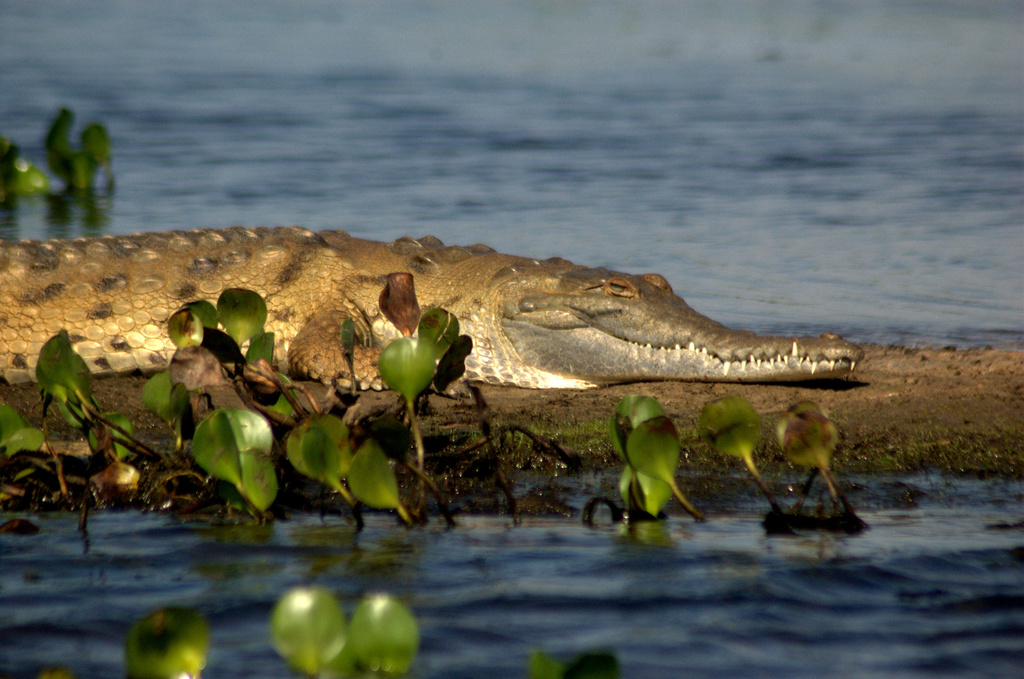
Orinoco Crocodile
Crocodylus intermedius
The Orinoco crocodile (Crocodylus intermedius) is a critically endangered crocodile which can only be found in the Orinoco river basin in Venezuela and Colombia. Extensively hunted for their skins in the 19th and 20th centuries, it is one of the most endangered species of crocodiles. It is a very large species of crocodilian; males have been reported up to 6.8 m (22 ft 4 in) in the past, weighing over 900 kg (2,000 lb), but such sizes do not exist today, 5.2 m (17 ft 1 in) being a more widely accepted maximum size. A large male today may attain 4.2 m (13 ft 9 in) in length and can weigh up to 450 kg (1,000 lb), while females are substantially smaller with the largest likely to weigh around 225 kg (496 lb). Sexual dimorphism is not as profound as in other crocodilian species. The coloration is light even in adults.
The ecology of the Orinoco crocodile is poorly documented in the wild, mostly due to its small population. It is thought to have a more piscivorous diet with an opportunistic nature, resulting in generalist predatory behaviour. It is an apex predator and preys on a variety of birds, mammals and reptiles, including caimans on occasion. Its prey base is mostly large predatory fish, challenging the general view by locals complaining about crocodiles hunting local fish to very low numbers. Reproduction takes place in the dry season when the water level is low. It is a hole nester and digs holes in the sand for its clutch of eggs. The females guard the nests and young for several years.
From the article Orinoco crocodile on Wikipedia (CC BY-SA), quoted section by section
Description
The Orinoco crocodile can be recognised by its relatively long snout, which is narrower than that of the somewhat similar-looking American crocodile. This species generally has a pale tan hide, though at least three coloration variations are known, with some almost completely yellowish, and some a dark brownish-gray. The skin can change colour over long periods of time; this phenomenon has been recorded in other species that can gradually change the amount of melanin in their skin. These crocodiles have dark-brown markings, which present as more pronounced bands in younger specimens and as scattered markings on mature ones. One individual measuring 3.4 m (11 ft 2 in) and weighing 182 kg (401 lb) had a bite force of 6,276 N (1,411 lbf).
Size. The Orinoco crocodile ranks among the largest living reptiles, as well as the largest predator in the Americas. It is arguably, on average, the largest crocodilian in the Americas; while American crocodiles, black caimans and the American alligator may approach similar dimensions, the Orinoco crocodile may be (or had been, when in healthy numbers) slightly longer. …
Wikipedia: “Characteristics”
Range & habitat
This species is restricted to the middle and lower reaches of the Orinoco river basin in Venezuela and Colombia. They have been occasionally reported on the island of Trinidad, but this has not been confirmed, and witnesses may have mistaken an American crocodile for the rarer species. This crocodile was once thought to have inhabited a wide range of riparian habitats, from tropical forests to the streams of the Andes foothills. Today, this species is restricted to the Llanos savanna and associated seasonal freshwater rivers.
Wikipedia: “Distribution and habitat”
What it does
Little study has gone into the dietary biology of Orinoco crocodiles but from eye-witness accounts and partial studies from captivity and crocodile farms, the majority of the Orinoco crocodile's diet appears to consist of large fish. The species' relatively narrow snout is ideally suited to minimize water resistance in capturing such aquatic prey. Juveniles prey on invertebrates and small fish, while large individuals prey on fish, terrestrial vertebrates and birds. Despite having a rather elongated skull, its base snout is wide, hinting to a generalist diet. Additionally, as they age, mature males in particular appear to manifest a broadened snout, presumably due to a shift to being able to take larger prey as is seen in several other large crocodile species. It stalks both aquatic and terrestrial prey. Prey includes South American tapirs, redtail catfish and large adult green anacondas. Similar to many of the larger crocodile species, the Orinoco crocodile has also been observed catching and eating smaller species of crocodilians, such as adult common caimans and sometimes cannibalizing smaller individuals of its own kind. Attacks on humans have been reported, but this is highly unlikely to be a common behavior today, given the very small population of the species and its relative isolation from large human settlements. …
Wikipedia: “Hunting and diet”
Where it lives
Recorded sightings
—
geo-referenced records in GBIF, from museums, herbaria and field observers.
Drag the globe to turn it. Dots are where records exist, not a range map; darker means more records.
In the stacks
Searching the stacks…
Every page naming Crocodylus intermedius in the Biodiversity Heritage Library →
This page is assembled live from iNaturalist, GBIF, Wikipedia, the Source Library and the Internet Archive. It is not yet part of the hand-edited codex. iNaturalist taxon 26081.