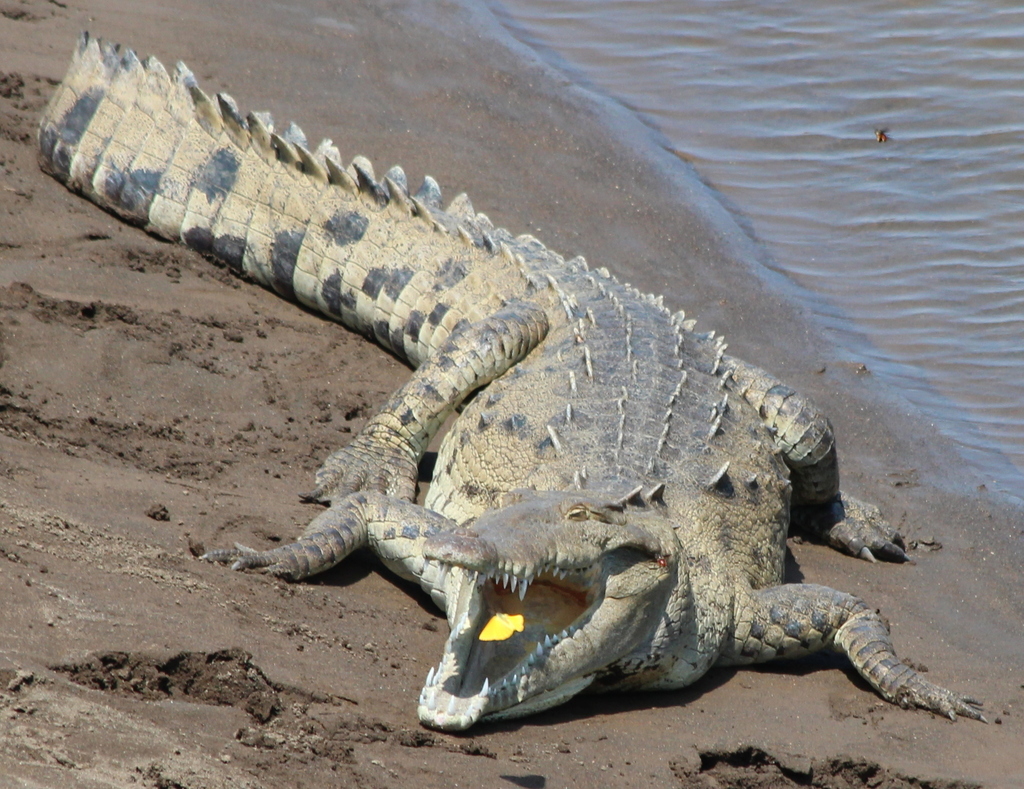
American Crocodile
Crocodylus acutus
The American crocodile (Crocodylus acutus) is a species of crocodilian found in the Neotropics. It is the most widespread of the four extant species of crocodiles from the Americas, with populations present from South Florida, the Caribbean islands of Cuba, Jamaica, and Hispaniola, and the coasts of Mexico to as far south as Peru, Ecuador, Colombia, and Venezuela.
The habitat of the American crocodile consists largely of coastal areas. It is also found in river systems, but tends to prefer salinity, resulting in the species congregating in brackish lakes, mangrove swamps, lagoons, cays, and small islands. Other crocodiles also have tolerance to saltwater due to salt glands underneath the tongue, but the American crocodile is the only species other than the saltwater crocodile to commonly live and thrive in saltwater. They can be found on beaches and small island formations without any freshwater source, such as many cays and islets across the Caribbean. They are also found in hypersaline lakes; one of the largest known populations inhabits Lago Enriquillo in the Dominican Republic.
From the article American crocodile on Wikipedia (CC BY-SA), quoted section by section
Description
Like all true crocodilians, the American crocodile is a quadruped, with short, stocky legs; a long, powerful tail; and a scaly hide with rows of ossified scutes running down its back and tail. Individuals can be identified by using multiple dorsal scute patterns. The American crocodile has the most reduced dorsal osteoderms amongst all living crocodilians. Its snout is elongated and includes a strong pair of jaws. A 3.2-metre (10 ft 6 in), 164-kilogram (362 lb) specimen had a bite force of 4,355 N (979 lbf). Its eyes have nictitating membranes for protection, along with lacrimal glands, which produce tears. The nostrils, eyes, and ears are situated on the top of its head, so the rest of the body can be concealed underwater for surprise attacks. The snout is longer and narrower than that of the American alligator, but broader on average than that of the Orinoco crocodile. American crocodiles are also paler and more grayish than the relatively dark-hued American alligator. As juveniles, they bear distinct dark cross-marks but typically lose them with age.
The American crocodile is sometimes confused with the Morelet's crocodile, a smaller species that is native to Mexico.
American crocodiles have a distinctive bump halfway down the snout, in front of the eyes. …
Range & habitat
The American crocodile is the most widespread of the four extant species of crocodiles from the Americas. They are saltwater-tolerant, and have thus been capable of colonizing a multitude of islands within the Caribbean, and on some coastal Pacific islands as well making it the most widely distributed New World crocodile. They inhabit waters such as mangrove swamps, river mouths, fresh waters, and salt lakes, and can even be found at sea, hence their wide distribution throughout southern Florida, the Greater Antilles (excluding Puerto Rico and Isla de la Juventud, where they are replaced by the introduced spectacled caiman), Martinique, southern Mexico (including the Yucatán Peninsula), Central America, and the South American countries of Colombia, Peru, Venezuela (including on Margarita Island), and Ecuador. The American crocodile is especially plentiful in Costa Rica. American crocodiles coexist with the American alligator in Florida and the spectacled caiman within Central America. The only other crocodiles present within the American crocodile's range are the Morelet's crocodile, and the critically endangered Cuban and Orinoco crocodiles. Recent morphological and genetic analyses have demonstrated hybridization with Cuban crocodiles among American crocodiles of the Yucatán.
Caribbean. …
Wikipedia: “Distribution and habitat”
What it does
This crocodile species normally crawls on its belly, but it can also "high walk". Larger specimens can charge up to nearly 16 km/h (10 mph). They can swim as fast as 32 km/h (20 mph) by moving their bodies and tails in a sinuous fashion, but they cannot sustain this speed. American crocodiles are more susceptible to cold weather than American alligators. American crocodiles do not have social groups, but occasionally they congregate for feeding and basking in the daytime. While basking, they will leave their mouths wide open that exposes blood vessels in the mouth to cooler and warmer air, which helps regulate body temperature. While an American alligator can survive in water temperatures of 7.2 °C (45.0 °F) and below for some time, an American crocodile in that environment would lose consciousness and drown due to hypothermia. American crocodiles have a faster growth rate than alligators, and are much more tolerant of saltwater. However, American crocodiles studied in northeast Florida Bay exposed to hypersaline conditions saltier than seawater were found to have reduced survival rates, growth rates, and body conditions.
Unlike other crocodiles, the American crocodile uses acoustic signals to communicate. …
Wikipedia: “Biology and behavior”
In human culture
The American crocodile was described by Georges Cuvier in 1807, and became known as the "sharp-snout alligator". In 1822, Constantine Samuel Rafinesque postulated that the species was in fact a crocodile. The species was redescribed as Crocodylus floridanus by William Temple Hornaday in 1875, when Hornaday and C. E. Jackson were sent to Florida to collect alligator hides. Upon hearing of a "big old gator" in Arch Creek at the head of Biscayne Bay, Hornaday and his companions searched for it and reported:
In a few hours, we got sight of him, out on the bank in a saw-grass wallow. He was a monster for size—a perfect whale of a saurian, gray in color—and by all the powers, he was a genuine crocodile! Crocodylus floridanus is now considered an invalid junior synonym of C. acutus. Recent genetic assays indicate that Jamaican populations of the American crocodile may be genetically distinct from the sympatric Cuban crocodile, despite a significant history of hybridization. Further comparative genetic analyses of Caribbean populations of the American and Cuban crocodile indicate that insular populations of Cozumel and Banco Chinchorro crocodiles may be genetically distinct species.
Wikipedia: “Taxonomy and etymology”
Where it lives
Recorded sightings
—
geo-referenced records in GBIF, from museums, herbaria and field observers.
Drag the globe to turn it. Dots are where records exist, not a range map; darker means more records.
In the stacks
Searching the stacks…
Every page naming Crocodylus acutus in the Biodiversity Heritage Library →
This page is assembled live from iNaturalist, GBIF, Wikipedia, the Source Library and the Internet Archive. It is not yet part of the hand-edited codex. iNaturalist taxon 26085.