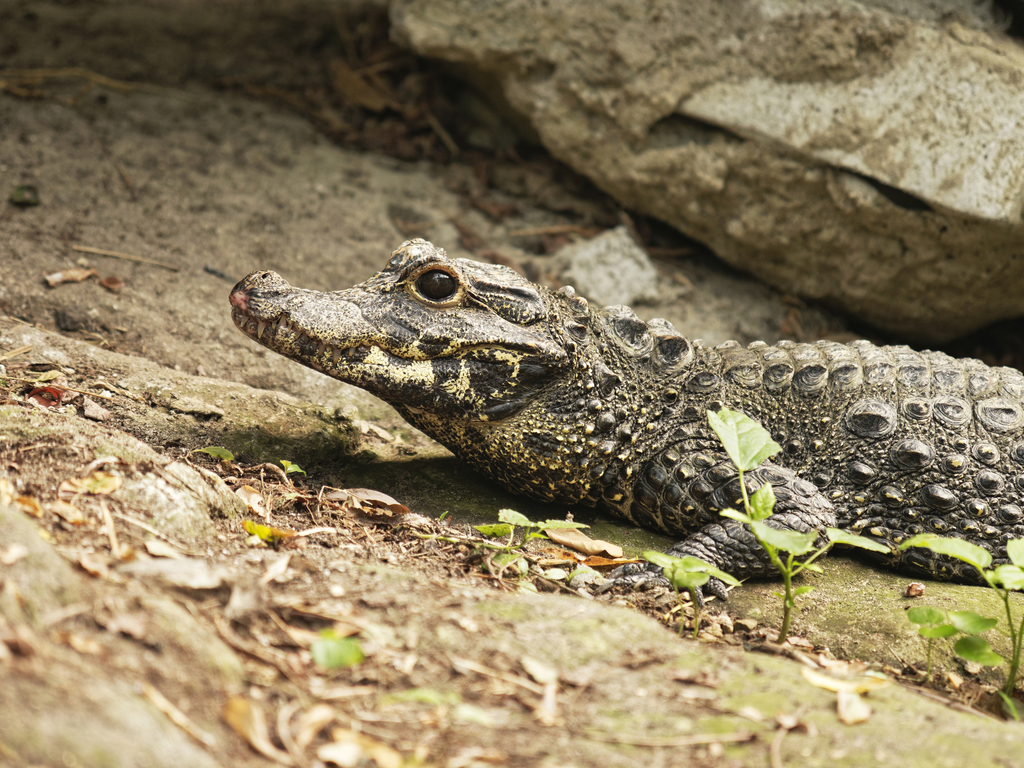
Dwarf Crocodile
Osteolaemus tetraspis
The dwarf crocodile (Osteolaemus tetraspis), also known commonly as the African dwarf crocodile, broad-snouted crocodile, or bony crocodile, is an African crocodile that is also the smallest extant crocodile species. Recent sampling has identified three genetically distinct populations. Some feel that the findings should elevate the subspecies to full species status.
From the article Dwarf crocodile on Wikipedia (CC BY-SA), quoted section by section
Description
Dwarf crocodiles attain an adult length of 1.7–1.9 m (5.6–6.2 ft). Adult specimens typically weigh between 18 and 32 kg (40 and 71 lb). This makes it the smallest living crocodile species, although the Cuvier's dwarf caiman (Paleosuchus palpebrosus), a member of the family Alligatoridae, is smaller at up to about 1.7 m (5.6 ft). If the Congo dwarf crocodile (O. osborni) is recognized as a valid species, it would be both the smallest crocodile and the smallest crocodilian since it does not surpass 1.2 m (3.9 ft). Adults are all dark above and on their sides, while the underside is yellowish with black patches. Some individuals living in the caves of Abanda, Gabon, displayed orange patches, apparently due to alkaline bat guano that erodes the skin of the crocodile. Juveniles have a lighter brown banding on body and tails and yellow patterns on the head. As a result of its small size and heightened vulnerability to predation, this species of crocodile has a heavily armoured neck, back, and tail and also has osteoderms on its belly and underside of neck. Osteolaemus has a blunt short snout, as long as it is wide, similar to that of a Cuvier's dwarf caiman, probably a result of occupying a similar ecological niche. The dentition consists of four premaxillary teeth, 12 to 13 on the maxilla, and 14 to 15 on the dentary bone. O. t. …
Range & habitat
Dwarf crocodiles range across tropical regions of Sub-Saharan West Africa and Central Africa; and they are endemic to the equatorial rainforest rain belt. Such a distribution greatly overlaps with that of the slender-snouted crocodile, encompassing countries as far west as Senegal, reaching Uganda in the east, and ranging as southerly as Angola. The last confirmed record from Uganda was in the 1940s, but whether the species, which is easily overlooked, still survives there is unclear (it was always marginal in this country, only occurring in the far southwest). Dwarf crocodiles live from lowlands to mid-altitude in streams, small rivers, swamps, pools and mangrove, but generally avoid main sections of large rivers. Most of their range is within forested regions, but it may extend into more open regions where the streams or river are well-shaded. They are also found in seasonally-flooded forest. Unlike most crocodiles, dwarf crocodiles only rarely bask in the sun. During the night they may move some distance from water on land. Reports exist of dwarf crocodiles in isolated pools in the savannah. Dwarf crocodiles living long-term in caves are known from western Gabon, which stand out as an isolated genetic group.
Wikipedia: “Distribution and habitat”
What it does
The dwarf crocodile is a timid and mainly nocturnal reptile that spends the day hidden in pools or burrows, although it occasionally may be active during the day. Foraging is mainly done in or near the water, although it is considered to be one of the most terrestrial species of crocodilian and may expand the feeding pattern to land in extensive forays, especially after rains. Dwarf crocodiles are generalist predators and have been recorded feeding on a wide range of small animals such as fish, crabs, shrimp, frogs, gastropods, millipedes, spiders, insects, juvenile ornate monitors, water birds, bats and shrews.
In a study in the Democratic Republic of the Congo the primary food item was fish, and in a study in Nigeria the primary food items were gastropods and crabs. In the Congo there is a level of seasonality in its diet, changing from fish in the wet season to crustaceans in the dry season, when fish are less available. Plant material has also been found in the stomach of dwarf crocodiles, but it is suspected that this is ingested by accident. They can survive for relatively long periods without food. During the dry season, dwarf crocodiles often retreat to deep holes.True to its solitary, nocturnal nature, a dwarf crocodile digs out a burrow in which to hide and rest during the day, which can sometimes have a submerged entrance. …
Wikipedia: “Biology and behaviour”
In human culture
The second species has had a somewhat convoluted taxonomical history. It was first described as Osteoblepharon osborni by Schmidt in 1919, based on a few specimens from the Upper Congo River Basin in what is now the Democratic Republic of Congo. However, Inger in a 1948 paper found the specimens wanting of characteristics that would justify a generic separation from Osteolaemus and referred the specimens to Osteolaemus osborni. In 1961, it was reduced to subspecies rank. A study of morphology published in 2007, and studies of DNA in 2009, 2013 and 2015 indicate that three distinctly different populations of Osteolaemus may merit full species recognition. These are O. tetraspis (Central Africa, except the Congo River Basin), O. osborni (Congo River Basin), and a third possibly unnamed species (West Africa). Uncertainty exists for the population in Nigeria (between O. tetraspis and the possibly unnamed West African species) as it has not been studied. A fourth clade was found in a study of captives in 2013, but where members of this clade live in the wild is unclear. In some regions the species may come into contact. For example, Cameroon is home to both O. tetraspis and O. osborni.
Etymology. The genus name, Osteolaemus, means "bony throat", and comea from Ancient Greek όστεον (ósteon), meaning "bone", and λαιμός (laimós), meaning "throat". …
Wikipedia: “Taxonomy and etymology”
Where it lives
Recorded sightings
—
geo-referenced records in GBIF, from museums, herbaria and field observers.
Drag the globe to turn it. Dots are where records exist, not a range map; darker means more records.
In the stacks
Searching the stacks…
Every page naming Osteolaemus tetraspis in the Biodiversity Heritage Library →
This page is assembled live from iNaturalist, GBIF, Wikipedia, the Source Library and the Internet Archive. It is not yet part of the hand-edited codex. iNaturalist taxon 26138.