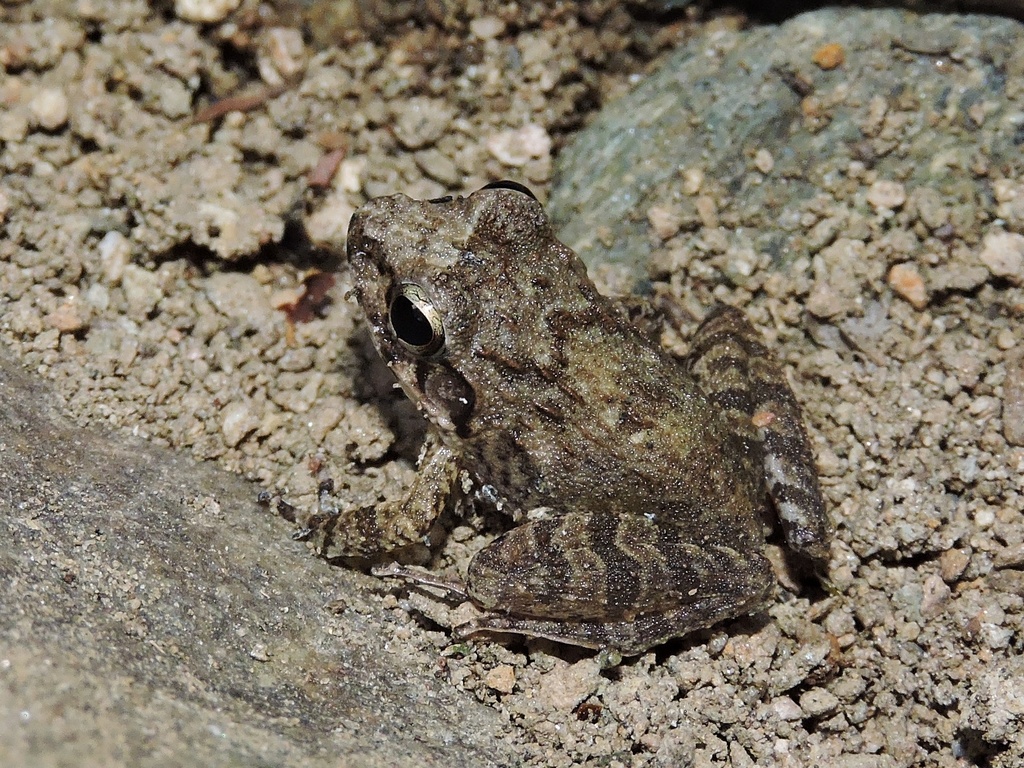
Gundia Leaping Frog
Indirana gundia
Indirana gundia is a species of frog found in the Western Ghats of India. It is only known from its type locality, Kempholey, Karnataka. Indirana gundia is listed among "Top 100 EDGE Amphibians". It represents a family that has been evolving independently in India for almost 50 million years.
From the article Indirana gundia on Wikipedia (CC BY-SA), quoted section by section
Description
Indirana gundia are small in size, with a total length of 23–38 mm (0.91–1.50 in). The dorsum is variable in colour, ranging from brown to yellowish, via golden, cream, pinkish and reddish hues, probably providing good camouflage against the background of decaying leaves on the forest floor. Adult frogs have long, muscular legs; the digits on both pairs of limbs are unwebbed but dilated into disc-like suckers. The head is fairly pointed and the skin has longitudinal glandular folds along the back. The mouth is wide and the buccal cavity is whitish or yellowish.
Range & habitat
This terrestrial frog lives among rocks and leaf litter on the floor of tropical forests. It seems to require some canopy cover and cannot live in fully cleared areas. This frog has been observed between 66 and 1080 meters above sea level.
Wikipedia: “Habitat”
What it does
The frog lays eggs on wet rocks. This frog's tadpoles are not fully aquatic. It moves across wet rocks and moss using its tail and hind legs, which grow in at a younger age than those of other tadpoles of other species.
Wikipedia: “Reproduction”
Listen
Looking for field recordings…
Where it lives
Recorded sightings
—
geo-referenced records in GBIF, from museums, herbaria and field observers.
Drag the globe to turn it. Dots are where records exist, not a range map; darker means more records.
In the stacks
Searching the stacks…
Every page naming Indirana gundia in the Biodiversity Heritage Library →
This page is assembled live from iNaturalist, GBIF, Wikipedia, the Source Library and the Internet Archive. It is not yet part of the hand-edited codex. iNaturalist taxon 26139.