- Animals
- ›Chordates
- ›Vertebrates
- ›Amphibians
- ›Frogs and Toads
- ›Old World Tree Frogs
- ›Rhacophorinae
- ›Raorchestes
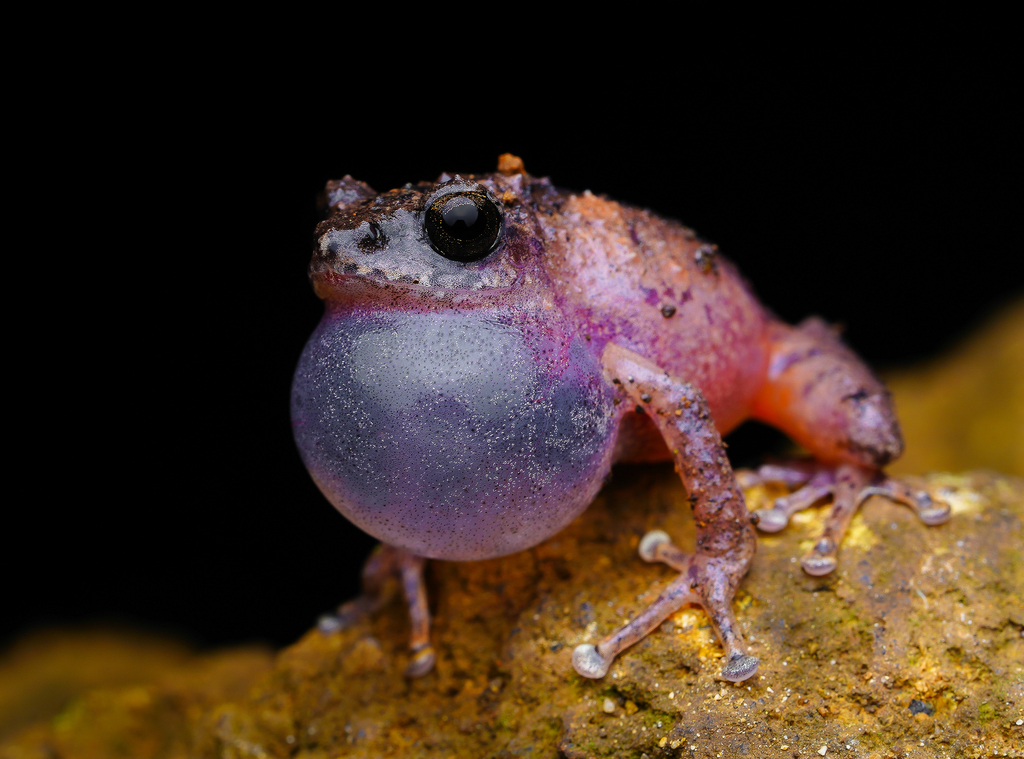
Griet's Bush Frog
Raorchestes griet
Raorchestes griet is a species of frog in the family Rhacophoridae. It is endemic to the Western Ghats south of the Palghat Gap in Kerala and Tamil Nadu states, India. The specific name griet honours Griet Decock, spouse of Franky Bossuyt, the scientist who described the species. The common name Griet bush frog has been coined for it.
From the article Raorchestes griet on Wikipedia (CC BY-SA), quoted section by section
Description
Adult males measure 20–22 mm (0.8–0.9 in) and adult females, based on a single specimen, 22 mm (0.9 in) in snout–vent length. The snout is rounded. The tympanum is indistinct, but the supratympanic fold is prominent. The fingers have well-developed discs and dermal fringes but no webbing. The toes have discs and rudimentary webbing. Skin of snout bears small horny spines, and there are horny ridges between eyes, arranged in triangle. Dorsal skin is covered with small horny spines. The dorsum is light greyish brown, light brownish grey, or light-reddish brown. Dark or light red markings may be present.
Range & habitat
Raorchestes griet has been observed in roadside vegetation near isolated forest patches or in plantations near forests at about 600–2,000 m (2,000–6,600 ft) above sea level. It is nocturnal and arboreal, which leaves it endangered by logging. Males call from ground level up to two metres above the ground. It has been observed on eucalyptus trees, but scientists do not think the frogs can live on commercial eucalyptus plantings as other frogs can. This species can be locally abundant, but it is threatened by habitat fragmentation associated with deforestation. Visitors may also disturb this frog during annual pilgrimages to the Western Ghats. Scientists have observed that the fungus Batrachochytrium dendrobatidis can infect other frogs in Raorchestes, so they infer the fungal disease chytridiomycosis may also infect R. griet. Scientists also name climate change as a threat to this frog. The frog's range includes several protected parks.Meghamalai Wildlife Sanctuary, Eravikulam National Park, Kodaikanal Wildlife Sanctuary, Anamalai Tiger Reserve and Periyar Tiger Reserve.
== References ==
Wikipedia: “Habitat and conservation”
Listen
Looking for field recordings…
Where it lives
Recorded sightings
—
geo-referenced records in GBIF, from museums, herbaria and field observers.
Drag the globe to turn it. Dots are where records exist, not a range map; darker means more records.
In the stacks
Searching the stacks…
Every page naming Raorchestes griet in the Biodiversity Heritage Library →
This page is assembled live from iNaturalist, GBIF, Wikipedia, the Source Library and the Internet Archive. It is not yet part of the hand-edited codex. iNaturalist taxon 26305.