- Animals
- ›Chordates
- ›Vertebrates
- ›Amphibians
- ›Frogs and Toads
- ›Old World Tree Frogs
- ›Rhacophorinae
- ›Rhacophorus
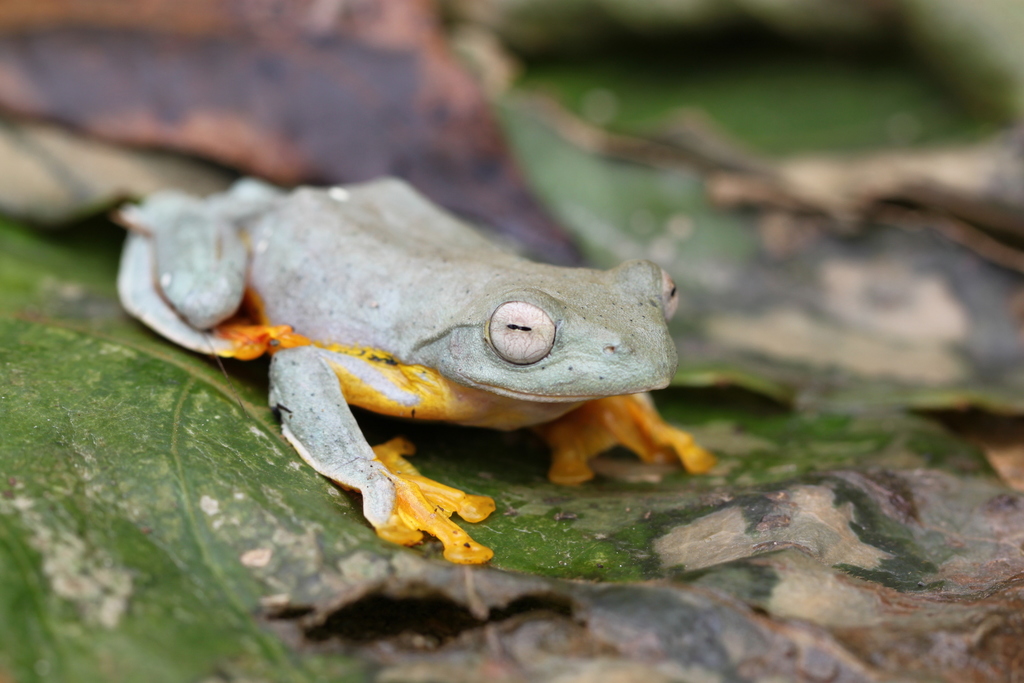
Twin-spotted Flying Frog
Rhacophorus bipunctatus
In sources published from 1999 onwards, the name Rhacophorus bipunctatus can also refer to R. rhodopus (see "Taxonomy" section).
Rhacophorus bipunctatus is a frog species in the moss frog family (Rhacophoridae) found from eastern India into Southeast Asia, possibly to southeastern China and south to Malaysia. Due to the identification problems surrounding this species, the eastern and southern limits of its range remain undetermined; all that is known is that the species certainly occurs in the border region of India, Bangladesh, China and Myanmar; its range might extend south to Malaysia, as similar frogs have been reported from Pahang.
From the article Rhacophorus bipunctatus on Wikipedia (CC BY-SA), quoted section by section
Description
Source: R. bipunctatus is a smallish tree frog with a pointed snout and body length of about 37–60 mm when adult, with females being larger than males. Its back is intensely green to violet-brown in living animals; in preserved specimens, this becomes blue to violet. No conspicuous pattern is visible on the back, though there may be a few tiny whitish and/or dark speckles. The arms and legs have very faint darker bands. The sides, belly and toes are brilliant yellow, becoming dull pink in preserved specimens. Behind the arms, there is almost always a conspicuous large black spot on the flanks; towards the hind legs there may be another one or two such spots, but very rarely the flank spots are absent entirely. The well-developed webbing of the toes is bright orange-red and not spotted, becoming whitish in preserved specimens. The eyes are dull green, sometimes with yellow rims. It can be distinguished from R. rhodopus, with which it was long confused, by the larger size (R. rhodopus has a body length of about 31–55 mm) and unspotted back with at least some trace of green or olive, often being entirely green (R. rhodopus has a reddish-brownish back with darker spots and lacks greenish hues). In individuals of similar size, R. bipunctatus has a much larger head.
What it does
Its natural habitats are subtropical or tropical moist montane forests, subtropical or tropical high-altitude shrubland, intermittent rivers, freshwater marshes, intermittent freshwater marshes, plantations and rural gardens. It is known from altitudes of several hundreds of meters ASL to more than 2,000 meters ASL; it is unclear whether this species is ever found in the lowlands. The IUCN classified R. bipunctatus as a Species of Least Concern in 2004. However, they include R. rhodopus under the name. It is not known whether the true R. bipunctatus occurs across the whole of Southeast Asia like R. rhodopus; the available data indicate it is only known with certainty from a rather restricted area in the hills and mountains of the India-China-Myanmar border region, but the status of the similar frogs from Pahang in Malaysia needs to be determined. Therefore, it is probably most appropriate to consider this frog a Data Deficient species. Indeed, R. htunwini – a junior synonym of R. bipunctatus as it seems – was in fact evaluated as Data Deficient by the IUCN in 2006 for precisely these reasons.
Wikipedia: “Ecology and status”
Listen
Looking for field recordings…
Where it lives
Recorded sightings
—
geo-referenced records in GBIF, from museums, herbaria and field observers.
Drag the globe to turn it. Dots are where records exist, not a range map; darker means more records.
In the stacks
Searching the stacks…
Every page naming Rhacophorus bipunctatus in the Biodiversity Heritage Library →
This page is assembled live from iNaturalist, GBIF, Wikipedia, the Source Library and the Internet Archive. It is not yet part of the hand-edited codex. iNaturalist taxon 26459.