- Animals
- ›Chordates
- ›Vertebrates
- ›Reptiles
- ›Snakes and Lizards
- ›Snakes
- ›Colubrid Snakes
- ›Dipsadine Snakes
- ›Diadophis
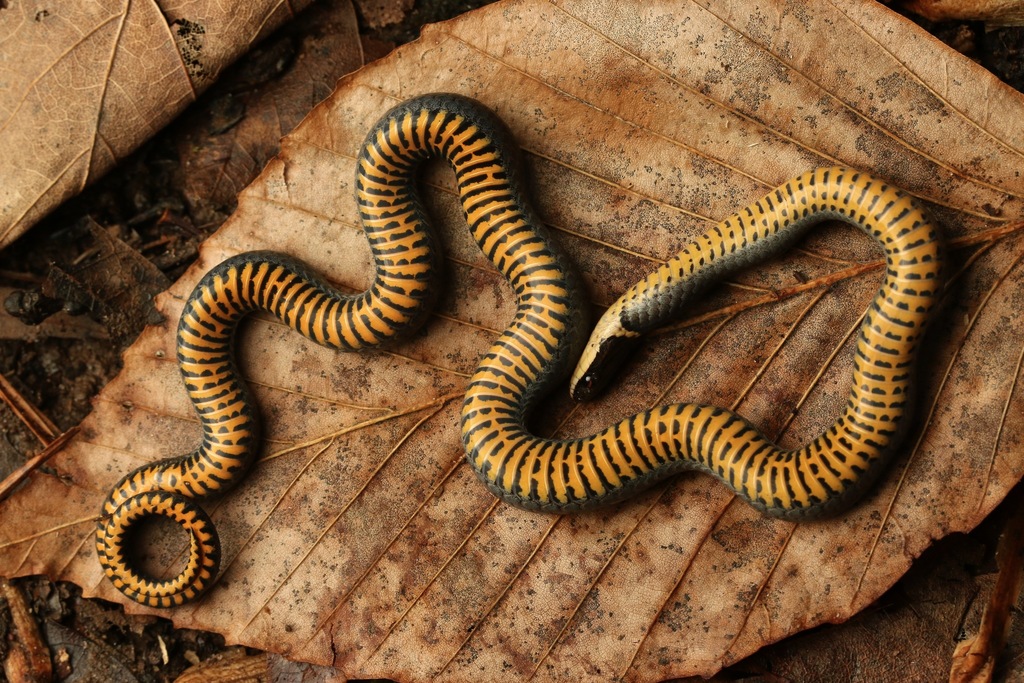
Ring-necked Snake
Diadophis punctatus
Diadophis punctatus, commonly known as the ring-necked snake or ringneck snake, is a small, harmless species of colubrid snake found throughout much of the United States, as well as south in Central Mexico and as far north as Nova Scotia, Canada. Ring-necked snakes are generally fossorial and somewhat secretive, by nature, and, as a nocturnal species, are rarely seen during the daytime. These snakes are believed to be fairly abundant throughout most of their range, though no scientific evaluation supports this hypothesis. Scientific research is lacking for the species, despite their apparently common status, and more in-depth investigations are greatly needed. It is the only species within the genus Diadophis and, currently, 14 subspecies are identified, though many herpetologists question the morphologically based classifications.
The ring-necked snake is perhaps best known for its unique defensive posture: when threatened, it curls its tail into a tight coil, partially rolls onto its back, and shows its bright red-orange underside and ventral surface. In nature, vivid coloration on an animal generally serves as a warning to others that it is not afraid of delivering a dose of venom, or that it is poisonous if eaten; this "false warning" coloration is a form of mimicry, a survival adaptation in which a non-venomous species (i.e., the ring-necked snake) has evolved brighter coloration, similar to truly venomous species, and used it to their advantage.
From the article Ring-necked snake on Wikipedia (CC BY-SA), quoted section by section
Description
Ring-necked snakes are fairly similar in morphology throughout much of their distribution.
Its dorsal coloration is solid olive, brown, bluish-gray to smoky black, broken only by a distinct yellow, red, or yellow-orange neck band. A few populations in New Mexico, Utah, and other distinct locations do not have the distinctive neck band. In another population throughout the Coastal Plains across the United States, the rings around their neck are often incomplete. Additionally, individuals may have reduced or partially colored neck bands that are hard to distinguish; coloration may also be more of a cream color rather than bright orange or red. Head coloration tends to be slightly darker than the rest of the body, with tendencies to be blacker than grey or olive. Ventrally, the snakes exhibit a yellow-orange to red coloration broken by crescent-shaped black spots along the margins. Some individuals lack the distinct ventral coloration, but typically retain the black spotting. Rarely do individuals lack both the ventral and neck band coloration, so the use of those two characteristics is the simplest way to distinguish the species. Size also varies across the species' distribution. Typically, adults measure 25–38 cm (10–15 in) in length, except for D. p. regalis, which measures 38–46 cm (15–18 in). Maximum size for D. p. punctatus is reported at 52 cm (20.5 in). …
Range & habitat
Ring-necked snakes are fairly common throughout much of the United States extending into southeastern Canada and central Mexico. Mexican populations diverged first in the phylogenetic lineage of the subspecies of ringneck species. Eastern populations cover the entire Eastern Seaboard from the Gulf of Saint Lawrence continuous through the Gulf Coast of Texas. Distribution moves inland into northern Minnesota, continuing diagonally through the US to include all of Iowa, eastern Nebraska, and most of Kansas. In the western US, the distribution is significantly less continuous, with spotty, distinct population segments through most of the Pacific Northwest. Populations extend from south-central Washington continuing along the extreme West Coast into Mexico. Population segments extend inland into western Idaho, through southern Nevada, into central Utah, and continuing south through Arizona and central Mexico.
Wikipedia: “Distribution”
What it does
The diet of the ring-necked snake consists primarily of smaller salamanders, earthworms, and slugs, but they also sometimes eat lizards, frogs, and some juvenile snakes of other species. The frequency at which prey species are chosen is dependent on their availability within the habitat. Michigan populations of the Eastern Ring-necked Snake (Diadophis punctatus edwardsii) feed almost exclusively on red-backed salamanders. Ring-necked snakes use a combination of constriction and envenomation to secure their prey. In a study analyzing the dietary habits of this species, age, amount of food consumed, and temperature were conditions that highly affected digestion. The snakes do not have a true venom gland, but they do have an analogous structure called the Duvernoy's gland derived from the same tissue, which evolved to assist in the subduing of larger prey items. Most subspecies are rear-fanged with the last maxillary teeth on both sides of the upper jaw being longer and channeled; the notable exception is D. p. edwardsii, which is fangless. The venom is produced in the Duvernoy's gland located directly behind the eye. It then drains out of an opening at the rear of the maxillary tooth. Ring-necked snakes first strike and then secure the prey using constriction. …
Wikipedia: “Diet”
Where it lives
Recorded sightings
—
geo-referenced records in GBIF, from museums, herbaria and field observers.
Drag the globe to turn it. Dots are where records exist, not a range map; darker means more records.
In the stacks
Searching the stacks…
Every page naming Diadophis punctatus in the Biodiversity Heritage Library →
This page is assembled live from iNaturalist, GBIF, Wikipedia, the Source Library and the Internet Archive. It is not yet part of the hand-edited codex. iNaturalist taxon 26575.