- Animals
- ›Chordates
- ›Vertebrates
- ›Birds
- ›Rollers, Kingfishers, and Allies
- ›Kingfishers
- ›Water Kingfishers
- ›Chloroceryle
On eBird ↗
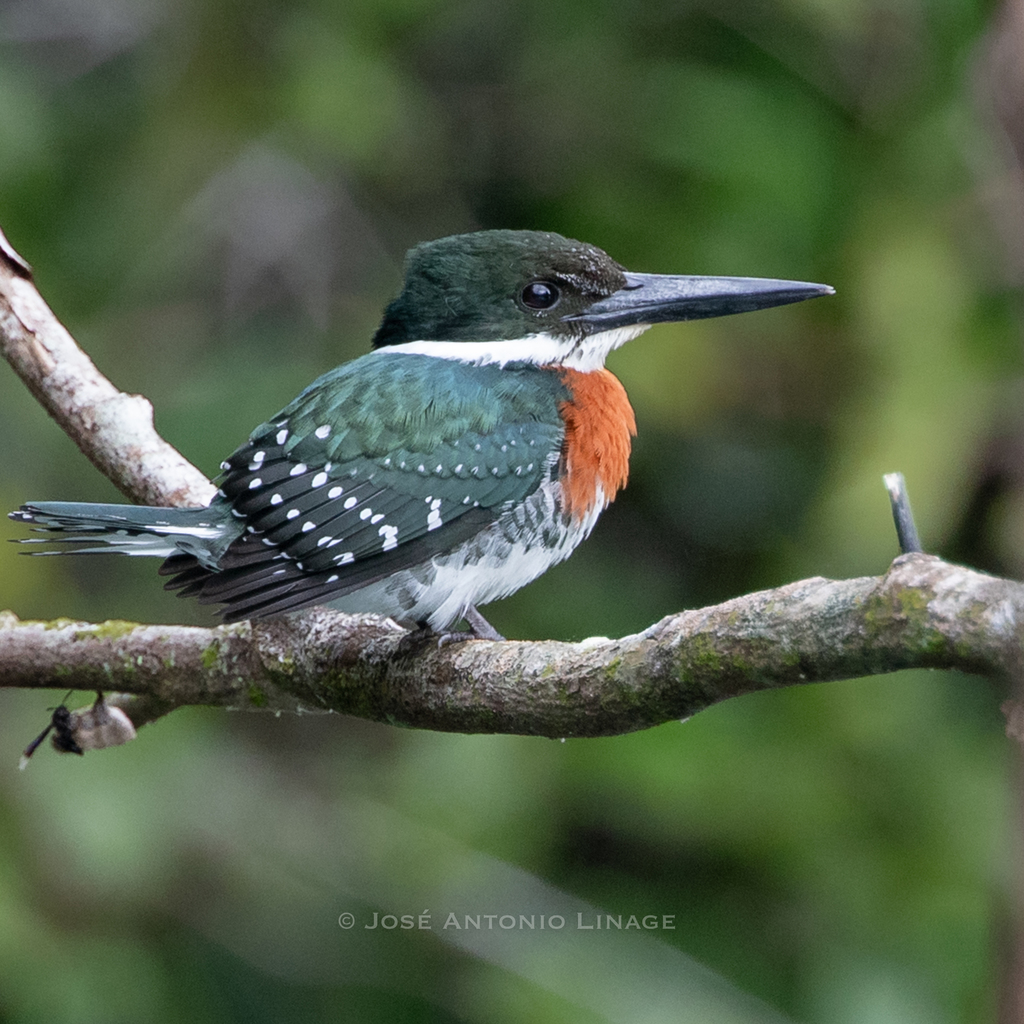
Green Kingfisher
Live sightings near you, the range map, bar charts of when it is seen, and Macaulay Library photos and recordings.
Green Kingfisher
Chloroceryle americana
The green kingfisher (Chloroceryle americana) is a species of "water kingfisher" in the subfamily Cerylinae of the family Alcedinidae. It is found from southern Texas in the United States south through Central America, and in every mainland South American country except Chile.
From the article Green kingfisher on Wikipedia (CC BY-SA), quoted section by section
Description
The green kingfisher is about 20 cm (8 in) long and weighs about 35 to 40 g (1.2 to 1.4 oz); females are larger and heavier than males. Birds in the northern and southern parts of its range, and those west of the Andes, are larger and heavier than the others, but the differences tend to be clinal. The species has the typical kingfisher shape with long heavy bill (heaviest in Trinidad and Tobago); in contrast to many other kingfishers, however, it does not have an obvious crest. The bill is black with some horn color at the base of the mandible and its legs and feet are dark gray. Both sexes have green upperparts with two or more rows of white spots on the flight feathers. Their underparts are mostly white with green spots on the sides and flanks. Their tail is green with much white on the outer feathers that shows best in flight. Adult males have a white collar and a rufous breast. Adult females have a white collar, a buffy throat and breast, and a band of green speckles across the breast and upper belly. Juveniles resemble females but are duller and have small buff spots on their crown and wing coverts. One vocalization "resembles the striking of two pebbles together, usually single or double". Another is "a harsh, buzzy scold, described variously as tsheersh, tseelp or zchrrk". …
Range & habitat
The green kingfisher inhabits wooded shorelines of streams and freshwater ponds and lakes. It favors still or slow-moving water, and though it requires low vegetation for hunting perches it generally prefers relatively open habitat rather than dense forest. It is a year-round resident throughout its range but roams a territory that may be as much as 1 km (0.6 mi) or more of river.
Wikipedia: “Distribution and habitat”
What it does
The Amazon kingfisher usually hunts from a perch from which it dives into water for its prey. The perch is typically about 1 to 1.5 m (3 to 5 ft) high; it may be directly over water or within a few meters of its edge. In a study in Amazonia about half of the perches were bare snags and the rest were a mix of leafless and leafy trees and bushes. It usually shifts perches after each foray. Occasionally it hovers before diving, sometimes from as high as 6 m (20 ft). Pairs often defend feeding territories from other green kingfishers but seldom from other kingfisher species. The prey is mostly small fish but includes crustaceans such as shrimp and also adult and nymph aquatic and terrestrial insects. The size of the fish taken varies, apparently with availability and the presence of other species of kingfishers. Studies have published sizes as 8 to 80 mm (0.3 to 3.1 in), as averages of 19.4 mm (0.76 in) and 41.1 mm (1.6 in) at different sites, and as "seldom exceed[ing] a length of two inches".
Wikipedia: “Feeding”
Listen
Looking for field recordings…
Where it lives
Recorded sightings
—
geo-referenced records in GBIF, from museums, herbaria and field observers.
Drag the globe to turn it. Dots are where records exist, not a range map; darker means more records.
In the stacks
Searching the stacks…
Every page naming Chloroceryle americana in the Biodiversity Heritage Library →
This page is assembled live from iNaturalist, GBIF, Wikipedia, the Source Library and the Internet Archive. It is not yet part of the hand-edited codex. iNaturalist taxon 2669.