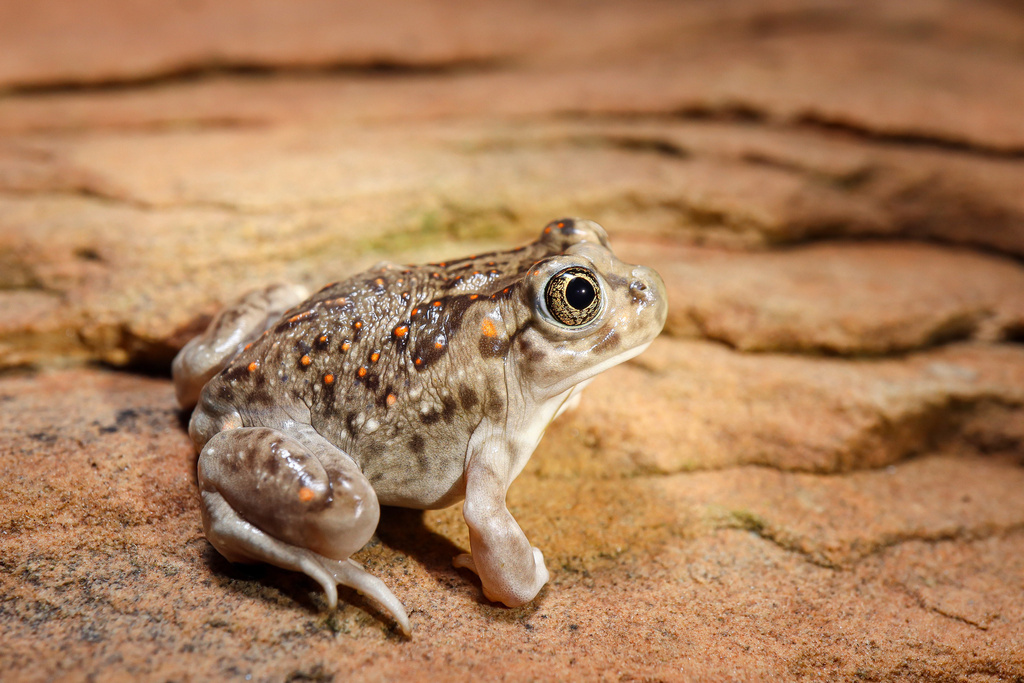
Plains Spadefoot
Spea bombifrons
The plains spadefoot toad (Spea bombifrons) is a species of American spadefoot toad which ranges from southwestern Canada, throughout the Great Plains of the western United States, and into northern Mexico. Like other species of spadefoot toads, they get their name from a spade-like projection on their hind legs which allows them to dig into sandy soils. Their name, in part, comes from their keratinized metatarsals, which are wide instead of "sickle shaped". The species name translates as buzzing leaf shaped. This refers to the species' distinguishing features; its buzzing mating call, and its leaf-shaped digging metatarsals. It was first described by Cope in 1863.
From the article Plains spadefoot toad on Wikipedia (CC BY-SA), quoted section by section
Description
The plains spadefoot toad generally grows from 1.5 to 2.5 inches (3.8 to 6.4 cm) in length, has a round body, with relatively short legs. These toads are usually a tannish to dark brownish color with visible orange spots. They are one of the easiest anurans to recognize in their region because of their unique appearance. Sometimes, they have light striping on their backs.
Range & habitat
This species is found throughout the Midwest from Alberta to Mexico wherever there is suitable soil for a fossorial lifestyle. The species is listed by IUCN 2015 as "least concern" and appears to be expanding its range, at least northwards into Alberta, Canada.
Wikipedia: “Geographical distribution and conservation status”
What it does
Spea bombifrons are famous for thriving in xeric environments, but a related species, Scaphiopus holbrookii has similar adaptation but does not live in similar extreme environments. The adults of this species is primarily fossorial for most of the year, but terrestrial during warm, wet periods. It only enters the water for breeding when nocturnal temperatures are at their yearly maximums and within 2–3 days of rain. The tadpoles hatch from eggs after 2 days and metamorphose within 2 weeks. Froglets hide in cracks and shade and live off stored tissue in their tails until they can start feeding as adults. Toads can only live where the ground is suitable for burrowing, and reproduce within 1 km of where they aestivate. Like all amphibians, they are immobilized by low temperatures. This species prefers to burrow near large objects such as logs or rocks. They like to live near a water source, but this can be a subterranean patch of wet sand. They have many predators, especially the hognose snake (Heterodon nasicus). Garter snakes predate most tadpoles, but often are not found in the desert, preferring riparian habitats. Many birds are opportunistic predators including burrowing owls and most wading birds. The tadpoles are also predated on by cannibal morphs, dragonfly larvae, giant scavenger beetles, and mosquito fish. …
Wikipedia: “Ecology, behaviour and physiology”
Listen
Looking for field recordings…
Where it lives
Recorded sightings
—
geo-referenced records in GBIF, from museums, herbaria and field observers.
Drag the globe to turn it. Dots are where records exist, not a range map; darker means more records.
In the stacks
Searching the stacks…
Every page naming Spea bombifrons in the Biodiversity Heritage Library →
This page is assembled live from iNaturalist, GBIF, Wikipedia, the Source Library and the Internet Archive. It is not yet part of the hand-edited codex. iNaturalist taxon 26699.