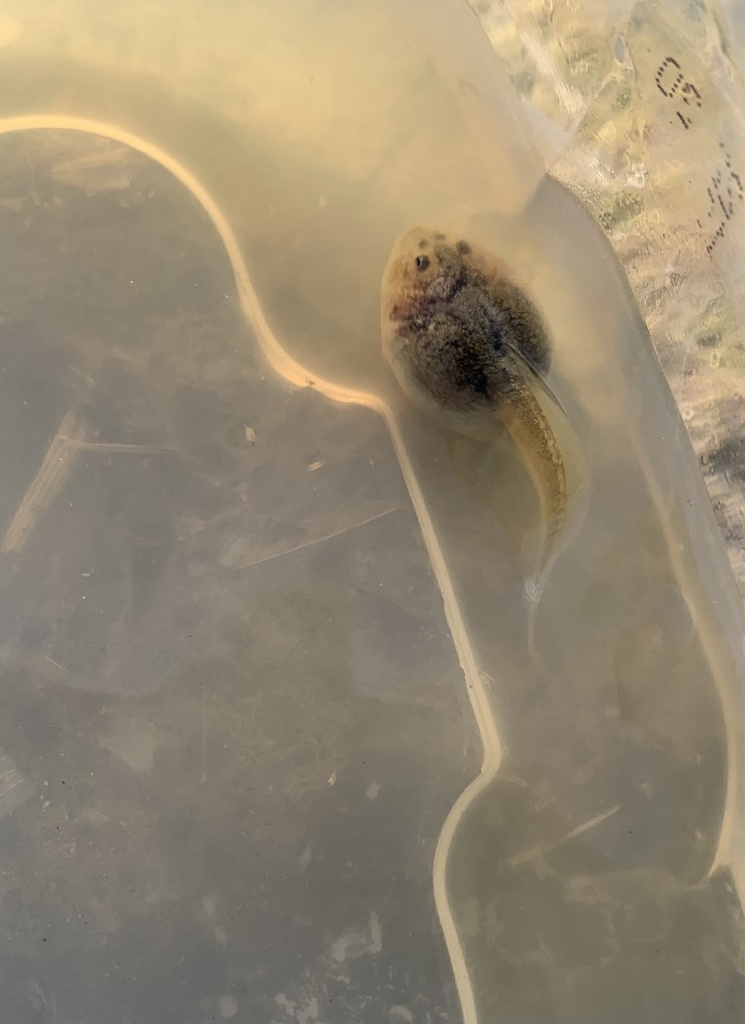
Western Spadefoot
Spea hammondii
The western spadefoot toad (Spea hammondii) is a relatively smooth-skinned species of American spadefoot toad. Its eyes are pale gold with vertical pupils. It has a green or grey dorsum often with skin tubercles tipped in orange, and it is a whitish color on the ventrum. It has a wedge-shaped black spade on each hind foot. Adult toads are between 3.8 and 7.5 cm (1.5 and 3.0 in) long.
From the article Spea hammondii on Wikipedia (CC BY-SA), quoted section by section
Description
Spea hammondii is a relatively smooth-skinned species of American spadefoot toad. Its eyes are pale gold with vertical pupils. It has a green or grey dorsum, often with skin tubercles tipped in orange, and has a whitish color on the abdomen. On each hind foot is a wedge-shaped black spade. Adult toads are between 3.8 and 7.5 cm (1.5 and 3.0 in) long. Juveniles have a similar appearance to adults, but with more distinct spotting.
Range & habitat
Populations of Spea hammondii are localized, but widespread. It ranges throughout the central valley of California and as far south as San Diego and some parts of the desert. The western spadefoot prefers grassland, scrub and chaparral locally but can occur in oak woodlands. It is nocturnal, and activity is limited to the wet season, summer storms, or during evenings with elevated substrate moisture levels. It is easily handled, with less skin secretions than similar toad species. Their secretions smell like peanut butter and may cause sneezing. The western spadefoot is experiencing some habitat loss, but is still common in its range and the population declines are very minor even though it is listed as "near threatened" in some counties of California.
Wikipedia: “Distribution”
What it does
Tadpoles feed mainly on plants and planktonic organisms, algae, ants, small invertebrates and dead aquatic larvae of amphibians, they may become cannibalistic. Adult toads feed on insects, worms and other invertebrates including; grasshoppers, true bugs, moths, ground beetles, ladybird beetles, click beetles, spiders, flies, ants and earthworms.
Wikipedia: “Diet”
Listen
Looking for field recordings…
Where it lives
Recorded sightings
—
geo-referenced records in GBIF, from museums, herbaria and field observers.
Drag the globe to turn it. Dots are where records exist, not a range map; darker means more records.
In the stacks
Searching the stacks…
Every page naming Spea hammondii in the Biodiversity Heritage Library →
This page is assembled live from iNaturalist, GBIF, Wikipedia, the Source Library and the Internet Archive. It is not yet part of the hand-edited codex. iNaturalist taxon 26702.