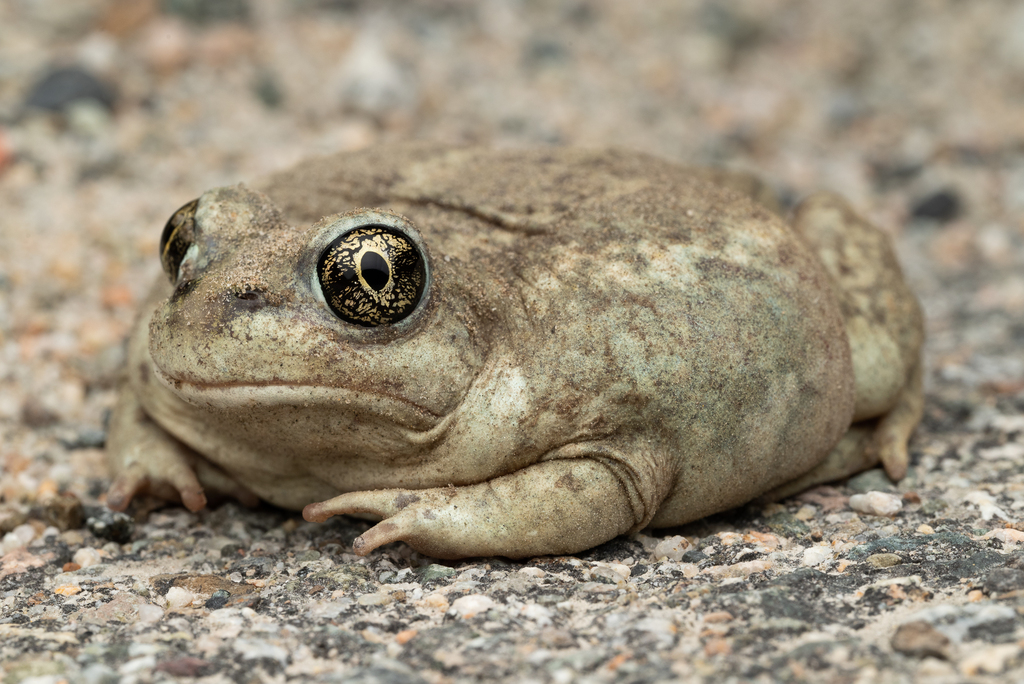
Great Basin Spadefoot
Spea intermontana
The Great Basin spadefoot (Spea intermontana) is an amphibian in the family Scaphiopodidae. It is 3.8 to 6.3 centimetres (1.5 to 2.5 in) long and is usually colored gray, olive or brown. Great Basin spadefoot toads have adapted to life in dry habitats. They use the hard, keratinized spade on each foot to dig a burrow, where they spend long periods during cold and dry weather. They are opportunistic hunters and will eat anything they can subdue. While their tadpoles have numerous predators, adults are able to produce skin secretions that deter enemies.
From the article Great Basin spadefoot on Wikipedia (CC BY-SA), quoted section by section
Range & habitat
The natural habitats of the Great Basin spadefoot include pinyon-juniper, ponderosa pine, and high elevation (up to 2,600 metres or 8,500 feet) spruce-fir forests, semidesert shrubland, sagebrush flats, temperate grasslands, and deserts. They are present in agricultural areas as well. The Great Basin Spadefoot can be found from southern British Columbia through the eastern portions of Washington and Oregon and in southern Idaho. Their range extends throughout all of Nevada and into most of Utah; they are also present in small areas in California, Arizona, Colorado, and Wyoming.
Wikipedia: “Habitat and distribution”
What it does
Adult spadefoots are opportunistic carnivores. Adults have been shown to eat arthropods from the taxa Coleoptera, Diptera, Hemiptera, Hymenoptera, Lepidoptera, Neuroptera, Orthoptera, Trichoptera, Collembola, and Araneae. Ants and beetles are their most common prey. Feeding seems to be generalized and opportunistic; the toads will eat anything they can subdue. Adults hunt in spring and summer, but only at night or during light rains. Spadefoot tadpoles are dimorphic. Within a cohort, some tadpoles have large mouthparts, while others have much smaller mouthparts. As well as consuming other types of food, large-mouthed individuals are cannibalistic, swallowing other tadpoles whole.
Wikipedia: “Diet”
Listen
Looking for field recordings…
Where it lives
Recorded sightings
—
geo-referenced records in GBIF, from museums, herbaria and field observers.
Drag the globe to turn it. Dots are where records exist, not a range map; darker means more records.
In the stacks
Searching the stacks…
Every page naming Spea intermontana in the Biodiversity Heritage Library →
This page is assembled live from iNaturalist, GBIF, Wikipedia, the Source Library and the Internet Archive. It is not yet part of the hand-edited codex. iNaturalist taxon 26704.