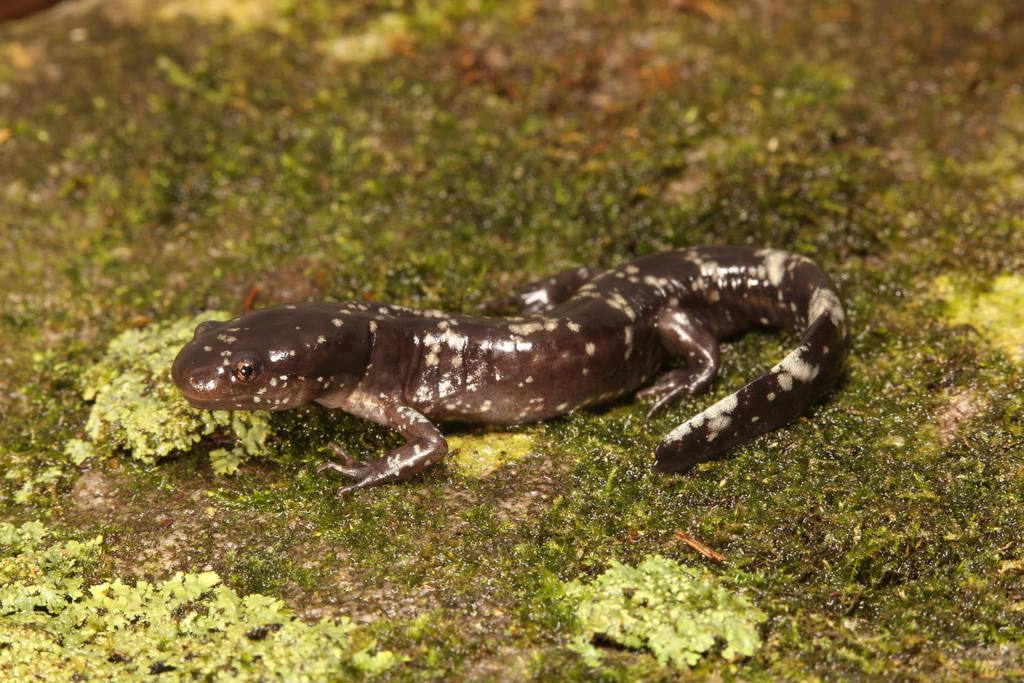
Ringed Salamander
Ambystoma annulatum
The ringed salamander (Ambystoma annulatum) is a species of mole salamander native to hardwood and mixed hardwood-pine forested areas in and around the Ozark Plateau and Ouachita Mountains of Arkansas, Oklahoma, and Missouri. This species of salamander has slender body, small head, and long tail. They are usually found to have various dorsal color from dark gray to dark brown. Various close relatives are found such as marbled salamander (A. opacum) and spotted salamander (A. maculatum). This species of salamander has cannibal behavior especially those in large body size.
It is found in damp, forested areas, usually under leaves, rotting logs, or in abandoned ground holes of other organisms, near shallow ponds. Highly fossorial (adapted to digging), adults are often found in subterranean refuges. This salamander is increasingly rare and perhaps endangered. This is likely a result of its restricted range and specific breeding habit needs. The world population is thought to be around 100,000 animals. Its conservation status is assessed as Least Concern by the IUCN. This salamander can perform embryotic learning and social-facilitated learning.
From the article Ringed salamander on Wikipedia (CC BY-SA), quoted section by section
Description
The Ringed Salamander has a slender body shape with a small head and a long tail. This species has 15 costal (along the ribs) grooves and a depressed round snout. There are two arrays of vomerine teeth—teeth along a thin bone that form the inferior and posterior part of the nasal septum and divide the nostrils. Each series contains 7 - 11 teeth. Each of their hind feet has five toes. The dorsal color of adults can range from dark gray to blackish brown decorated with white to yellowish bands and light-colored dots. Ventral sides are generally grayish-yellow. Newly metamorphosed juveniles have black backs and white bellies. A row of light spots extended from their forelimbs to the tails. Soon after metamorphosis yellow bands started to appear, and complete adult colorations form within two months after metamorphosis.
Range & habitat
Ringed salamander is strictly terrestrial and has been found in hardwood and mixed hardwood-pine forests. During non-breeding seasons, adults hide under leaves, rotting logs, or abandoned holes on the ground in damp forest areas. Larvae and juveniles exist in small, fishless semi-permanent ponds. Most ringed salamanders are found in the vicinity of Hot Springs, Arkansas, and the Missouri portion of the Ozark Plateau. Small populations have also been found in eastern Oklahoma.
Wikipedia: “Habitat”
What it does
Common preys for ringed salamander larvae include microcrustaceans, dipteran larvae, larval chironimids, and many larval and adult insects such as beetles, snails, earthworms, and eggs of other salamanders and frogs. Ringed salamanders usually serve as the top predator in their breeding ponds. This is likely due to the fall breeding timing of ringed salamanders, which allows them to prey on individuals of other spring breeding species that are still in their early life stages such as spotted salamanders, marbled salamanders, red-spotted newts, and many other anuran species, thus decreases their abundances.
Cannibalism. Although larvae of all sizes eat other prey species, those with larger body sizes can be cannibalistic. Cannibalism can be beneficial as conspecific preys are large, might contain growth-promoting hormones, and lack toxic substances in heterospecific preys. However, there is also a risk of pathogen and endoparasite transmissions. The cannibals differ from their conspecific prey by having twice longer mean body lengths and slightly broader heads. The long breeding season leads to increasing larvae size variation, which contributes to the possibility of cannibalism. …
Wikipedia: “Diet”
Listen
Looking for field recordings…
Where it lives
Recorded sightings
—
geo-referenced records in GBIF, from museums, herbaria and field observers.
Drag the globe to turn it. Dots are where records exist, not a range map; darker means more records.
In the stacks
Searching the stacks…
Every page naming Ambystoma annulatum in the Biodiversity Heritage Library →
This page is assembled live from iNaturalist, GBIF, Wikipedia, the Source Library and the Internet Archive. It is not yet part of the hand-edited codex. iNaturalist taxon 26729.