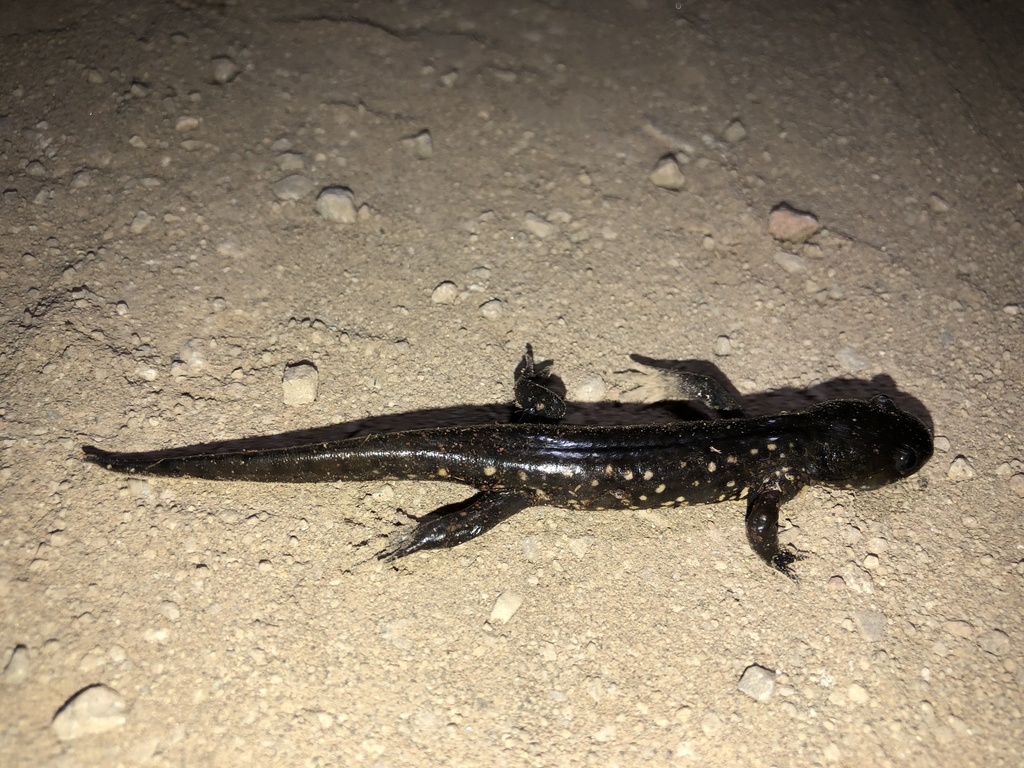
Blunt-headed Salamander
Ambystoma amblycephalum
The blunt-headed salamander (Ambystoma amblycephalum) is a mole salamander endemic to Mexico. It is only known from the vicinity of its type locality, near Morelia, in Michoacán state in Southwestern Mexico. It inhabits a landscape consisting of a mosaic of natural grasslands and pine-oak forests at elevations of about 2,000 m (6,600 ft) asl. Breeding takes place in ponds. An average adult has a mass of 6.18 grams while wet. Adult females of the species range from 42 to 93 mm and males range from 45.4 to 70.5 mm in standard length.
It has both neotenic and terrestrial populations. Neotenic populations are perennibranchiate and retain their fins. Neotenes are very long with extremely short, blunt heads and round eyes. They have relatively short, thick gills. Their coloring is dark brown-gray dorsally, with a lighter gray under-belly. They have small, dark marks on their head and back.
From the article Blunt-headed salamander on Wikipedia (CC BY-SA), quoted section by section
Description
Females range from 42 to 93 mm (1.65-3.66 inches) in standard length. Including the tail, females can have total lengths up to 161 mm (6.34 inches). Males of this species are typically smaller than females. Their standard lengths range from 45.4 to 70.5 mm (1.79-2.78 inches). Their total length has been recorded up to 128.8 mm (5.07 inches). Their tails are similar in length to their bodies. They have 70-80 maxillary-premaxillary teeth and 11 costal grooves. Their limbs are long and webbing of the feet is found in adults. Coloration differs based on the lifecycle stage of the salamanders. Some individuals ranged from black to an olive-green dorsally, and ventrally are grey with some creme-colored spots. These spots are primarily observed in adult males. Few individuals have been found to possess redness on their gills. This was noted in younger individuals, with the older ones being faded. Their colors are a result of the chromatophores and their pigments, and anything irregular from that is a result of a mutation that occurred within them.
Wikipedia: “Morphology”
Range & habitat
Blunt-headed salamanders are native only to a small region of Michoacán located in Mexico. They inhabit pine forests in hilly regions located near agricultural sites. These areas are typically subjected to fragmentation. They also are found in grasslands, and mostly exist on land. They need wetland areas with ponds for breeding. Some have been found to utilize cattle ponds with muddy bottoms during larval stages. Blunt-headed salamanders have been discovered hiding under logs nearby to ponds and wetland breeding sites. Their region has humid weather during all seasons, with the rainy season occurring in the summer. The area contains an arrangement of native grass and shrub species.
Wikipedia: “Habitat”
Listen
Looking for field recordings…
Where it lives
Recorded sightings
—
geo-referenced records in GBIF, from museums, herbaria and field observers.
Drag the globe to turn it. Dots are where records exist, not a range map; darker means more records.
In the stacks
Searching the stacks…
Every page naming Ambystoma amblycephalum in the Biodiversity Heritage Library →
This page is assembled live from iNaturalist, GBIF, Wikipedia, the Source Library and the Internet Archive. It is not yet part of the hand-edited codex. iNaturalist taxon 26750.