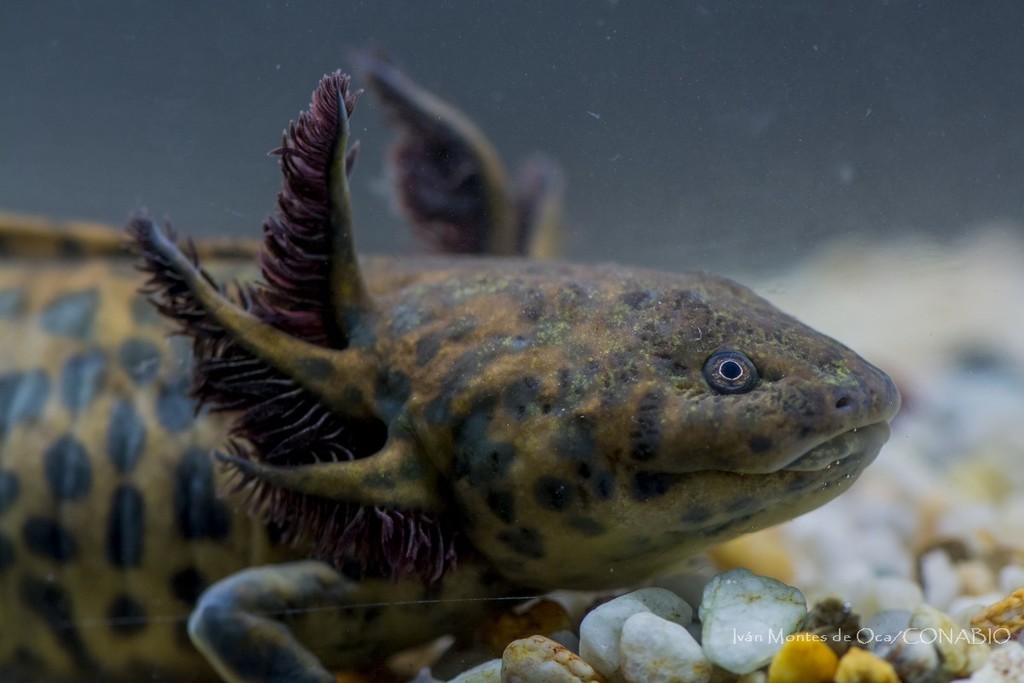
Anderson's Salamander
Ambystoma andersoni
Anderson's salamander (Ambystoma andersoni) is a neotenic salamander from Zacapu Lagoon in the Mexican state of Michoacán.
This salamander is a relatively recent discovery, first described by Branden and Krebs in 1984. Ambystoma andersoni is named after James Anderson, a herpetologist with the American Museum of Natural History, who did extensive fieldwork studying Ambystoma and other amphibians and reptiles in Mexico.
From the article Anderson's salamander on Wikipedia (CC BY-SA), quoted section by section
Range & habitat
Lake Zacapu is a small lake near Zacapu, sitting at an altitude of 2000 meters. The lake is located within the Mesa Central portion of Mexico, an area home to many neotenic Ambystoma species. It is temperate, with low salinity, and has a single stream originating from it. Ambystoma andersoni is listed as critically endangered on the IUCN Red List.
Wikipedia: “Habitat”
Listen
Looking for field recordings…
Where it lives
Recorded sightings
—
geo-referenced records in GBIF, from museums, herbaria and field observers.
Drag the globe to turn it. Dots are where records exist, not a range map; darker means more records.
In the stacks
Searching the stacks…
Every page naming Ambystoma andersoni in the Biodiversity Heritage Library →
This page is assembled live from iNaturalist, GBIF, Wikipedia, the Source Library and the Internet Archive. It is not yet part of the hand-edited codex. iNaturalist taxon 26780.