Hellbender
Cryptobranchus alleganiensis
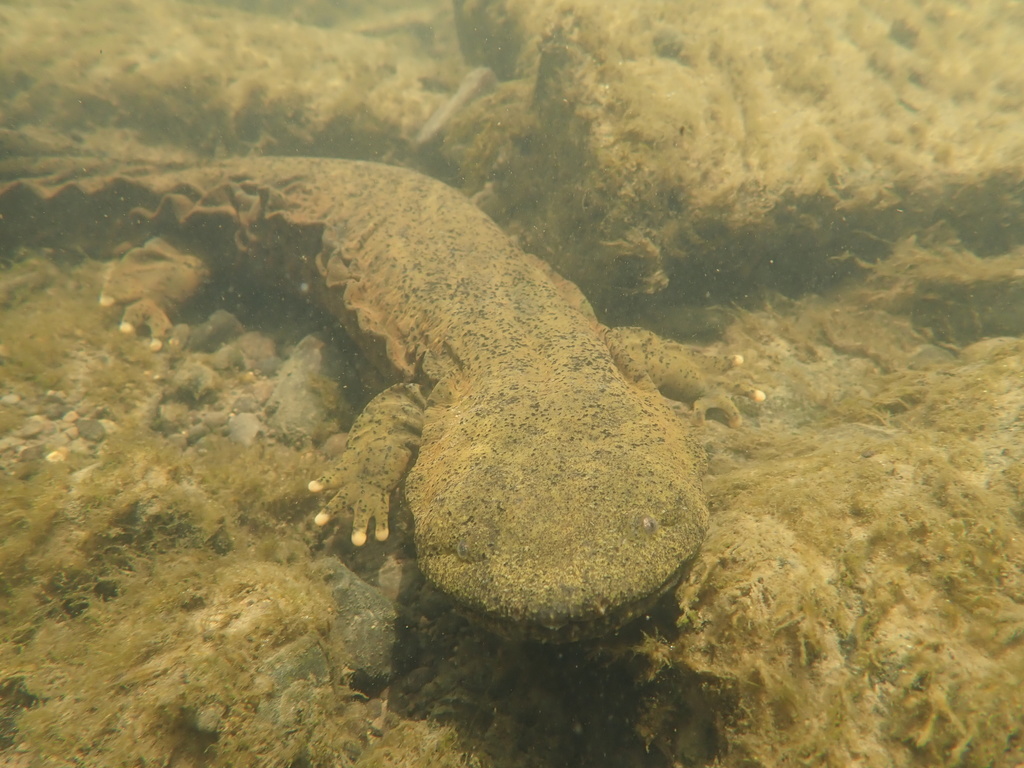
The hellbender (Cryptobranchus alleganiensis), also known as the hellbender salamander, is a species of aquatic giant salamander endemic to the eastern and central United States. It is the largest salamander in North America. A member of the family Cryptobranchidae, the hellbender is the only extant member of the genus Cryptobranchus. Other closely related salamanders in the same family are in the genus Andrias, which contains the Japanese and Chinese giant salamanders. The hellbender is much larger than any other salamander in its geographic range, and employs an unusual adaption for respiration through cutaneous gas exchange via capillaries found in its lateral skin folds. It fills a particular niche—both as a predator and prey—in its ecosystem, which either it or its ancestors have occupied for around 65 million years. The species is listed as Vulnerable on the IUCN Red List of Threatened Species due to the impacts of disease and widespread habitat loss and degradation throughout much of its range. Eastern hellbender populations are dropping quickly across most of their range, nearly 80% are declining or disappearing altogether. A reason for this is the loss of forest along streams, which they rely on to keep their habitats stable and clean. In many places, the populations are mostly older individuals, with few young hellbenders showing up to replace them.
From the article Hellbender on Wikipedia (CC BY-SA), quoted section by section
Description
Cryptobranchus alleganiensis has a flat body and head, with beady dorsal eyes and slimy skin. Like most salamanders, it has short legs with four toes on the front legs and five on its back limbs, and its tail is keeled for propulsion. Its tail is shaped like a rudder, but it is rarely used for swimming; these salamanders instead use pads on their toes to grip rocks and walk up and down streams instead of swimming. The hellbender has working lungs, but gill slits are often retained, although only immature specimens have true gills; the hellbender absorbs oxygen from the water through capillaries of its side frills. The frills run from their neck down to the base of their tail on each side of their body. The frills' function is to increase the surface area of the hellbender and to help the hellbender breathe. Only occasionally leaving the water, the hellbender makes little use of these lungs and the juveniles lose their external gills after around 18 months or about 125 mm (4.9 in) in length. It is blotchy brown or red-brown in color, with a paler underbelly. …
Range & habitat
Hellbenders are present in a number of Eastern US states, from southern New York to northern Georgia, including parts of Ohio, Pennsylvania, Maryland, West Virginia, Virginia, Kentucky, Illinois, Indiana, Tennessee, North Carolina, South Carolina, Alabama, Mississippi, Arkansas, Missouri, and extending into Oklahoma and Kansas. However, only one documented sighting has been recorded in South Carolina. The subspecies (or species, depending on the source) C. a. bishopi is confined to the Ozarks of northern Arkansas and southern Missouri, while C. a. alleganiensis is found in the rest of these states. Some hellbender populations—namely a few in Missouri, Pennsylvania, and Tennessee—have historically been noted to be quite abundant, but several man-made threats have converged on the species such that it has seen a serious population decline throughout its range. In Missouri, it is estimated that the populations have declined by 77% since the 1980s. Hellbender populations were listed in 1981 as already extirpated or endangered in Illinois, Indiana, Iowa, and Maryland, decreasing in Arkansas and Kentucky, and generally threatened as a species throughout their range by various human activities and developments.
Wikipedia: “Distribution”
What it does
Hellbenders are found in clear, clean water, and their presence is an indicator that the water is of good quality. The hellbender salamander, considered a "habitat specialist", has adapted to fill a specific niche within a very specific environment, and is labeled as such "because its success is dependent on a constancy of dissolved oxygen, temperature and flow found in swift water areas", which in turn limits it to a narrow spectrum of stream/river choices. As a result of this specialization, hellbenders are generally found in areas with large, irregularly shaped, with intermittent rocks that are not embedded in the substrate and swiftly moving water, while they tend to avoid wider, slow-moving waters with muddy banks and/or slab rock bottoms. This specialization likely contributed to the decline in their populations, as collectors could easily identify their specific habitats. One collector noted, at one time, "one could find a specimen under almost every suitable rock", but after years of collecting, the population had declined significantly. The same collector noted, he "never found two specimens under the same rock", corroborating the account given by other researchers that hellbenders are generally solitary; they are thought to gather only during the mating season. If rocks are lacking, hellbenders have been known to use holes in stream banks as habitat. …
Wikipedia: “Ecology”
In human culture
The origin of the name "hellbender" is unclear. The Missouri Department of Conservation says:
The name 'hellbender' probably comes from the animal's odd look. One theory claims the hellbender was named by settlers who thought "it was a creature from hell where it's bent on returning." Another rendition says the undulating skin of a hellbender reminded observers of "horrible tortures of the infernal regions." In reality, it's a harmless aquatic salamander.In 1802, while traveling through the Holston Valley in present-day North Carolina and Virginia, French explorer François Michaux encountered a giant salamander and recorded that enslaved African American men in the area referred to it as a "hellbender," indicating the name was already in common use. In a study conducted in Indiana, informing the public about the rarity and locality of the hellbender resulted in more positive attitudes toward this species than were previously held. Other vernacular names include snot otter, lasagna lizard, devil dog, mud-devil, mud dog, water dog, grampus, Allegheny alligator, and leverian water newt. The generic name, Cryptobranchus, is derived from the Ancient Greek kryptos (hidden) and branchion (gill). The subspecies name bishopi honors the American herpetologist Sherman C. Bishop.
Wikipedia: “Etymology”
Listen
Looking for field recordings…
Where it lives
Recorded sightings
—
geo-referenced records in GBIF, from museums, herbaria and field observers.
Drag the globe to turn it. Dots are where records exist, not a range map; darker means more records.
In the stacks
This page is assembled live from iNaturalist, GBIF, Wikipedia, the Source Library and the Internet Archive. It is not yet part of the hand-edited codex. iNaturalist taxon 26804.