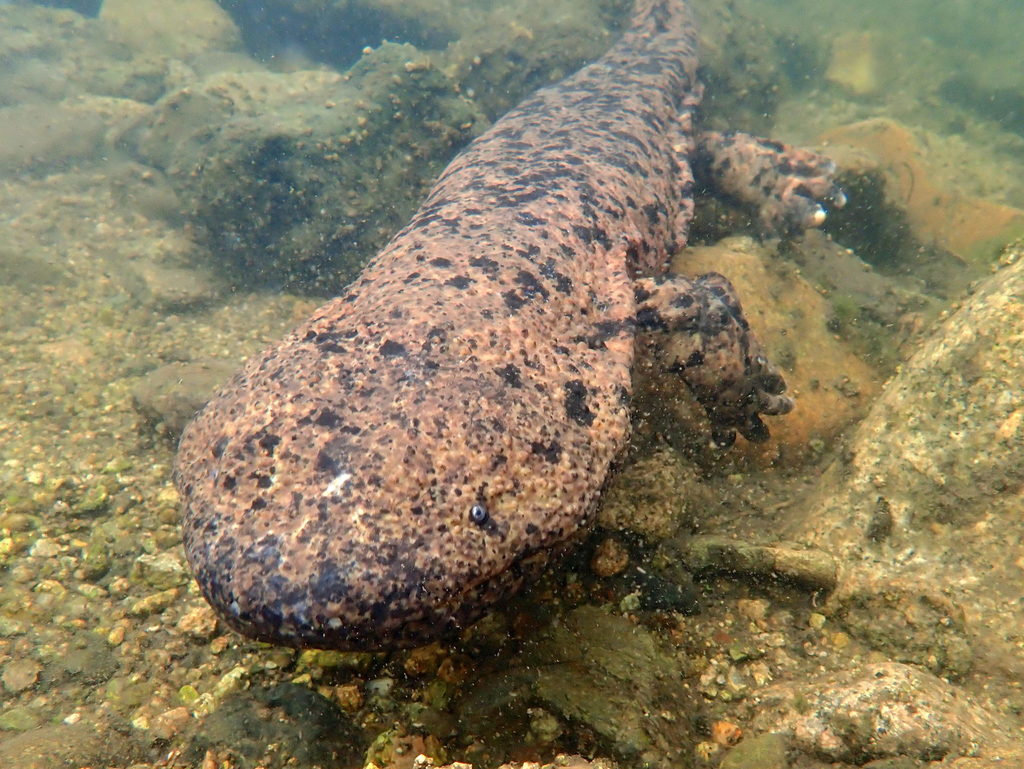
Japanese Giant Salamander
Andrias japonicus
The Japanese giant salamander (Andrias japonicus) is a species of fully aquatic giant salamander endemic to Japan, occurring across the western portion of the main island of Honshu, with smaller populations present on Shikoku and in northern Kyushu. With a length of up to 5 feet (1.5 m), it is the third-largest salamander in the world, being surpassed only by the very similar and closely related Chinese giant salamander and the South China giant salamander.
It is known in Japanese as ōsanshōuo (オオサンショウウオ/大山椒魚), literally meaning "giant salamander". Other local names include hanzaki, hanzake, and ankou. This salamander was first catalogued by Europeans when the resident physician of Dejima Island in Nagasaki, Philipp Franz von Siebold, captured an individual and shipped it back to Leiden in the Netherlands, in the 1820s. The species was designated as a special natural monument in 1951, and is protected by the Central Government. It is one of only six species of giant salamanders in the world.
From the article Japanese giant salamander on Wikipedia (CC BY-SA), quoted section by section
Description
The Japanese giant salamander can grow to a length of 5 ft (150 cm) and a weight of 55 lb (25 kg). The largest wild specimen on record weighed 58 lb (26.3 kg) and was 4.46 ft (136 cm) long. It is the third-largest amphibian in the world, only smaller than its close relatives, the South China giant salamander and the Chinese giant salamander. The brown and black mottled skin of A. japonicus provides camouflage against the bottoms of streams and rivers. Its body surface is covered with numerous small warts with distinctive warts concentrating on its head. It has very small eyes with no eyelids and poor eyesight. Its mouth extends across the width of its head, and can open to the width of its body. A. japonicus possesses large skin folds on its neck that effectively increase its overall body surface area. This assists in epidermal gas exchanges, which in turn regulates carbon dioxide and oxygen exchange with the water. Capillaries in the surface of the skin facilitate this gas exchange. The skin folds along each side of the body are more pronounced in the hellbender than in the Japanese giant salamander. The Japanese giant salamander can be distinguished from the Chinese giant salamander by the arrangement of tubercles on the head and throat. The tubercles are larger and more numerous compared to the mostly single and irregularly scattered tubercles of the Chinese giant salamander. …
Range & habitat
The Japanese giant salamander occurs in southwestern Japan (west of Gifu Prefecture in Honshu and parts of Shikoku and Kyushu). In particular, Okayama, Hyogo, Shimane, Tottori, Yamaguchi, Mie, Ehime, Gifu, and Ōita Prefectures are known to harbor its robust populations. They are typically found in fast-flowing mountain streams of these prefectures. It has been speculated that some of the populations in Wakayama Prefecture were introduced by humans and it is unknown whether naturally-distributed populations exist in Wakayama Prefecture. The Japanese giant salamander occurs in freshwater habitats ranging from relatively large river (20–50 m) to small headwater streams (0.5–4 m). Smaller breeding adults tend to use small headwater streams presumably in order to avoid intraspecific competition with larger individuals in larger streams. Mark-recapture records suggest that giant salamanders migrate between a mainstem and tributaries of the same river. Environmental DNA surveys and the following physical field surveys suggest that small headwater streams likely serve as important habitats for juveniles and larvae. While habitat degradation threatens the Japanese giant salamander, it can inhabit disturbed streams surrounded by agriculture fields such as rice paddy fields. …
Wikipedia: “Distribution”
What it does
The Japanese giant salamander is restricted to streams with clear, cool water. Due to its large size and lack of gills, it is confined to flowing water where oxygen is abundant. It is entirely aquatic and almost entirely nocturnal. Unlike typical pond-breeding salamanders whose juveniles migrate to land after losing their gills through metamorphosis, it stays in the aquatic habitat even after metamorphosis and breaches its head above the surface to obtain air without venturing out of the water and onto land. The salamander also absorbs oxygen through its skin, which has many folds to increase surface area. When threatened, the Japanese giant salamander can excrete a strong-smelling, milky substance. It has very poor eyesight, and possesses special sensory cells covering its skin, running from head to toe, the lateral line system. These sensory cells' hair-like shapes detect minute vibrations in the environment, and are quite similar to the hair cells of the human inner ear. This feature is essential for hunting prey due to its poor eyesight. Adults feed mainly on freshwater crabs, other crustaceans, worms, insects, frogs, other small amphibians, fish, and even small mammals. It has a very slow metabolism and can sometimes go for weeks without eating. It lacks natural competitors. …
Wikipedia: “Behavior”
Listen
Looking for field recordings…
Where it lives
Recorded sightings
—
geo-referenced records in GBIF, from museums, herbaria and field observers.
Drag the globe to turn it. Dots are where records exist, not a range map; darker means more records.
In the stacks
Searching the stacks…
Every page naming Andrias japonicus in the Biodiversity Heritage Library →
This page is assembled live from iNaturalist, GBIF, Wikipedia, the Source Library and the Internet Archive. It is not yet part of the hand-edited codex. iNaturalist taxon 26811.