- Animals
- ›Chordates
- ›Vertebrates
- ›Birds
- ›Rollers, Kingfishers, and Allies
- ›Kingfishers
- ›Tree Kingfishers
- ›Lacedo
On eBird ↗
Banded Kingfisher
Live sightings near you, the range map, bar charts of when it is seen, and Macaulay Library photos and recordings.
Banded Kingfisher
Lacedo pulchella
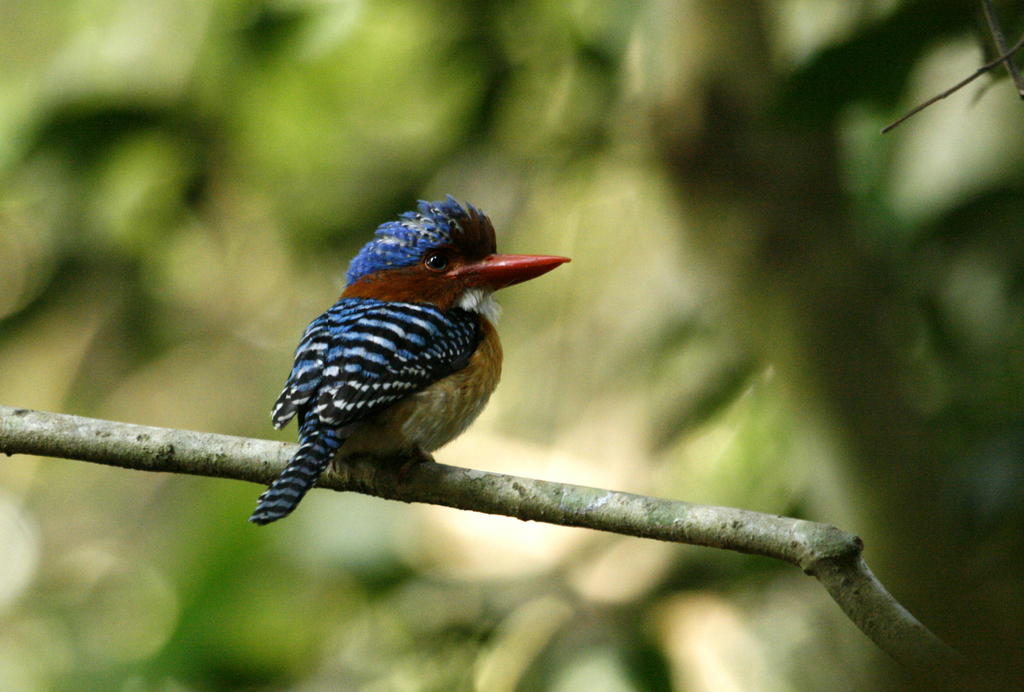
The banded kingfisher (Lacedo pulchella) is a tree kingfisher found in lowland tropical forests of southeast Asia. It is the only member of the genus Lacedo. Male and female adults are very different in plumage. The male has a bright blue crown with black and blue banding on the back. The female has rufous and black banding on the head and upperparts.
From the article Banded kingfisher on Wikipedia (CC BY-SA), quoted section by section
Description
The banded kingfisher is 20 cm (7.9 in) long with a sturdy red bill and a short crest which is slowly raised and lowered. It shows striking sexual dimorphism compared to most of its relatives. The adult male has a chestnut forehead, cheeks and nape, and a bright blue cap. The rest of the upperparts, wings and tail are black with blue bands. The breast, flanks and undertail are rufous, and the central belly is white. The adult female is equally striking, with black-and-rufous-banded upperparts, and white underparts with some black bars on the chest and flanks. Young birds are duller than the adult of the same sex, have a brown and orange bill, and dusky barring on the underparts. The call is a long whistled wheeeoo followed by 15 repetitions of chiwiu in 17 seconds, the second syllable gradually fading away. The banded kingfisher will respond to imitations of its call.
Range & habitat
The species occurs in Myanmar, Thailand, Cambodia, Vietnam, Laos, Malaysia, Sumatra, Java and Brunei. It is rare in Java, very rare in Sumatra and extinct in Singapore.
Wikipedia: “Distribution and habitat”
What it does
This is a bird of lowland rainforest found up to 1,700 m in Brunei, but normally below 1100 m altitude in the rest of its range. Unlike most kingfishers, it does not need pools or streams in its territory. The nest is a hole in a rotting tree trunk, or sometimes in the spherical nest of tree termites. Two to five white eggs are laid. In Thailand the eggs are laid between February and May. The banded kingfisher hunts large insects and occasionally small lizards, usually taken in the trees, but sometimes from the ground.
Wikipedia: “Behaviour”
Listen
Looking for field recordings…
Where it lives
Recorded sightings
—
geo-referenced records in GBIF, from museums, herbaria and field observers.
Drag the globe to turn it. Dots are where records exist, not a range map; darker means more records.
In the stacks
Searching the stacks…
Every page naming Lacedo pulchella in the Biodiversity Heritage Library →
This page is assembled live from iNaturalist, GBIF, Wikipedia, the Source Library and the Internet Archive. It is not yet part of the hand-edited codex. iNaturalist taxon 2685.