- Animals
- ›Chordates
- ›Vertebrates
- ›Amphibians
- ›Salamanders
- ›Asian Salamanders
- ›Hynobiine Salamanders
- ›Salamandrella
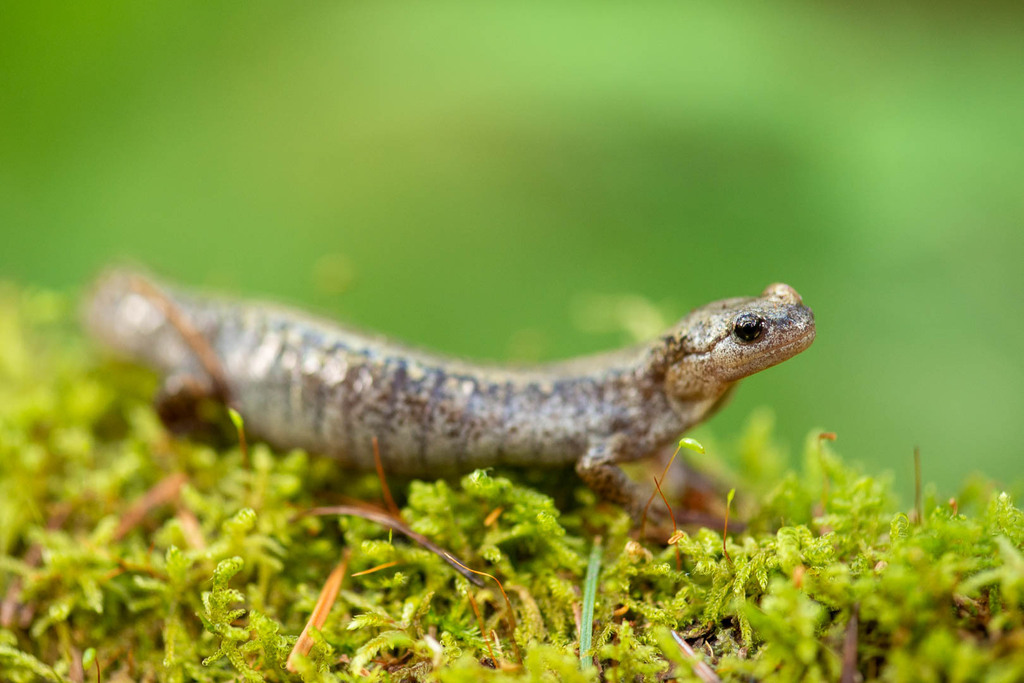
Siberian Salamander
Salamandrella keyserlingii
The Siberian salamander, Salamandrella keyserlingii, is a species of salamander found in Northeast Asia. It is found primarily in Siberia, in wet woods and riparian groves, with outlying populations also in northern Kazakhstan and Mongolia, northeastern China, and on the Korean Peninsula. It is believed to be extirpated from South Korea. An isolated population exists on Hokkaidō, Japan, in the Kushiro Shitsugen National Park. A breeding ground of Siberian salamanders in Paegam, South Hamgyong, is designated...
From the article Salamandrella keyserlingii on Wikipedia (CC BY-SA), quoted section by section
Description
Adults are from 9.0 to 12.5 cm in length. Their bodies are bluish-brown in color, with a purple stripe along the back. Thin, dark brown stripes occur between and around the eyes, and also sometimes on the tail. Four clawless toes are on each foot. The tail is longer than the body. Males are typically smaller than females. The species is known for surviving deep freezes (as low as −50 °C). They accomplish this by losing one fourth of their body weight through water loss and liver shrinkage, and by increasing the concentration of glycerol in their body.
Range & habitat
It is found primarily in Siberia east of the Sosva River and the Urals, in the East Siberian Mountains, including the Verkhoyansk Range, northeast to the Anadyr Highlands, east to the Kamchatka Peninsula and south into Manchuria, with outlying populations also in northern Kazakhstan and Mongolia, northeastern China, and on the Korean Peninsula. It is believed to be extirpated from South Korea. An isolated population exists on Hokkaidō, Japan, in the Kushiro Shitsugen National Park. A breeding ground of Siberian salamanders in Paegam, South Hamgyong, is designated North Korean natural monument #360.
Wikipedia: “Distribution”
What it does
The Siberian salamander is fairly nocturnal, foraging above ground at night and staying under moist logs or woody debris during the day.
Wikipedia: “General behavior”
Listen
Looking for field recordings…
Where it lives
Recorded sightings
—
geo-referenced records in GBIF, from museums, herbaria and field observers.
Drag the globe to turn it. Dots are where records exist, not a range map; darker means more records.
In the stacks
Searching the stacks…
Every page naming Salamandrella keyserlingii in the Biodiversity Heritage Library →
This page is assembled live from iNaturalist, GBIF, Wikipedia, the Source Library and the Internet Archive. It is not yet part of the hand-edited codex. iNaturalist taxon 26851.