- Animals
- ›Chordates
- ›Vertebrates
- ›Reptiles
- ›Snakes and Lizards
- ›Snakes
- ›Colubrid Snakes
- ›Colubrine Snakes
- ›Hemorrhois
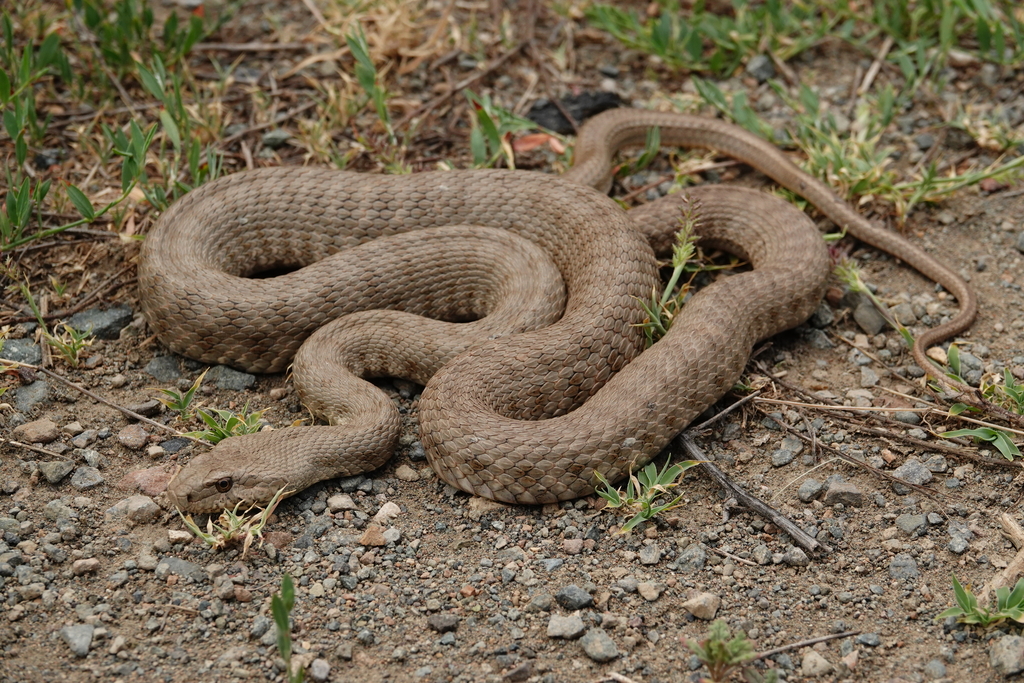
Asian Racer
Hemorrhois nummifer
Hemorrhois nummifer, also known as the coin-marked snake, Asian racer, and leaden-colored racer, is a species of snake belonging to the family Colubridae. It is found in southeastern Europe, Western and Central Asia, and northeast Africa.
From the article Hemorrhois nummifer on Wikipedia (CC BY-SA), quoted section by section
Description
Hemorrhois nummifer can grow to 100 cm (39 in) in total length but is often smaller. The body is strong and fairly robustly built. It is brown, grey, or olive grey above and often has a dorsal row of about 57–65 large spots, turning into a continuous line on the tail. Smaller spots complement the larger spots on the sides. The belly is grey white.
Range & habitat
Hemorrhois nummifer is found widely in Western and Central Asia (Turkey southward to Syria, Lebanon, northern and central Israel, Palestine, western and northwestern Jordan, and eastward to Armenia, northern Iraq, northeastern Iran, Turkmenistan, southern Uzbekistan, Tajikistan, and Kyrgyzstan) and also occurs in extreme southeastern Europe (Greece: the Aegean islands, including Kalymnos, Kos, and Lipsi; Cyprus). Isolated populations exist in northern Egypt (near Cairo and in the southern Sinai Peninsula).
Wikipedia: “Geographic range”
What it does
This snake is a diurnal, actively foraging predator with a diet consisting mainly of small mammals, lizards, and small birds. It is harmless to humans but appears to mimic vipers both in appearance and behaviourally (i.e., Batesian mimicry).
Wikipedia: “Behaviour and ecology”
Where it lives
Recorded sightings
—
geo-referenced records in GBIF, from museums, herbaria and field observers.
Drag the globe to turn it. Dots are where records exist, not a range map; darker means more records.
In the stacks
Searching the stacks…
Every page naming Hemorrhois nummifer in the Biodiversity Heritage Library →
This page is assembled live from iNaturalist, GBIF, Wikipedia, the Source Library and the Internet Archive. It is not yet part of the hand-edited codex. iNaturalist taxon 27038.