- Animals
- ›Chordates
- ›Vertebrates
- ›Amphibians
- ›Salamanders
- ›Lungless Salamanders
- ›Hemidactyliine Salamanders
- ›Eurycea
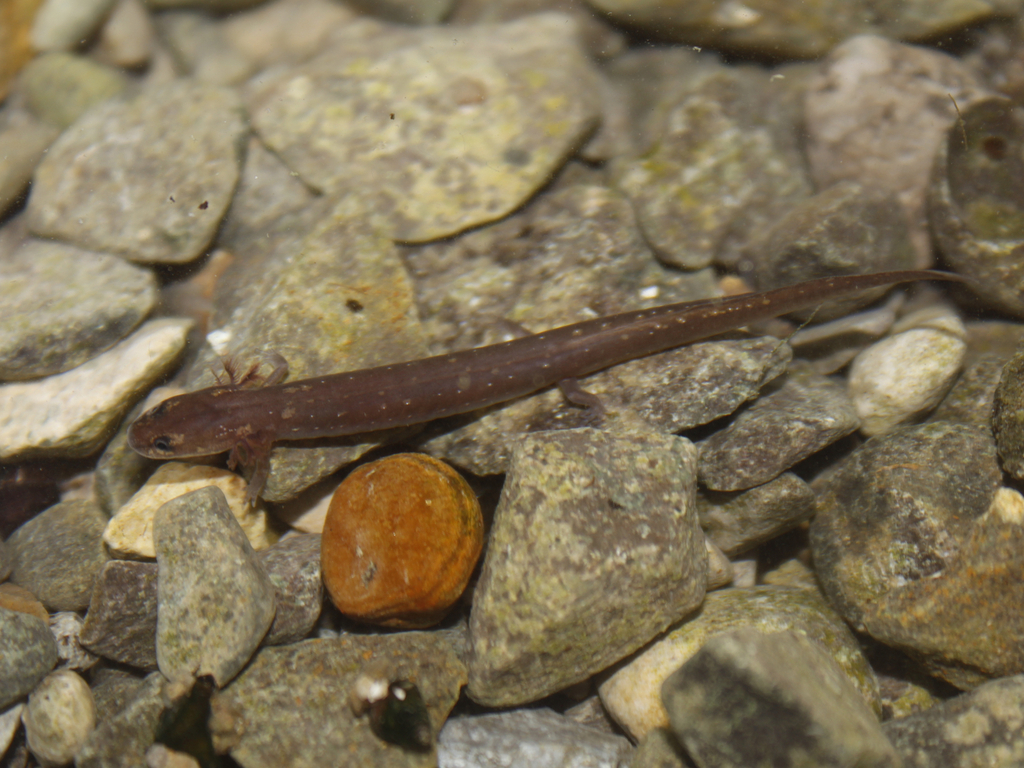
San Marcos Salamander
Eurycea nana
The San Marcos salamander (Eurycea nana) is a small species of aquatic, lungless salamander native to the United States, endemic to Spring Lake and a small region of the headwaters of the San Marcos River near Aquarena Springs, in Hays County, Texas. It is one to two inches long, with a slender body and external gills, and is a reddish-brown in color.
From the article San Marcos salamander on Wikipedia (CC BY-SA), quoted section by section
Description
E. nana is an aquatic salamander. It does not leave the water to change into a terrestrial form, but rather matures in the water. As a neotenic form, E. nana retains its gills for its lifetime. The San Marcos salamander has a narrow head with a round snout, large eyes, and a dark iris. External gills are developed and pigmented. 2–6 palatopterygoid and 7–13 premaxillary teeth are present. The species is uniformly light brown in color, with a series of seven to nine irregular light spots present along its midline. The trunk is flattened above with a dorsal furrow that extends from head to tail. The tail is slender and has a dorsal fin. The venter, the bottom of a salamander, is white in color, and males have larger vents than females do. There are 16–17 costal grooves present, with 6–7 occurring between limbs. It has four toes on its forefeet and five on its hind feet. The size of the species was measured to be 56 millimetres (2.2 in) total in length.
Range & habitat
Spring Lake, which is the headwaters of the San Marcos River, located in Hays County, Texas, is the only known location of the San Marcos salamander. The population estimate in 1973 was about 20,880 salamanders living in the uppermost reaches of Spring Lake. An estimate in 1993 suggested about 30,451 salamanders across all ranges of Spring Lake and up to 150 metres (490 ft) downstream. The ratio of males to females was reported to be stable throughout the year.
Wikipedia: “Distribution”
What it does
The diet of E. nana includes amphipods, fly larvae, and aquatic snails. San Marcos Salamanders typically follow a temporal diet, or a diet that varies with the availability of invertebrates present to them at a given time. It relies on the schedule of invertebrate behavior and locations, and generally consumes many aquatic invertebrates. The surrounding vegetation is a rich source of food.
Wikipedia: “Diet”
Listen
Looking for field recordings…
Where it lives
Recorded sightings
—
geo-referenced records in GBIF, from museums, herbaria and field observers.
Drag the globe to turn it. Dots are where records exist, not a range map; darker means more records.
In the stacks
Searching the stacks…
Every page naming Eurycea nana in the Biodiversity Heritage Library →
This page is assembled live from iNaturalist, GBIF, Wikipedia, the Source Library and the Internet Archive. It is not yet part of the hand-edited codex. iNaturalist taxon 27091.