- Animals
- ›Chordates
- ›Vertebrates
- ›Amphibians
- ›Salamanders
- ›Lungless Salamanders
- ›Hemidactyliine Salamanders
- ›Eurycea
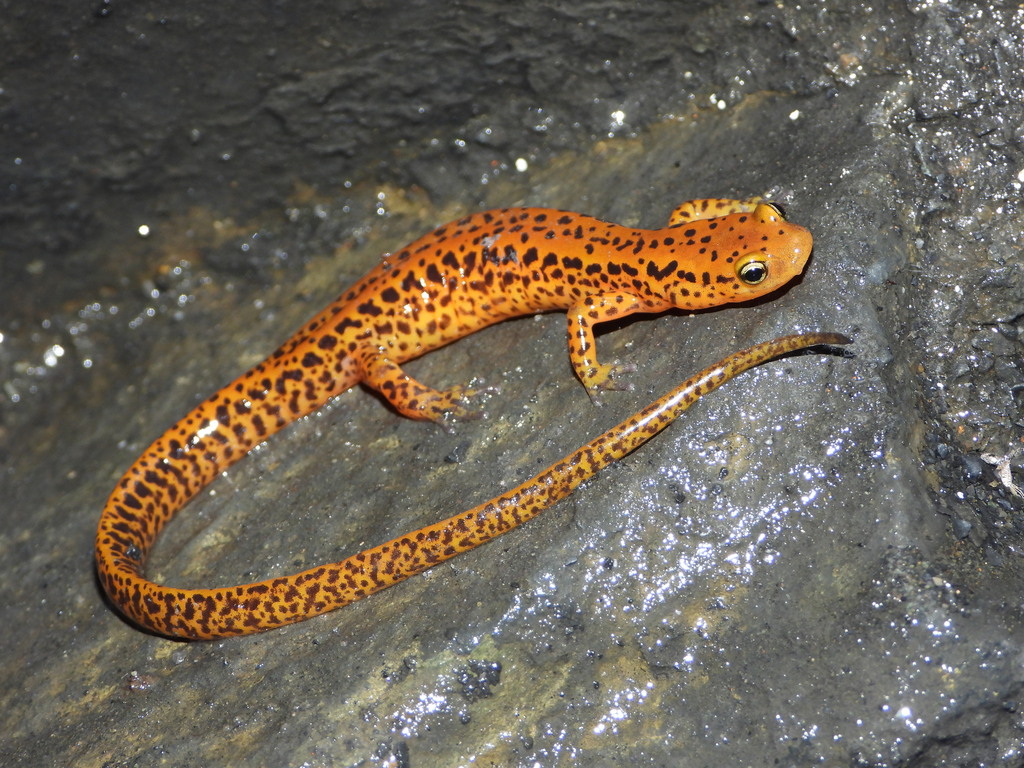
Long-tailed Salamander
Eurycea longicauda
Eurycea longicauda, commonly known as the long-tailed salamander or longtail salamander, is a species of lungless salamander native to the Appalachian Region and Ohio River valley of the eastern United States. It is a "cave salamander" that frequents twilight zones of caves and also inhabits springs and surrounding forest.
From the article Eurycea longicauda on Wikipedia (CC BY-SA), quoted section by section
Description
Body color varies from yellow to orange-red to red with random black spots. E. l. longicauda measure on average 50 mm (2.0 in) snout–vent length (SVL) and have 72 mm (2.8 in) long tail.
Range & habitat
Eurycea longicauda inhabit streamsides, spring runs, ponds, cave mouths, and abandoned mines. With wet weather, they may venture into wooded terrestrial habitats. They hide in rock crevices or under rocks, logs, etc. Eggs are laid in underground crevices associated with aquatic environments, but in caves they may also be attached to objects in or above water. The overall population size of this species is large (probably more than 100,000). Some local populations may have been impacted by strip mining and acid drainage from coal mining, but there are no major threats overall. Its range overlaps with several protected areas.
Wikipedia: “Habitat and conservation”
What it does
E. l. melanopleura reproduces in November to February. The eggs measure 7 mm (0.28 in) in diameter. The larvae hatch in January–March at about 10 mm (0.39 in) snout–vent length (SVL). They metamorphose seven months later at 23–28 mm (0.91–1.10 in) SVL. Males become sexually mature between 31–43 mm (1.2–1.7 in) SVL and females 33–43 mm (1.3–1.7 in) SVL. The largest males and females are 55 mm (2.2 in) SVL.
Wikipedia: “Reproduction”
Listen
Looking for field recordings…
Where it lives
Recorded sightings
—
geo-referenced records in GBIF, from museums, herbaria and field observers.
Drag the globe to turn it. Dots are where records exist, not a range map; darker means more records.
In the stacks
Searching the stacks…
Every page naming Eurycea longicauda in the Biodiversity Heritage Library →
This page is assembled live from iNaturalist, GBIF, Wikipedia, the Source Library and the Internet Archive. It is not yet part of the hand-edited codex. iNaturalist taxon 27101.