- Animals
- ›Chordates
- ›Vertebrates
- ›Reptiles
- ›Snakes and Lizards
- ›Snakes
- ›Colubrid Snakes
- ›Colubrine Snakes
- ›Platyceps
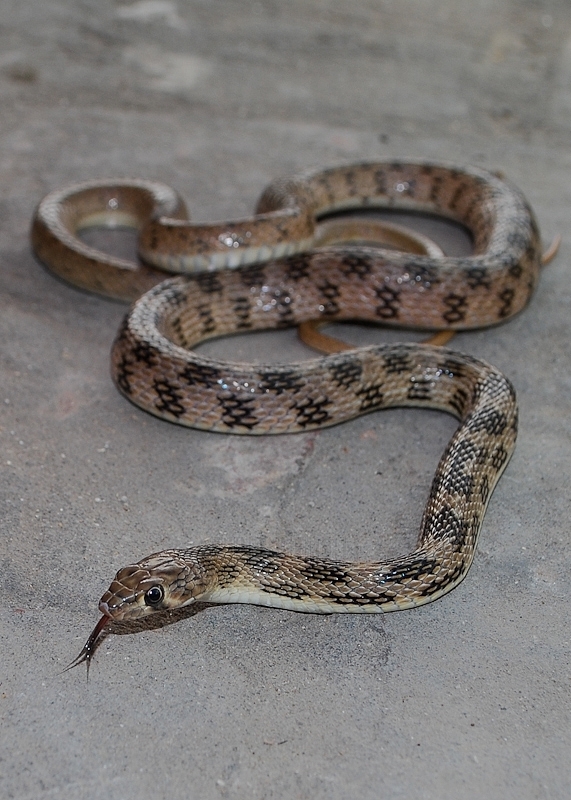
Glossy-bellied Racer
Platyceps ventromaculatus
Hardwicke's rat snake (Platyceps ventromaculatus), also known commonly as the glossy-bellied racer, Gray's rat snake, and the spotted bellied snake, is a species of snake in the family Colubridae. The species is native to Asia. There are three recognized subspecies.
From the article Hardwicke's rat snake on Wikipedia (CC BY-SA), quoted section by section
Description
P. ventromaculatus is a graceful snake with a smooth, round, elongate, gradually tapering body, and a tail more than one-fourth the total length. It has a moderately narrow head. It varies in colour and can be grey, olive-brown, olive-green, or dirty yellow. It has a series of black rhomboidal cross-bars running down the middle of the back. The scales forming the cross-bars normally have colour on the edges only. The sides of the body have similar smaller spots alternating with interspaces which may be broader or narrower than them. The belly is yellow to white with glossy scales. The head is of the body-colour with or without symmetrical darkish markings. These may consist of:
A blackish spot between the lores. A black streak obliquely placed below the eye. A black stripe from the temporal area to the gape. A cross-bar and two stripes on the nape.
Size. Adults are usually 90 to 120 cm (35 to 47 in) in total length (including tail), and have been recorded to grow up to 1.28 m (4.2 ft) .
Identifying characteristics. Dorsal scales in 19:19:15 or 13 rows. Anal divided. Supralabials (upper lip scales). The 4th, 5th and 6th touch the eye. …
Range & habitat
P. ventromaculatus is found in southern and southwestern Asia from northern India through Pakistan, southern Iran, and Iraq to Kuwait, Bahrain, and Saudi Arabia along the Persian Gulf. Its presence in Afghanistan, Uzbekistan, Syria, and Turkey requires confirmation.
Wikipedia: “Geographic range”
What it does
P. ventromaculatus is oviparous. Gravid females have been obtained in early summer. About 9 eggs are laid. They hatch around September. The young snakes are 30–33 centimetres (12–13 in) long.
Wikipedia: “Reproduction”
Where it lives
Recorded sightings
—
geo-referenced records in GBIF, from museums, herbaria and field observers.
Drag the globe to turn it. Dots are where records exist, not a range map; darker means more records.
In the stacks
Searching the stacks…
Every page naming Platyceps ventromaculatus in the Biodiversity Heritage Library →
This page is assembled live from iNaturalist, GBIF, Wikipedia, the Source Library and the Internet Archive. It is not yet part of the hand-edited codex. iNaturalist taxon 27104.