- Animals
- ›Chordates
- ›Vertebrates
- ›Amphibians
- ›Salamanders
- ›Lungless Salamanders
- ›Hemidactyliine Salamanders
- ›Eurycea
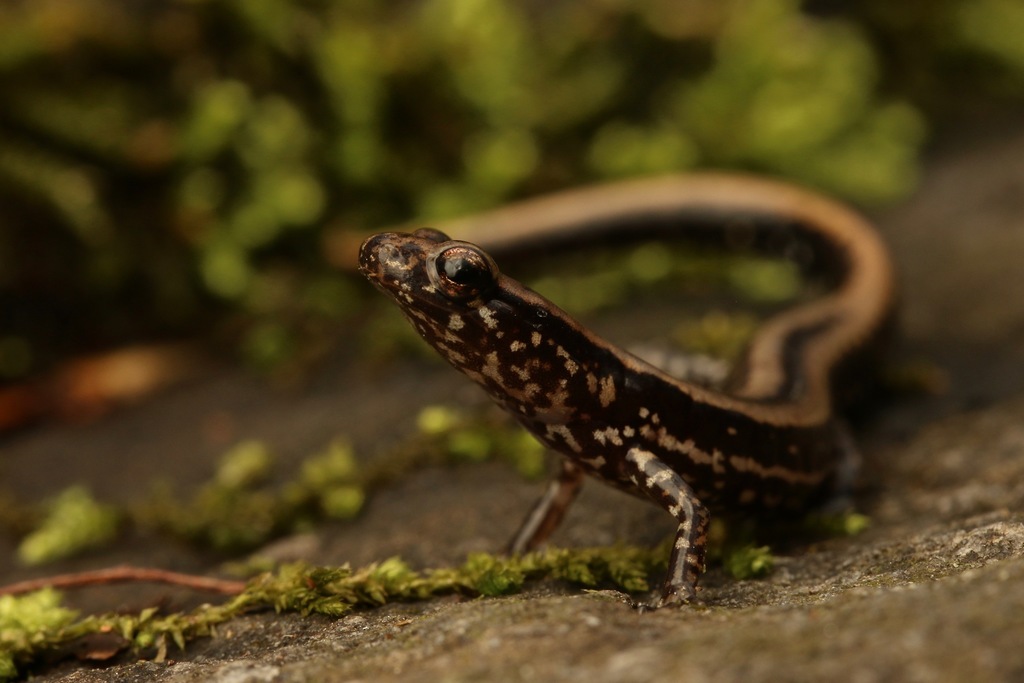
Three-lined Salamander
Eurycea guttolineata
The three-lined salamander (Eurycea guttolineata) is a species of salamander in the family Plethodontidae. It is endemic to the south-eastern United States. This species was classified as a sub-species of long tailed salamanders until DNA sequencing revealed that there was no hybridization between the two species. Like other Plethodontidae species, E. guttolineata captures prey via tongue projection.
From the article Three-lined salamander on Wikipedia (CC BY-SA), quoted section by section
Description
Eurycea guttolineata is a mid-sized, slender stream salamander which ranges from about 10-15.9 cm in its adult form. It is tan to light yellow with three black longitudinal stripes running from the eyes down the length of the body to the tail. They possess 13-14 costal grooves that aid in cutaneous respiration. The tail is very long at approximately two-thirds its total body length. Additionally, the ventrum (belly) of the three-lined salamander is boldly marked with black and white marbling.
Range & habitat
The species is distributed throughout much of the southeastern United States. It can be found in the Appalachian Mountains from Virginia and Tennessee south through the Carolinas, Georgia, Alabama, and Mississippi to the Gulf Coast, including eastern Louisiana and western Florida.
Wikipedia: “Distribution”
What it does
Breeding takes place in slow moving bogs and streams. Hatchlings are generally around 10-13 mm and undergo metamorphosis when they are 22-27 mm snout-to-vent length. Metamorphosis starts with the reduction of labial folds, formation of eyelids, and resorption of the tail-fin. Metamorphosis is then complete with loss of gills and gill slits, along with pigment changes. This is typically a 4-6 month larval stage. The effects that elevation has on larval stages have been studied extensively showing that at lower elevations larvae metamorphosized sooner than those at higher elevations which had delayed metamorphosis mostly due to overwintering. Due to this species being a semi-aquatic salamander in the Plethodontidae family, the females will enter cooler waters in late autumn and winter to drop eggs. Females lay clutch sizes averaging 12-14 eggs.
Wikipedia: “Reproduction”
Listen
Looking for field recordings…
Where it lives
Recorded sightings
—
geo-referenced records in GBIF, from museums, herbaria and field observers.
Drag the globe to turn it. Dots are where records exist, not a range map; darker means more records.
In the stacks
Searching the stacks…
Every page naming Eurycea guttolineata in the Biodiversity Heritage Library →
This page is assembled live from iNaturalist, GBIF, Wikipedia, the Source Library and the Internet Archive. It is not yet part of the hand-edited codex. iNaturalist taxon 27107.