On eBird ↗
Rodrigues Solitaire
Live sightings near you, the range map, bar charts of when it is seen, and Macaulay Library photos and recordings.
Rodrigues Solitaire
Pezophaps solitaria
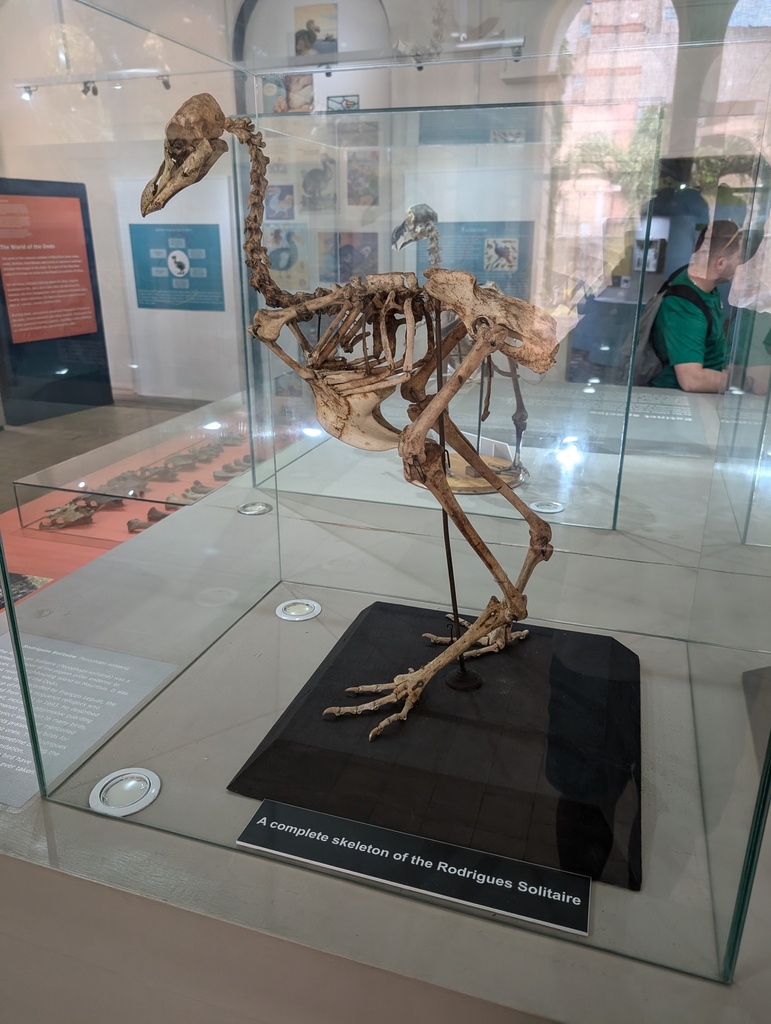
The Rodrigues solitaire (Pezophaps solitaria) is an extinct flightless bird that was endemic to the island of Rodrigues, east of Madagascar in the Indian Ocean. A member of the family of pigeons and doves, it was most closely related to the also extinct dodo of the nearby island Mauritius, the two forming the subfamily Raphinae. The Nicobar pigeon is their closest living genetic relative.
Rodrigues solitaires grew to the size of swans, and demonstrated pronounced sexual dimorphism. Males were much larger than females and measured up to 75.7–90 centimetres (30–35 inches) in height and 28 kilograms (62 pounds) in weight, contrasting with 63.8–70 centimetres (25–28 in) and 17 kilograms (37 lb) for females. Its plumage was grey and brown; the female was paler than the male. It had a black band at the base of its slightly hooked beak, and its neck and legs were long. Gizzard stones helped digest its food, which included fruit and seeds. Both sexes were highly territorial, with large bony knobs on their wings that were used in combat, probably due to competition for the limited resources on the island. The Rodrigues solitaire laid a single egg that was incubated in turn by both sexes.
From the article Rodrigues solitaire on Wikipedia (CC BY-SA), quoted section by section
Description
The beak of the Rodrigues solitaire was slightly hooked, and its neck and legs were long. One observer described it as the size of a swan. The skull was 170 mm (6.7 in) long, flattened at the top with the fore and hind parts elevated into two bony ridges structured with cancellous bone. A black band (a contemporary description described it as a "frontlet") appeared on its head just behind the base of the beak. The plumage of the Rodrigues solitaire was described as grey and brown. Females were paler than males and had light-coloured elevations on the lower neck. Sexual size dimorphism in this species is perhaps the greatest in any neognath bird. Males were considerably larger than females, measuring 75.7–90 centimetres (30–35 inches) in height and weighing up to 28 kilograms (62 pounds), whereas females were 63.8–70 centimetres (25–28 in) and weighed up to 17 kilograms (37 lb). This is only 60% of the weight of a mature male. Their weight may have varied substantially due to fat cycles, meaning that individuals were fat during cool seasons, but slim during hot seasons, and may have been as low as 21 kg in males and 13 kg in females. Though male pigeons are usually larger than females, there is no direct evidence for the largest specimens actually being the males of the species, and this has only been assumed based on early works. …
What it does
Some evidence, including their large size and the fact that tropical and frugivorous birds have slower growth rates, indicates that the Rodrigues solitaire may have had a protracted development period. Based on mass estimates, the American ornithologist Bradley C. Livezey suggested in 1993 the male could reach the age of 28, and the female 17. The French economist Pierre-André d'Héguerty, writing about his time on the island around 1735, stated that a captive Rodrigues solitaire (which he described as having a melancholic appearance) would always walk in the same line until running out of space, and then return. The species may have lived primarily in the island's woodlands, rather than on the shores. Many other of the endemic species of Rodrigues became extinct after the arrival of humans, so the ecosystem of the island is heavily damaged. Before humans arrived, forests covered the island entirely, but very little remains today due to deforestation. The Rodrigues solitaire lived alongside other recently extinct birds such as the Rodrigues rail, the Rodrigues parrot, Newton's parakeet, the Rodrigues starling, the Rodrigues scops owl, the Rodrigues night heron, and the Rodrigues pigeon. Extinct reptiles include the domed Rodrigues giant tortoise, the saddle-backed Rodrigues giant tortoise, and the Rodrigues day gecko.
Diet. …
Wikipedia: “Behaviour and ecology”
Listen
Looking for field recordings…
Where it lives
Recorded sightings
—
geo-referenced records in GBIF, from museums, herbaria and field observers.
Drag the globe to turn it. Dots are where records exist, not a range map; darker means more records.
In the stacks
Searching the stacks…
Every page naming Pezophaps solitaria in the Biodiversity Heritage Library →
This page is assembled live from iNaturalist, GBIF, Wikipedia, the Source Library and the Internet Archive. It is not yet part of the hand-edited codex. iNaturalist taxon 2711.