- Animals
- ›Chordates
- ›Vertebrates
- ›Amphibians
- ›Salamanders
- ›Lungless Salamanders
- ›Hemidactyliine Salamanders
- ›Eurycea
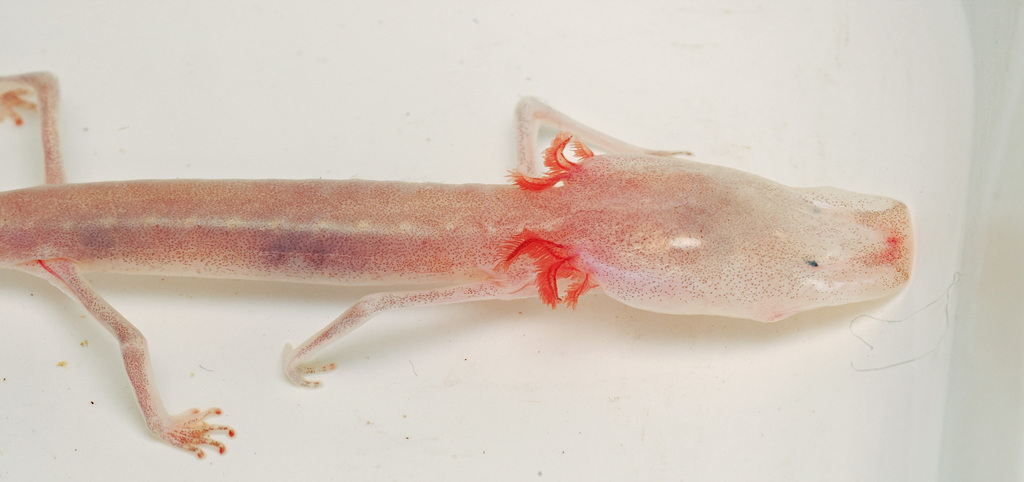
Texas Blind Salamander
Eurycea rathbuni
The Texas blind salamander (Eurycea rathbuni) is a rare and endangered cave-dwelling troglobite amphibian native to San Marcos, Hays County, Texas, specifically the San Marcos Pool of the Edwards Aquifer. This species resembles the olm, another stygofaunal salamander from Europe. Its body is less elongated than the olm's, and it has more digits on each limb: four on the front limbs and five on the back, while the olm has three and two respectively.
From the article Texas blind salamander on Wikipedia (CC BY-SA), quoted section by section
Description
The species has a broad, flat snout and head, and vestigial eyes beneath that are covered by skin. This species' vestigial eyes contain an optic nerve, but are less developed than those of other species in the Eurycea, often lacking important features like lenses and well-defined retinas associated with image-forming vision. Similar to other cave-dwelling salamanders, this species has numerous neuromasts in their lateral line that detect mechanical stimuli in the environment. Many of these neuromasts express the PAX6 protein, which is often expressed during eye development of other salamander species. These neuromasts are thought to play an important role in navigation and prey detection for this species with reduced visual capacity. Like other neotenous salamanders, it has external gills for absorbing oxygen from the water. The salamander's mature length is around 13 cm (5 in). The forelimbs carry four digits and the hind limbs possess five digits. The species is found to be able to regenerate its tail and limbs if they are lost. Its diet varies by what flows into its cave, and includes blind shrimp (Palaemonetes antrorum), snails, and amphipods. It is not known if this salamander has any natural predators, however the stygobitic catfish Satan eurystomus also lives in Edwards Aquifer, so is a potential predator. …
Range & habitat
Specimens have been collected at seven localities in the Purgatory Creek system and along the San Marcos Fault near San Marcos, Texas. Adults and immature larvae are well-adapted for living in underground streams or deep pools in caves, and many probably inhabit deep recesses that are not accessible to collectors. The deep pools are cool environments nearly constantly staying at 21–22 °C (70–72 °F) with a minimal current. It is a unique ground system hundreds of feet below Earth's surface. The first specimens of this species were collected in 1895 from a newly constructed well that drew water from 58 metres (190 ft) below the surface.
Wikipedia: “Distribution and habitat”
Listen
Looking for field recordings…
Where it lives
Recorded sightings
—
geo-referenced records in GBIF, from museums, herbaria and field observers.
Drag the globe to turn it. Dots are where records exist, not a range map; darker means more records.
In the stacks
Searching the stacks…
Every page naming Eurycea rathbuni in the Biodiversity Heritage Library →
This page is assembled live from iNaturalist, GBIF, Wikipedia, the Source Library and the Internet Archive. It is not yet part of the hand-edited codex. iNaturalist taxon 27130.