- Animals
- ›Chordates
- ›Vertebrates
- ›Amphibians
- ›Salamanders
- ›Lungless Salamanders
- ›Plethodontine Salamanders
- ›Plethodon
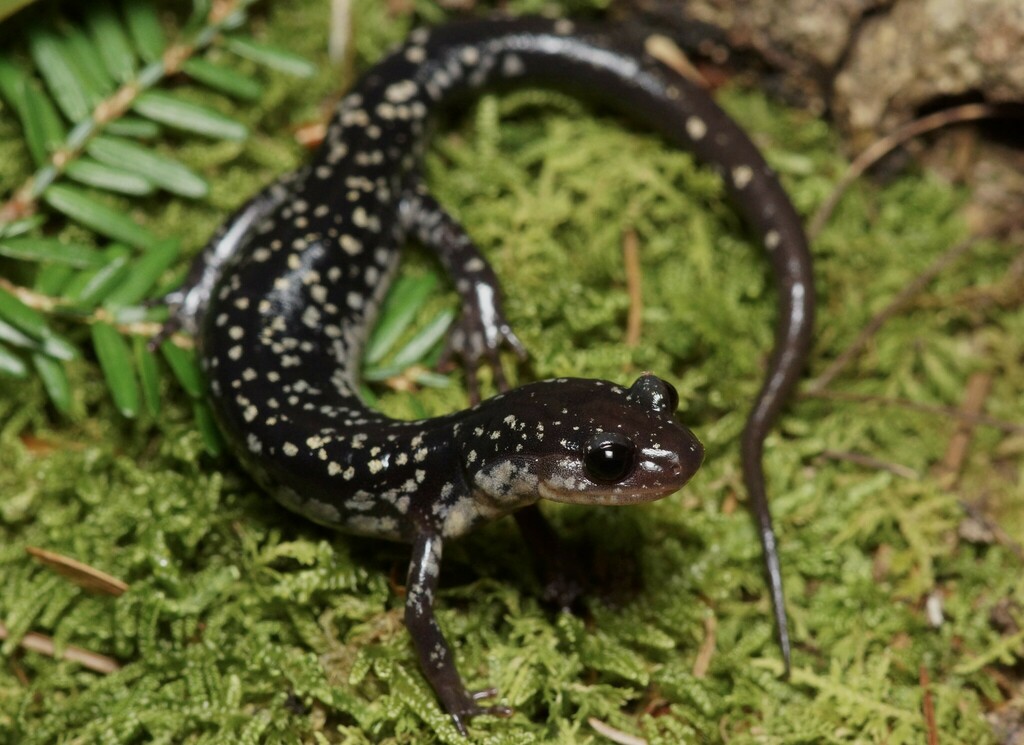
Tellico Salamander
Plethodon aureolus
The Tellico salamander (Plethodon aureolus) is a small woodland salamander resembling Plethodon glutinosus found in mountainous and lowland regions of southeastern Tennessee and extreme southwestern North Carolina. Little has been published on the species.
From the article Tellico salamander on Wikipedia (CC BY-SA), quoted section by section
Description
It has a grayish-black or black dorsum with brassy spotting. The chin is light-coloured and the sides have more concentrated yellow or white spotting. This brassy coloration is the source of the specific name aureolus, Latin for "gilded" or "ornamented". Rounded in cross section, the maximum size for adults is 151 mm (5.9 in) from tip of the snout to tip of the tail.
Wikipedia: “Appearance”
What it does
Sexually active males have circular mental glands just behind the chin. The courtship ritual performed is indistinguishable from P. glutinosus. It ends with the deposition of a spermatophore by the male which is picked up by the female's cloacal lips. Chemical cues are important in species recognition and prevention of interbreeding with P. oconaluftee. Males seem to prefer the odor of female conspecifics, while females tend to prefer the odor of male heterospecifics.
Wikipedia: “Reproduction”
Listen
Looking for field recordings…
Where it lives
Recorded sightings
—
geo-referenced records in GBIF, from museums, herbaria and field observers.
Drag the globe to turn it. Dots are where records exist, not a range map; darker means more records.
In the stacks
Searching the stacks…
Every page naming Plethodon aureolus in the Biodiversity Heritage Library →
This page is assembled live from iNaturalist, GBIF, Wikipedia, the Source Library and the Internet Archive. It is not yet part of the hand-edited codex. iNaturalist taxon 27174.