- Animals
- ›Chordates
- ›Vertebrates
- ›Amphibians
- ›Salamanders
- ›Lungless Salamanders
- ›Plethodontine Salamanders
- ›Plethodon
- ›Plethodon glutinosus
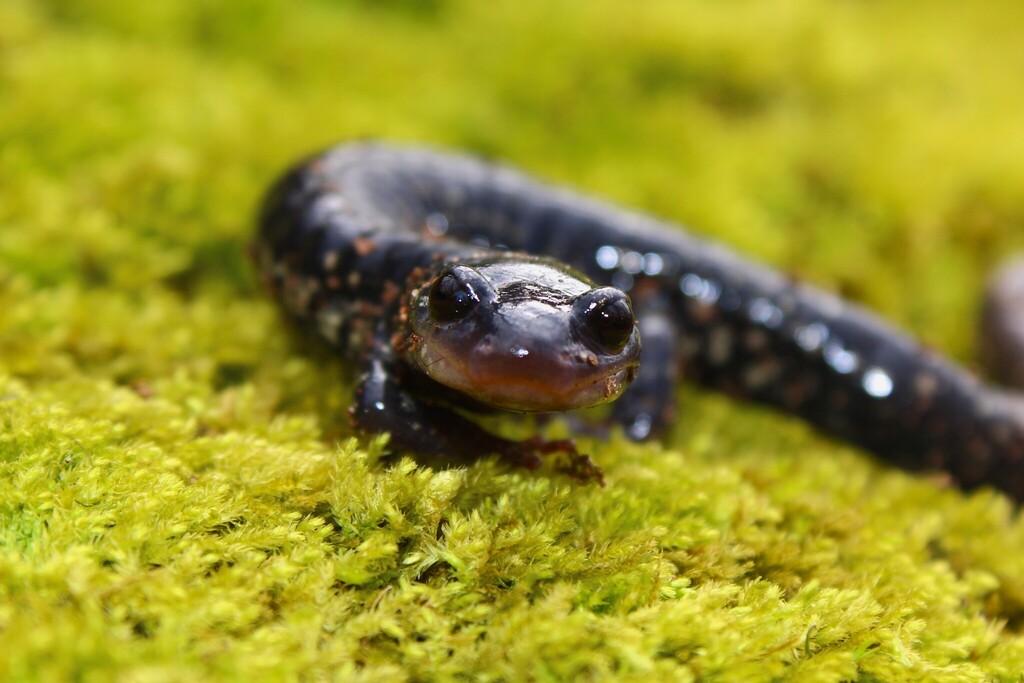
Northern Slimy Salamander
Plethodon glutinosus
The northern slimy salamander (Plethodon glutinosus) is a species of terrestrial plethodontid salamander found throughout much of the eastern two-thirds of the United States.
From the article Northern slimy salamander on Wikipedia (CC BY-SA), quoted section by section
Description
The northern slimy salamander is typically an overall black in color, with numerous silvery spots or gold spots across its back. It is usually 12–17 cm (4.7–6.7 in) in total length (including tail), but can grow to 20.6 cm (8.1 in). Males are not easily distinguished from females, though females tend to be slightly larger. It has 15-17 costal grooves.
Range & habitat
P. glutinosus is found from New York, west to Illinois, south to Mississippi, and east to Alabama, with isolated populations in southern New Hampshire and northwestern Connecticut.
Wikipedia: “Geographic range”
What it does
All plethodontid salamanders are territorial, and fight aggressively for territory. Their preferred habitat is in moist soil or leaf litter beneath stones, rotting logs, or other debris near a permanent water source. They sometimes make use of other animals' burrows. As their name suggests, slimy salamanders produce significant amounts of skin secretions that are highly adhesive. These adhesives bind to predators and can compromise both mastication and locomotion. Whenever threatened they will thrash their tail, exposing the glands that secrete this sticky substance.
Wikipedia: “Behavior”
Listen
Looking for field recordings…
Where it lives
Recorded sightings
—
geo-referenced records in GBIF, from museums, herbaria and field observers.
Drag the globe to turn it. Dots are where records exist, not a range map; darker means more records.
In the stacks
Searching the stacks…
Every page naming Plethodon glutinosus in the Biodiversity Heritage Library →
This page is assembled live from iNaturalist, GBIF, Wikipedia, the Source Library and the Internet Archive. It is not yet part of the hand-edited codex. iNaturalist taxon 27184.