- Animals
- ›Chordates
- ›Vertebrates
- ›Reptiles
- ›Snakes and Lizards
- ›Snakes
- ›Colubrid Snakes
- ›Dipsadine Snakes
- ›Clelia
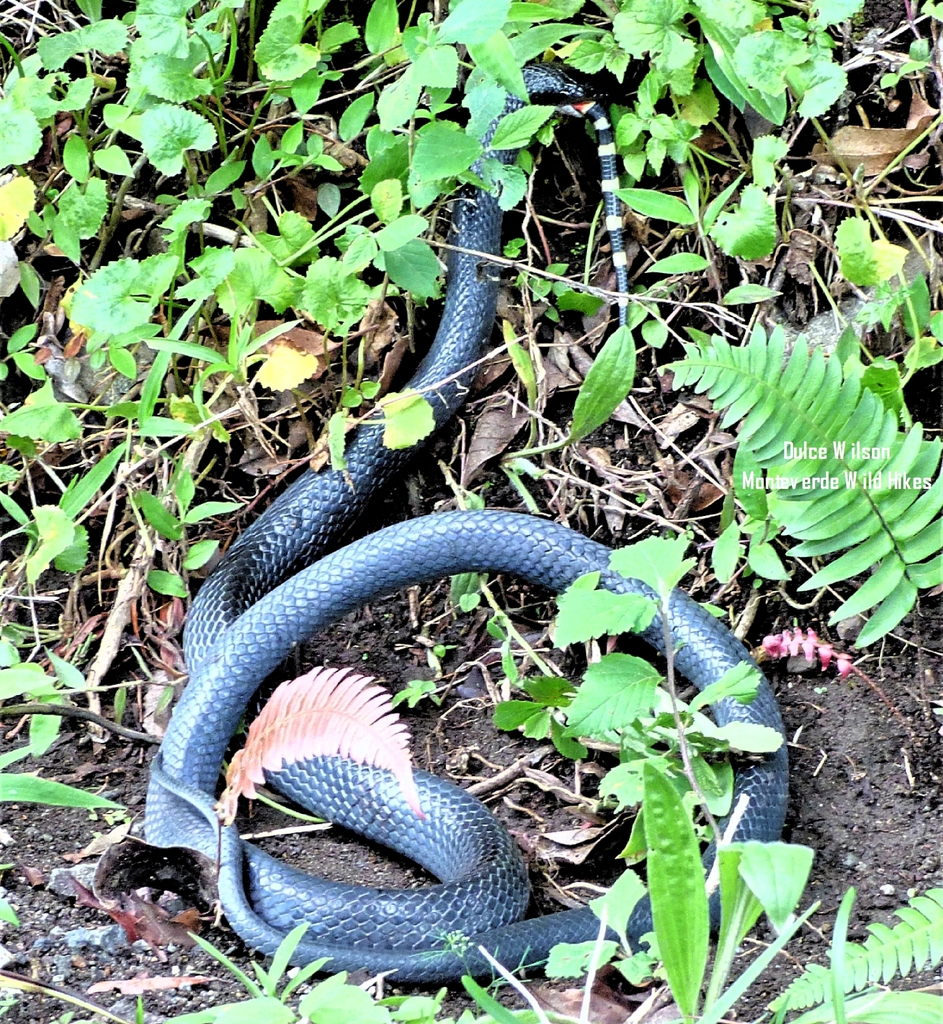
Mexican Snake Eater
Clelia scytalina
Clelia scytalina, commonly known as the Mexican snake eater or zopilota de altura (highland mussarana), is a species of snake in the family Colubridae. The species is endemic to the New World.
From the article Clelia scytalina on Wikipedia (CC BY-SA), quoted section by section
Description
The head of C. scytalina is somewhat distinct from the neck. The eye is moderate in size, with a vertically elliptical pupil. The body is cylindrical, and the tail is moderately long. The smooth dorsal scales are arranged in 17 rows at midbody. The coloration of juveniles is completely different from that of adults. Juveniles have a black head, a yellow or white nuchal crossband (collar), and a red body. Juveniles are often mistaken for coral snakes and killed. Adults are uniform bluish black dorsally, and cream-colored ventrally.
Range & habitat
Clelia scytalina is a terrestrial animal which inhabits old-growth and second-growth forests and their borders. Occasionally it is found in open areas in submontane and montane life zones.
Wikipedia: “Habitat”
Where it lives
Recorded sightings
—
geo-referenced records in GBIF, from museums, herbaria and field observers.
Drag the globe to turn it. Dots are where records exist, not a range map; darker means more records.
In the stacks
Searching the stacks…
Every page naming Clelia scytalina in the Biodiversity Heritage Library →
This page is assembled live from iNaturalist, GBIF, Wikipedia, the Source Library and the Internet Archive. It is not yet part of the hand-edited codex. iNaturalist taxon 27203.