- Animals
- ›Chordates
- ›Vertebrates
- ›Reptiles
- ›Snakes and Lizards
- ›Snakes
- ›Colubrid Snakes
- ›Asia-Pacific Whipsnakes
- ›Chrysopelea
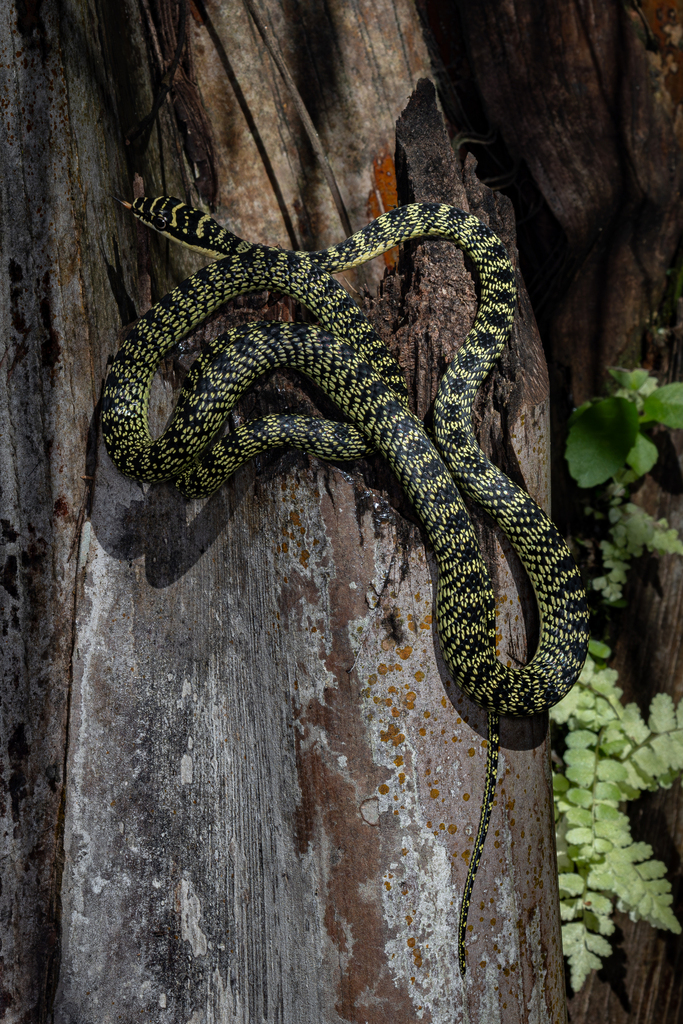
Golden Tree Snake
Chrysopelea ornata
Chrysopelea ornata (Thai: งูเขียวพระอินทร์) is a species of mildly venomous opisthoglyphous (rear-fanged) colubrid snake found in both South Asia and Southeast Asia. It is commonly known as the golden tree snake, ornate flying snake, and golden flying snake. Along with the other species in the genus Chrysopelea, the golden tree snake is unusual, as it is capable of a type of gliding "flight" (more of a controlled "throwing" or "falling") — mainly utilised during the pursuit of prey animals — from tree-to-tree. This action is also used to great effect for the snake to flee its own potential predators (such as birds or other reptiles). Currently, three subspecies are recognised. The snake's striking looks, and potential for gliding, have made it a coveted choice for captivity.
From the article Chrysopelea ornata on Wikipedia (CC BY-SA), quoted section by section
Description
Chrysopelea ornata is usually green in color, with black cross-hatching and yellow or gold colored accents. The body, though slender, is far less so than in other tree snakes. It has a flattened head with constricted neck, a blunt nose and large eyes with round pupils. The lateral, sharp and pronounced keeled condition of the ventrals in association with the normal, not enlarged, vertebral row of scales distinguish this snake. This snake ranges from 11.5 to 130 cm (0.38 to 4.27 ft) long. Maturity is reached at about 1 m (3.3 ft) in length. The tail is about one-fourth of the total length. Chrysopelea ornata has two major colour forms, and their descriptions are given below:
In Sri Lanka and the southern extent of its Indian range, the snake is primarily greenish yellow or pale green. Each scale has a black mesial streak or spot, and is more or less edged with black. The snake also has dark crossbars at intervals. A series of large, flower-shaped, reddish or orange vertebral spots may be present or absent. Ventrals greenish, outside the keel edged with black or spotted. Head black with yellow crossbars and spots. The flower-shaped spots are more common in Sri Lanka than in south India. The second color variety which is more common in Southeast Asia lacks the reddish vertebral spots, and has less prominent black crossbars. …
Range & habitat
It is found in India (North Bengal), Bangladesh, Sri Lanka, Nepal, Myanmar, Thailand, Western Malaysia, Laos, Cambodia, Vietnam, China (Hong Kong, Hainan, Yunnan), and Singapore (introduced). In India, Chrysopelea ornata ranges from the Western Ghats, up to the Dangs, Katernia Ghat in Uttar Pradesh, North Bihar, northern West Bengal eastwards to Arunachal Pradesh. It is also found in the forests of the Andaman Islands.
Wikipedia: “Geographic range”
What it does
C. ornata is diurnal and arboreal. The snake's gliding ability, while not as impressive as that of the paradise flying snake (C. paradisi), still makes it capable of moving from tree to tree with relative ease. These snakes are excellent climbers, being able move across even the smallest of branches and even straight up trees with few branches by using the edges of rough bark. They are frequently seen moving up a coconut palm, or up vertical rock faces in graceful curves, gripping the somewhat uneven surfaces with their scales. They tend to be nervous, fast-moving snakes, and attempt to flee if disturbed, but generally do not hesitate to bite if handled. They are mildly venomous, but the venom is not considered to be dangerous to humans. It is intended to assist in subduing fast-moving, arboreal prey. C. ornata takes small arboreal prey, such as lizards, bats, and small rodents. It might also feed on bird eggs and insects. Also, it is reported to take snakes occasionally, and to avoid frogs, though frogs are also reported being eaten. The snake stalks or pursues the prey and seizes it by the neck, which is crushed in its strong jaws.
Flight. C. ornata, like others of its genus, glides or parachutes. This is presumably done to cover distances faster, to escape predators, to catch prey, or to move around in forests. …
Wikipedia: “Behaviour”
In human culture
The species name ornata is Latin for "decorated or "ornamented", in reference to the ornate coloration.
Common names. English: golden tree snake, gliding snake, ornate flying snake, golden flying snake, gold and black tree snake, flying tree snake Hindi: kala jin. Sinhala: pol-mal-karawala, malsara. German: Gelbgrüne Schmuckbaumnatter, Gewöhnliche Schmuckbaumnatter. Bengali: কালনাগিনী (Kaalnagini), উড়ন্ত সাপ, উড়াল মহারাজ সাপ, সুন্দরী সাপ, কালসাপ, কালনাগ Konkani: Naneto Nepali: Seerise Thai: งูเขียวดอกหมาก (Ngoo kee-ow dork maak) Khmer: ពស់តុកកែ (Pous Tok Kae) Malayalam: നാഗത്താൻ പാമ്പ് (nagathan pambu)
Wikipedia: “Etymology”
Where it lives
Recorded sightings
—
geo-referenced records in GBIF, from museums, herbaria and field observers.
Drag the globe to turn it. Dots are where records exist, not a range map; darker means more records.
In the stacks
Searching the stacks…
Every page naming Chrysopelea ornata in the Biodiversity Heritage Library →
This page is assembled live from iNaturalist, GBIF, Wikipedia, the Source Library and the Internet Archive. It is not yet part of the hand-edited codex. iNaturalist taxon 27207.