- Animals
- ›Chordates
- ›Vertebrates
- ›Reptiles
- ›Snakes and Lizards
- ›Snakes
- ›Colubrid Snakes
- ›Asia-Pacific Whipsnakes
- ›Chrysopelea
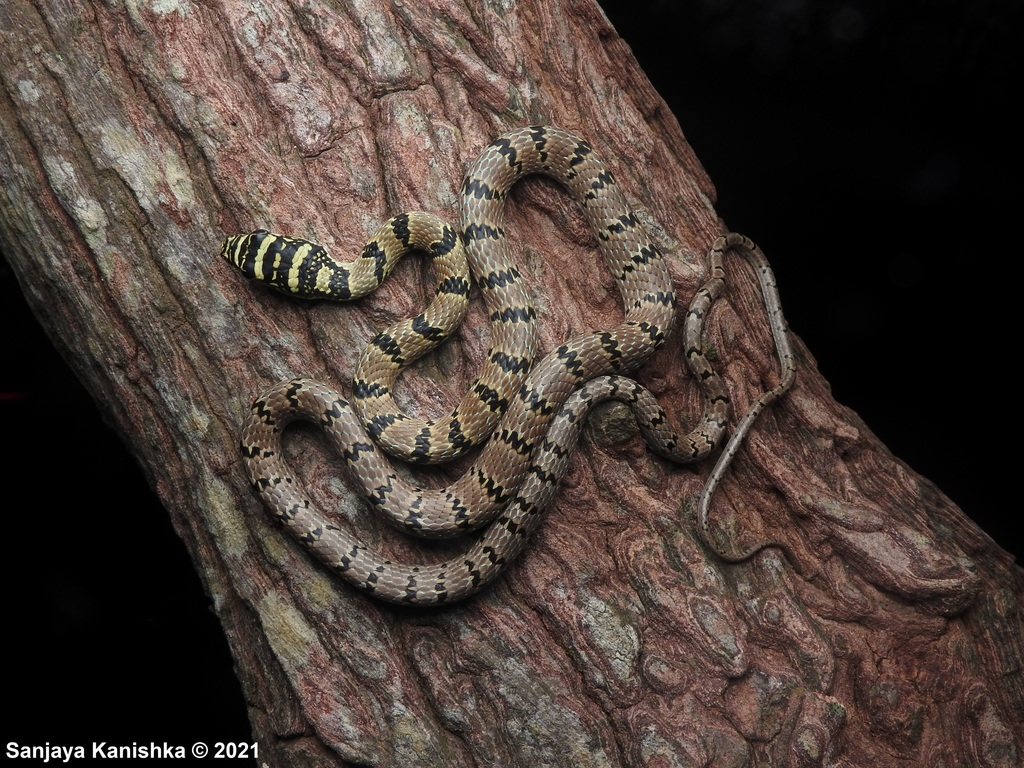
Sri Lankan Flying Snake
Chrysopelea taprobanica
Chrysopelea taprobanica, the Sri Lankan flying snake or Indian flying snake, is a species of gliding colubrid snake distributed in India and Sri Lanka. It can glide, as with all species of its genus Chrysopelea, by stretching the body into a flattened strip using its ribs. The snake is known as "dangara dandaa - දඟරදන්ඩා" in Sinhala, due to its folding postures.
From the article Chrysopelea taprobanica on Wikipedia (CC BY-SA), quoted section by section
Description
Chrysopelea taprobanica is a medium-sized snake, reaching 60–90 cm (24–35 in) length. The head is depressed. Eyes are large with round pupils. Ventral scales have keels laterally. Vertebral scales are not enlarged. Dorsal scales are smooth or feebly keeled. Dorsal side is greenish yellow or pale green. Orange to red spots can be seen between dark cross bands. Head is black dorsally with yellow and black cross-bars. Ventral side is pale green with a series of black lateral spots on each side.
Scalation. There are 198–214 ventral scales and 107–123 subcaudal scales.
Range & habitat
The Sri Lankan flying snake is distributed in Sri Lanka and Peninsular India. population in Sri Lanka can be found in dry zone lowlands and parts of the intermediate climatic zones, including Polonnaruwa, Wilpattu National Park, Sigiriya, Kurunegala, Jaffna, Trincomalee, and Monaragala. This species was believed to be endemic to Sri Lanka until researchers recorded a few specimens from Andhra Pradesh (India) and found old museum specimens collected from India that are now assigned to this species. More recently this species has been sighted in parts of Eastern Ghats in Tamil Nadu.
Wikipedia: “Distribution”
What it does
The snake inhabits old growth trees, as well as secondary vegetation, cultivation, sometimes entering human dwellings. They are diurnal and arboreal.
Wikipedia: “Ecology”
Where it lives
Recorded sightings
—
geo-referenced records in GBIF, from museums, herbaria and field observers.
Drag the globe to turn it. Dots are where records exist, not a range map; darker means more records.
In the stacks
Searching the stacks…
Every page naming Chrysopelea taprobanica in the Biodiversity Heritage Library →
This page is assembled live from iNaturalist, GBIF, Wikipedia, the Source Library and the Internet Archive. It is not yet part of the hand-edited codex. iNaturalist taxon 27222.