- Animals
- ›Chordates
- ›Vertebrates
- ›Amphibians
- ›Salamanders
- ›Lungless Salamanders
- ›Hemidactyliine Salamanders
- ›Pseudoeurycea
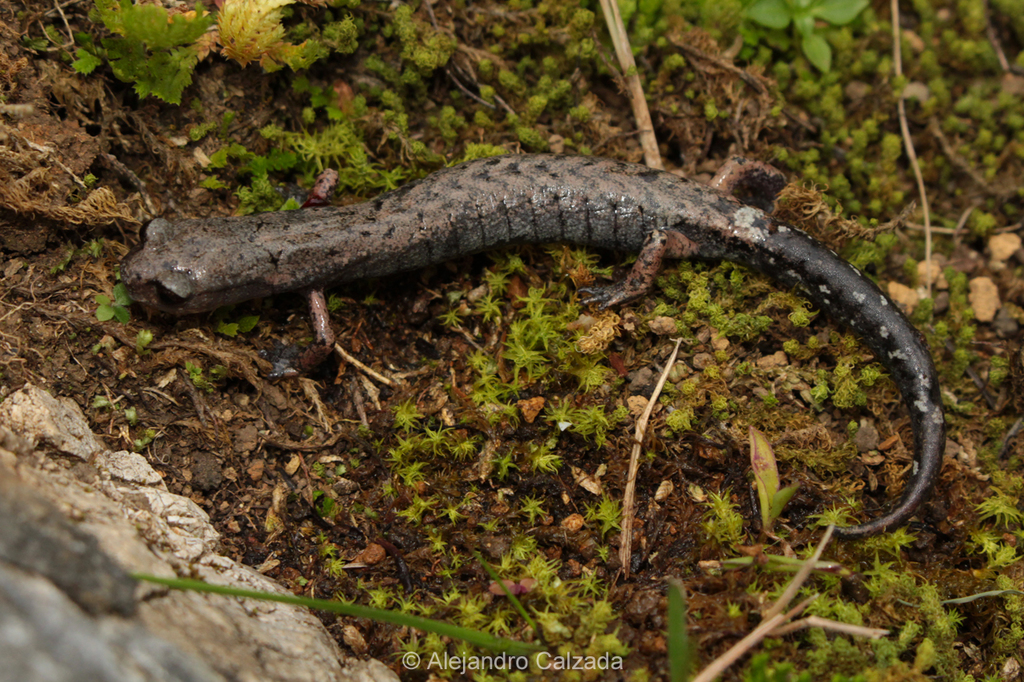
Firschein's False Brook Salamander
Pseudoeurycea firscheini
Pseudoeurycea firscheini is a species of salamander in the family Plethodontidae. It is endemic to the Sierra Madre de Oaxaca of west-central Veracruz, Mexico, and known from Acultzingo (its type locality) on the Puebla–Veracruz border eastward to the Sierra Zongolica. It is also known as the Firschein's false brook salamander or simply Firschein's salamander. The specific name firscheini honors Mr. Irwin Lester Firschein, an American biologist, geneticists, and anthropologist. The authors acknowledge Firschein for his explorations on Volcan San Martin, said to "have done much toward stimulating interest in this region of Mexico".
From the article Pseudoeurycea firscheini on Wikipedia (CC BY-SA), quoted section by section
Description
Pseudoeurycea firscheini was described based on four specimens of unspecified sex, including the holotype measuring 47 mm (1.9 in) in snout–vent length and a juvenile measuring 23 mm (0.91 in) in snout–vent length and 47 mm (1.9 in) in total length. The adults have small, lichen-like light spots on the tail. The sides and the underparts of the body are almost black. The hind legs are relatively large. The fingers are less than half-webbed, whereas the slender toes are about one-third webbed.
Range & habitat
Its natural habitats are pine-oak forests and lower cloud forests at elevations of 1,900–2,200 m (6,200–7,200 ft) above sea level. The type series was collected in water-filled bromeliads growing on trees at heights of 2.1–6.1 m (7–20 ft) above ground, and it appears to require the presence of abundant bromeliads growing on mature trees in its habitat. The dependence of Pseudoeurycea firscheini on large bromeliad-covered trees makes it susceptible to habitat loss caused by expanding agriculture and human settlements and by wood extraction. The species might be present in the Cañón del Río Blanco National Park, but this has yet to be confirmed. Mexican law protects it under the "Special Protection" category.
== References ==
Wikipedia: “Habitat and conservation”
Listen
Looking for field recordings…
Where it lives
Recorded sightings
—
geo-referenced records in GBIF, from museums, herbaria and field observers.
Drag the globe to turn it. Dots are where records exist, not a range map; darker means more records.
In the stacks
Searching the stacks…
Every page naming Pseudoeurycea firscheini in the Biodiversity Heritage Library →
This page is assembled live from iNaturalist, GBIF, Wikipedia, the Source Library and the Internet Archive. It is not yet part of the hand-edited codex. iNaturalist taxon 27306.