- Animals
- ›Chordates
- ›Vertebrates
- ›Amphibians
- ›Salamanders
- ›Lungless Salamanders
- ›Hemidactyliine Salamanders
- ›Pseudoeurycea
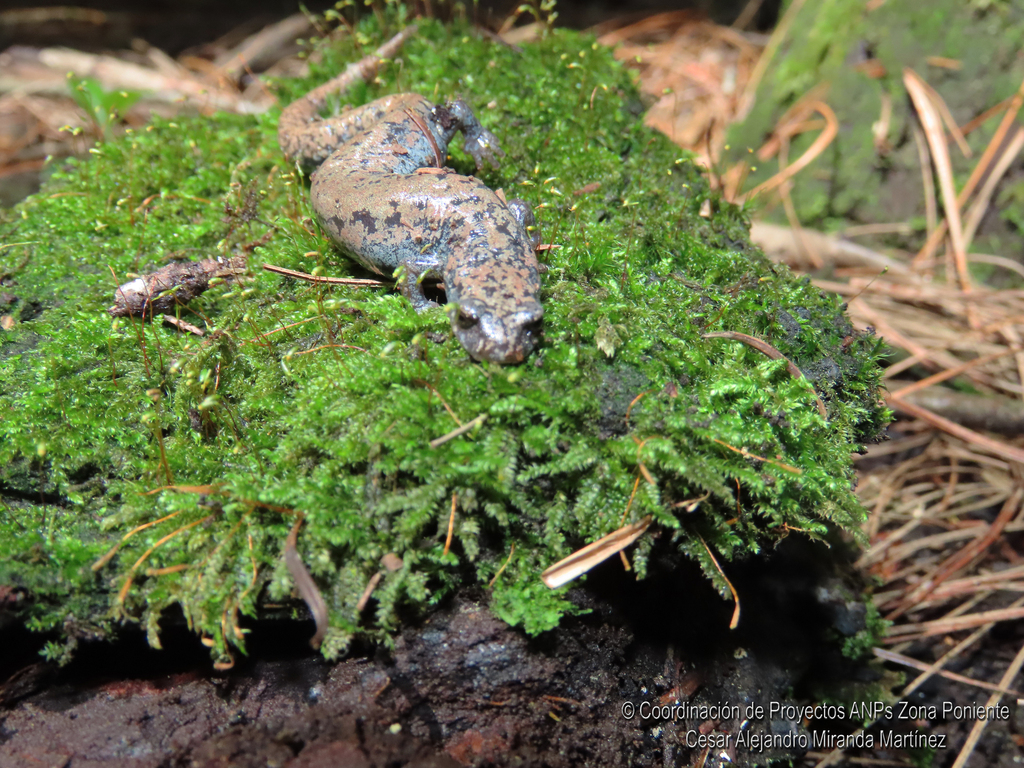
Morelos False Brook Salamander
Pseudoeurycea altamontana
Pseudoeurycea altamontana, commonly known as the Morelos salamander or Morelos false brook salamander, is a species of salamander in the family Plethodontidae. It is endemic to central Mexico and known from its type locality, Lake Zempoala and from the west slope of Popocatépetl, in the state of Morelos, the extreme east of Mexico State, and southern Mexico City.
From the article Pseudoeurycea altamontana on Wikipedia (CC BY-SA), quoted section by section
Description
The two specimens in the type series measured 40 and 49 mm (1.6 and 1.9 in) in snout–vent length; the larger specimen (holotype) had a 47 mm (1.9 in) tail. The head is relatively large. The fingers are nearly free from webbing. There are 12 costal folds. Living individuals have striking violet-purplish color in their head and body, with creamy markings and mottling.
Range & habitat
Its natural habitats are pine, pine-oak and fir forests at around 3,000 m (9,800 ft) above sea level. It is terrestrial species found under the bark of logs and stumps. It is threatened by habitat loss. It is found in the Lagunas de Zempoala National Park, but habitat loss is also occurring within this protected area.
== References ==
Wikipedia: “Habitat and conservation”
Listen
Looking for field recordings…
Where it lives
Recorded sightings
—
geo-referenced records in GBIF, from museums, herbaria and field observers.
Drag the globe to turn it. Dots are where records exist, not a range map; darker means more records.
In the stacks
Searching the stacks…
Every page naming Pseudoeurycea altamontana in the Biodiversity Heritage Library →
This page is assembled live from iNaturalist, GBIF, Wikipedia, the Source Library and the Internet Archive. It is not yet part of the hand-edited codex. iNaturalist taxon 27333.