- Animals
- ›Chordates
- ›Vertebrates
- ›Amphibians
- ›Salamanders
- ›Lungless Salamanders
- ›Plethodontine Salamanders
- ›Desmognathus
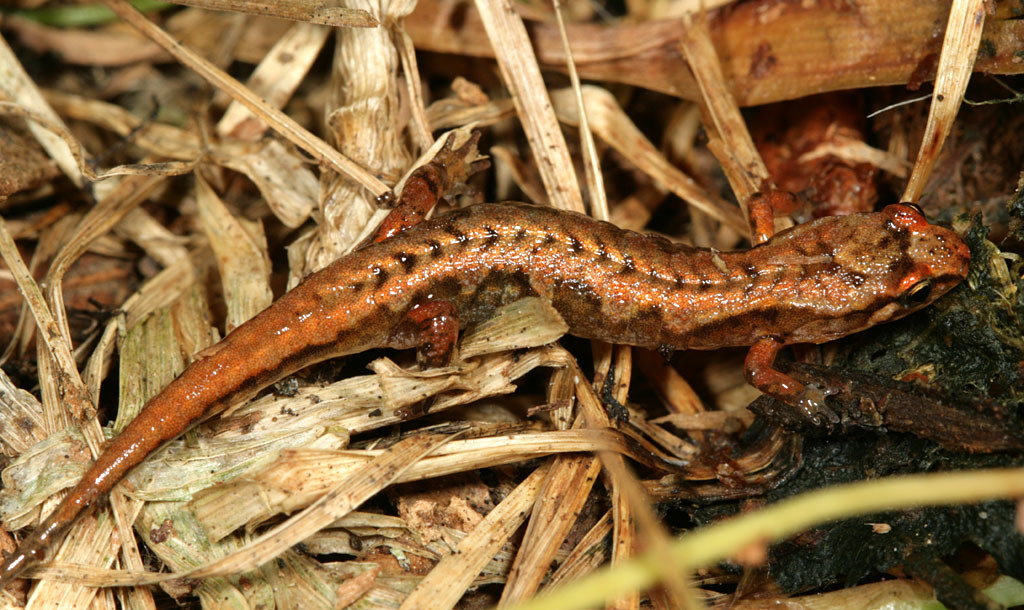
Pygmy Salamander
Desmognathus wrighti
The pygmy salamander (Desmognathus wrighti) is a species of salamander in the family Plethodontidae. It is endemic to the United States in the southern Appalachians in North Carolina and Tennessee.
Desmognathus wrighti is a member of the family Plethodontidae and is commonly known as the pygmy salamander. As the name suggest the pygmy salamander is the smallest of the nineteen species in the genus Desmognathus. D. wrighti undergoes direct development and does not have a free-living larval stage. Only two other taxa in Desmognathus, D. aeneus and D. organi, exhibit direct development along with the pygmy salamander. In the genus Desmognathus, body size, habitat preferences, and patterns used by males during courtship are quite variable. D. wrighti courtship is noted by the male biting and seizing its partner in order to provide them with a chemical stimulus. The pygmy salamander can be found in the southern Appalachians of the United States in western North Carolina and eastern Tennessee. Geographical distribution of the Desmognathus wrighti is fragmented and the highest abundance of the species can be found at high elevations in spruce and fir tree forest.
From the article Pygmy salamander on Wikipedia (CC BY-SA), quoted section by section
Range & habitat
Desmognathus wrighti has a very fragmented geographical distribution. The species is found in the Southern Appalachian Mountains of North Carolina and Tennessee south of the French Broad River. In Tennessee, D. wrighti inhabits the Great Smoky Mountains National Park in Blount, Cocke, and Sevier counties. The species is also found in the Cherokee National Forest in Monroe County. In North Carolina, the pygmy salamander is only documented in Graham County along the Tennessee border. The highest abundance of pygmy salamanders is found at higher elevations ranging from 1600 to 2082 meters. The distribution of the salamander primarily lies adjacent to areas of red spruce (Picea rubens) and Fraser's fir (Abies fraseri) forests at these high elevations. However, pygmy salamanders populations can be found at lower elevations from 950 to 1400 meters, but the highest densities occur at the higher elevations. Desmognathus wrighti populations appear to have stayed fragmented for some time due to their restriction to high elevation. The lower elevation populations of the pygmy salamanders documented exhibit little gene flow. This low gene flow reflects their preference for higher elevation and possible competition with other Appalachian salamanders. …
Wikipedia: “Geographical distribution”
What it does
Desmognathus wrighti is typically a light brown color with a dorsal pigmentation pattern of inverted V's in a darker brown. The salamander ranges from 35 mm to 55 mm and rarely exceeds 50 mm making it the smallest salamander in the genus Desmognathus. Pygmy salamanders are typically found at higher elevations. Adult salamanders are active at night and have been found up to one meter above the ground in vegetation. The pygmy salamander is the most terrestrial species of its genus. It lives in depressions in moss and leaf litter on the forest floors and is most often found in spruce-fir forests of high elevation. The salamander goes to seepages and stream banks for egg-laying in summer and early autumn.
Wikipedia: “Ecology”
In human culture
D. wrighti courtship differs from other members of Desmognathus in the phenology of oviposition which is in late summer into autumn. Males reach sexual maturity by their second or third year while females reach their sexual maturity by their third year. Males normally have two testes lobes but this number can increase with body size. In courtship males use their vomerine teeth to bite the female which in turn allows pheromone secretion to enter directly into the female circulation. D. wrighti and D. aeneus are the only two desmognathine salamanders that exhibit the courtship that which the male bite and seizes its partner before behaviors exhibited to accomplish sperm transfer. The male approaches the female quickly, bites, and tugs as he begins to undulate his tail. The female in return turns towards the male and places her chin on his laterally undulating tail so that they rotate in full circle. Typically in courtship behavior a Plethodontidae characteristic tail-straddling walk follows. In the tail-straddling walk, the male release the female and slides his head under her chin, then her forelimbs straddle the male's tail and the pair then move forward. …
Wikipedia: “Life history and behavior”
Listen
Looking for field recordings…
Where it lives
Recorded sightings
—
geo-referenced records in GBIF, from museums, herbaria and field observers.
Drag the globe to turn it. Dots are where records exist, not a range map; darker means more records.
In the stacks
Searching the stacks…
Every page naming Desmognathus wrighti in the Biodiversity Heritage Library →
This page is assembled live from iNaturalist, GBIF, Wikipedia, the Source Library and the Internet Archive. It is not yet part of the hand-edited codex. iNaturalist taxon 27411.