- Animals
- ›Chordates
- ›Vertebrates
- ›Amphibians
- ›Salamanders
- ›Lungless Salamanders
- ›Plethodontine Salamanders
- ›Aneides
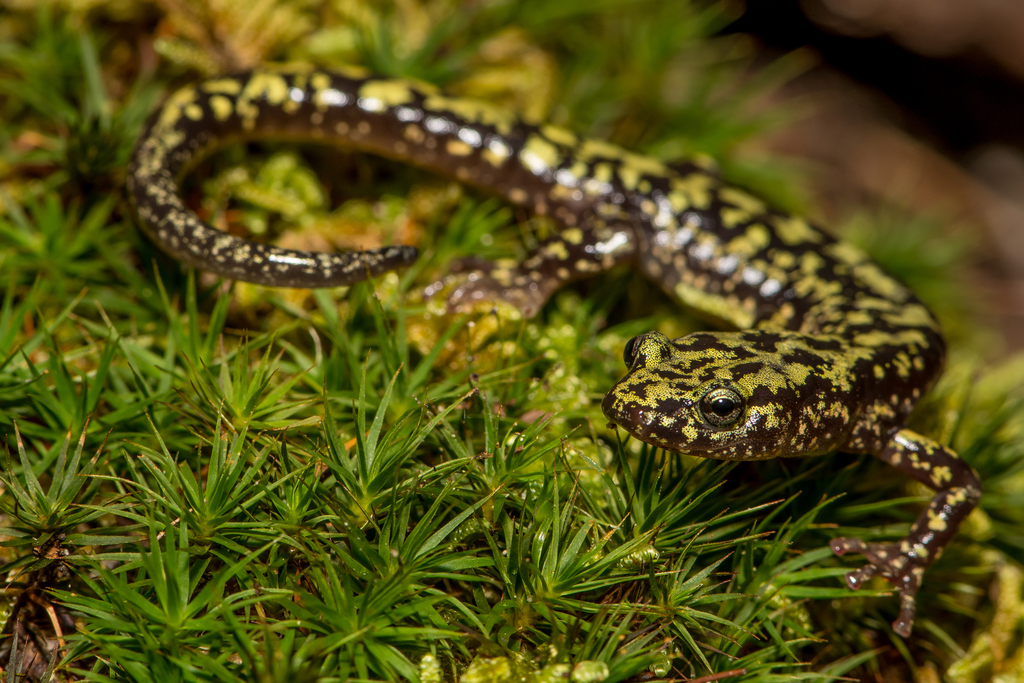
Green Salamander
Aneides aeneus
The green salamander (Aneides aeneus) is a species of lungless salamander in the family Plethodontidae. It and the Hickory Nut Gorge green salamander (A. caryaensis) are the only currently-described members of the genus Aneides that inhabit any areas in the eastern half of United States (all other Aneides salamanders are found west of the Mississippi River). Rarely seen in the field, the green salamander is an extremely habitat-specific terrestrial species that is seldom found away from its preferred surroundings: moist, shaded rock crevices. Green salamanders have one of the most specialized niches of any salamander.
From the article Green salamander on Wikipedia (CC BY-SA), quoted section by section
Description
The green salamander's scientific name is Aneides aeneus. The generic name, Aneides, is Greek for "lacking form or shape", in reference to its flattened, elongated body. The specific epithet, aeneus, is Latin, meaning bronze or copper, and refers to its dorsal coloration. The green salamander is small and notably flat. Green, lichen-like blotches against a darker dorsum make A. aeneus the only salamander in North America with green markings. A. aeneus possesses squared toe-tips, large, conspicuous eyes, and a light blue to yellow ventral surface. The square toe-tips, as well as a prehensile tail, are morphological adaptations that help the salamander with climbing. Adults range from 8 to 12 cm (3 to 5 inches) in total length (tail included), with 14 to 15 costal grooves. Aeneus was formerly considered the only species of the genus Aneides found in the Eastern United States. However, some claimed that there could be up to four different species of Aneides between the Cumberland Plateau and Blue Ridge Escarpment populations. A 2019 study found several A. aeneus populations to represent distinct taxonomic groups, supporting the presence of a possible species complex. At least one was found to represent a distinct species in its own right, the Hickory Nut Gorge green salamander (Aneides caryaensis). …
Wikipedia: “Description and taxonomy”
Range & habitat
Aneides aeneus is known to inhabit both the Alleghenies and Cumberland Plateau, reaching from southwestern Pennsylvania to northern Alabama and northeastern Mississippi. It is also commonly found in South-Central Ohio. Isolated populations are known at the Blue Ridge Escarpment at the junction of Georgia, North Carolina and South Carolina. The range of the Alleghenies and Cumberland Plateau extends southwest from Fayette County, Pennsylvania through eastern West Virginia, eastern Kentucky, the extreme western portions of Virginia, Tennessee, and Alabama. The population discovered in 1930 in the Great Smoky Mountains National Park has not been located since. There may be disjunct populations on Clinch Mountain, on Bays Mountain and the Appalachian Ridge and Valley, and in the Inner Central Basin of Tennessee.
Wikipedia: “Geographic distribution”
In human culture
Aneides aeneus is an extreme habitat specialist. This species of Aneides is found almost exclusively in an environment following these guidelines. A. aeneus prefers the crevices of rocks on the sides of cliffs or other outcroppings. In most crevices in which A. aeneus is observed, there is little to no sun light allowed. This shade may be due to either vegetation outside of the crevice or outcroppings above the crevice. While a number of instances of A. aeneus observations in arboreal situations have occurred, most of these instances are in trees either adjacent to rock outcroppings and cliffs, or the specimen in question was located underneath the bark of the tree. Habitat preferences shift seasonally, with trees serving as the primary habitat from May to September, and research suggest that green salamanders are more abundant in habitat at lower elevations with south-facing slopes. Males are extremely territorial toward other salamanders and would-be predators when disturbed or presented with any manner of threat. Cupp observed aggressive behavior in 45 of 49 instances where a male was placed within an artificial territory of another. Such a high level of aggression is rare in salamanders, and is observed in few other species, though hardly to the degree as observed in A. aeneus. …
Wikipedia: “Life history”
Listen
Looking for field recordings…
Where it lives
Recorded sightings
—
geo-referenced records in GBIF, from museums, herbaria and field observers.
Drag the globe to turn it. Dots are where records exist, not a range map; darker means more records.
In the stacks
Searching the stacks…
Every page naming Aneides aeneus in the Biodiversity Heritage Library →
This page is assembled live from iNaturalist, GBIF, Wikipedia, the Source Library and the Internet Archive. It is not yet part of the hand-edited codex. iNaturalist taxon 27429.