- Animals
- ›Chordates
- ›Vertebrates
- ›Amphibians
- ›Salamanders
- ›Lungless Salamanders
- ›Hemidactyliine Salamanders
- ›Gyrinophilus
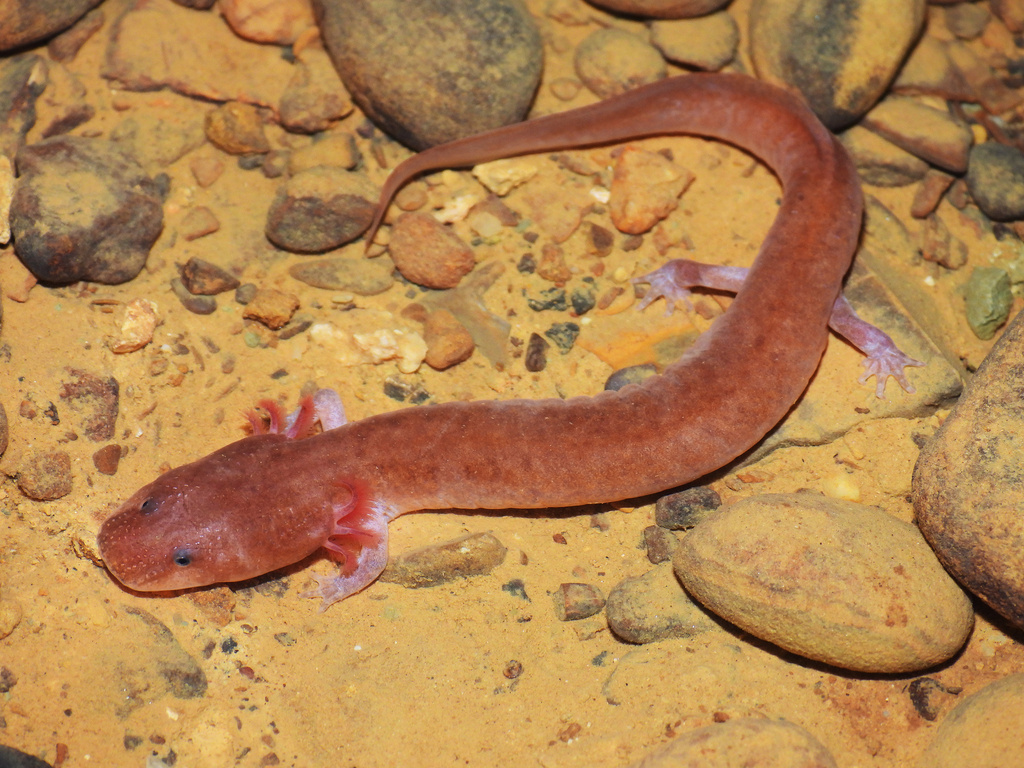
Tennessee Cave Salamander
Gyrinophilus palleucus
The Tennessee cave salamander (Gyrinophilus palleucus) is a species of salamander in the family Plethodontidae, endemic to the Appalachian Mountains in the United States. Its natural habitats are streams in caves. It is threatened by habitat loss.
From the article Tennessee cave salamander on Wikipedia (CC BY-SA), quoted section by section
Range & habitat
The Tennessee cave salamander inhabits the southern Cumberland Plateau in the Appalachian Mountains in the United States. Its range includes south-central Tennessee, western North Carolina, northeastern Alabama, northwestern Alabama and northwestern Georgia. The salamander lives in cave systems, and is probably present in some systems as yet unexplored.
Wikipedia: “Distribution”
What it does
The salamander's diet consists of amphipods and other small aquatic invertebrates that live in caves. It occurs on sand, gravel, mud or rock, in streams, in rimstone pools and in isolated pools. It prefers clear water without sediment. It is occasionally seen outside caves but it is thought that this occurs when it has been accidentally washed out by floodwater. This species is usually paedomorphic. This means it remains in the larval state for all of its life. Paedomorphic individuals breed as larvae, but some individuals continue to develop and undergo metamorphosis in the usual way.
Wikipedia: “Ecology”
Listen
Looking for field recordings…
Where it lives
Recorded sightings
—
geo-referenced records in GBIF, from museums, herbaria and field observers.
Drag the globe to turn it. Dots are where records exist, not a range map; darker means more records.
In the stacks
Searching the stacks…
Every page naming Gyrinophilus palleucus in the Biodiversity Heritage Library →
This page is assembled live from iNaturalist, GBIF, Wikipedia, the Source Library and the Internet Archive. It is not yet part of the hand-edited codex. iNaturalist taxon 27506.