- Animals
- ›Chordates
- ›Vertebrates
- ›Amphibians
- ›Salamanders
- ›Lungless Salamanders
- ›Hemidactyliine Salamanders
- ›Nototriton
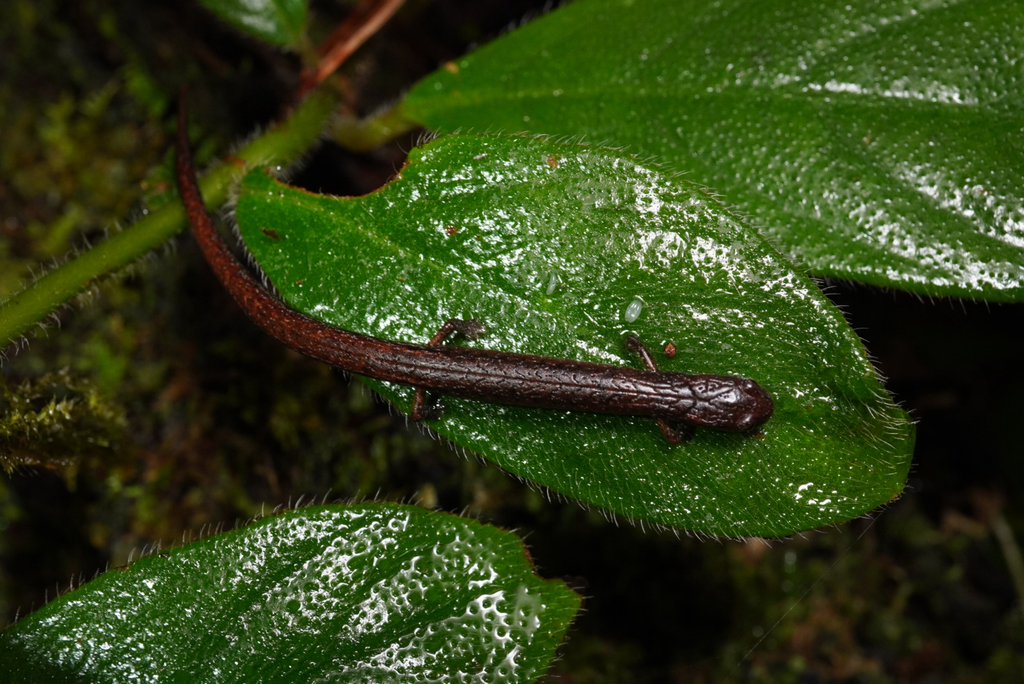
Merendon Moss Salamander
Nototriton brodiei
Nototriton brodiei is a species of salamander in the family Plethodontidae. It is endemic to the Sierra del Merendón and known from its type locality, Sierra de Caral in Izabal Department, eastern Guatemala, and from the Cusuco National Park in northwestern Honduras. The specific name brodiei honors Edmund D. Brodie, Jr., an American herpetologist. Common name Cerro Pozo de Agua moss salamander has been coined for it.
From the article Nototriton brodiei on Wikipedia (CC BY-SA), quoted section by section
Description
Females in the type series measure 32–34.5 mm (1.26–1.36 in) in snout–vent length. The tail length is about 1.4 times the body length, giving a maximum total length of 84 mm (3.3 in). The snout is broadly rounded and the eyes are protuberant. The head is just slightly wider than the neck. The parotoid glands are weakly developed. The limbs are short and slender. Both the fingers and the toes are about half-webbed and have sub-digital pads. The dorsum is mahogany or rust-brown and bears dark brown chevrons. The underside is blackish or dark purplish brown and has cream flecks. The tail irregular black or dark brown markings on the sides and ventrally. The iris is bronze.
Range & habitat
Nototriton brodiei occurs in subtropical old-growth wet forests at elevations of 760–1,590 m (2,490–5,220 ft) above sea level. Active individuals have been found at night in low vegetation and on a rock bank near a waterfall. During the daytime, a specimen was spotted under a pile of dead palm leaves. Nototriton brodiei is known from less than ten specimens and appears to be rare, although it might also be difficult to detect. Its habitat is threatened by extensive logging and agricultural encroachment. Illegal logging also occurs in the Cusuco National Park. Use of agrochemicals is also a threat.
== References ==
Wikipedia: “Habitat and conservation”
Listen
Looking for field recordings…
Where it lives
Recorded sightings
—
geo-referenced records in GBIF, from museums, herbaria and field observers.
Drag the globe to turn it. Dots are where records exist, not a range map; darker means more records.
In the stacks
Searching the stacks…
Every page naming Nototriton brodiei in the Biodiversity Heritage Library →
This page is assembled live from iNaturalist, GBIF, Wikipedia, the Source Library and the Internet Archive. It is not yet part of the hand-edited codex. iNaturalist taxon 27615.