- Animals
- ›Chordates
- ›Vertebrates
- ›Reptiles
- ›Snakes and Lizards
- ›Snakes
- ›Colubrid Snakes
- ›Colubrine Snakes
- ›Boiga
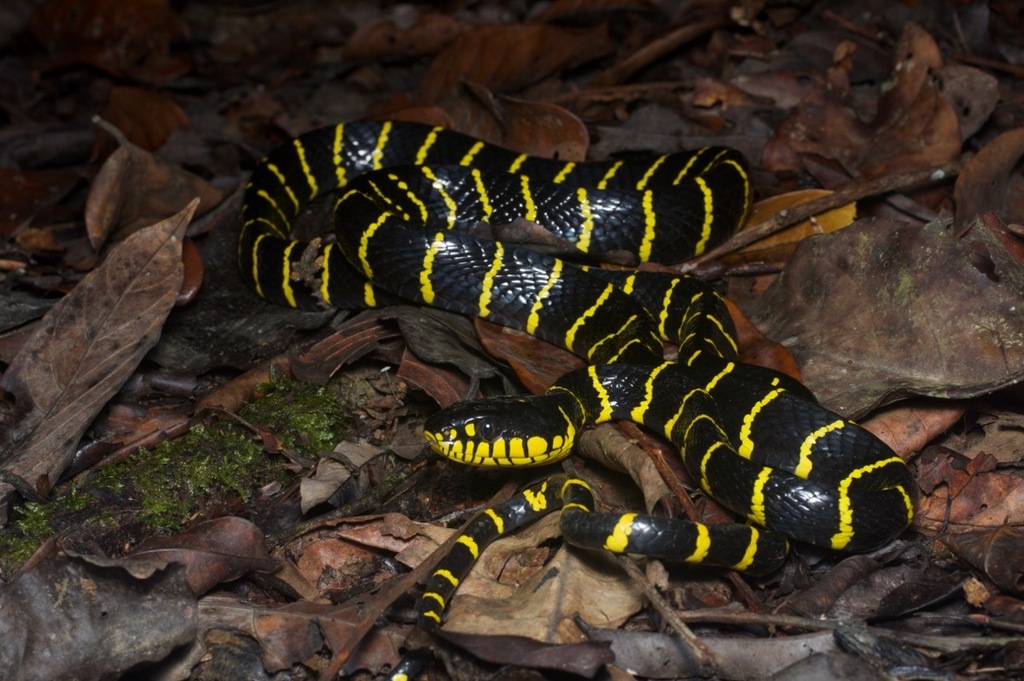
Gold-ringed Cat Snake
Boiga dendrophila
Boiga dendrophila, commonly called the mangrove snake or the gold-ringed cat snake, is a species of rear-fanged venomous snake in the family Colubridae. The species is endemic to southeast Asia. It is one of the biggest cat snake species, averaging 8–9 feet (2.4–2.7 m) in length. It is considered mildly venomous. Although moderate envenomations resulting in intense swelling have been reported, there has never been a confirmed fatality.
From the article Boiga dendrophila on Wikipedia (CC BY-SA), quoted section by section
Description
B. dendrophila has the following characteristics: Snout longer than eye; rostral broader than deep, visible from above; internasals as long as or shorter than the prae-frontals; frontal as long as or slightly shorter than its distance from the tip of the snout; loreal at least as long as deep; a praeocular extending to the upper surface of the head, not reaching the frontal; two postoculars; temporals 2 + 2 or 2 + 3; eight (nine) upper labials, third to fifth entering the eye; four or five lower labials in contact with the anterior chin-shields; latter as long as or longer than the posterior; anterior palatine teeth not much larger than the posterior. Scales in 21 (23) rows, vertebral row enlarged; ventrals 209–239; anal entire; subcaudals 89. Black above, with yellow transverse bands, continuous or not extending across the back; labials yellow, with black edges. Lower surface black or bluish, uniform or speckled with yellow; throat yellow.
Range & habitat
B. dendrophila is present across Southeast Asia and Indochina, found in Cambodia, Indonesia (Bangka, Belitung, Borneo, Java, the Riau Archipelago, Sulawesi, Sumatra), Brunei, Malaysia, Myanmar, the Philippines, Singapore, Thailand, and Vietnam.
Wikipedia: “Geographic range”
What it does
Mostly nocturnal, B. dendrophila is a potentially defensive snake. Even captive bred specimens can be nervous and may strike repeatedly. Although many specimens will calm down and allow handling, it is normally easily stressed and may refuse food for extended periods of time if disturbed.
Wikipedia: “Behavior”
Toxicity
In common with other colubrids, mangrove snakes have a Duvernoy's gland on the posterior end of the eye with a duct that connects to the rear fangs. The snake needs to chew in order to release the venom, which is released gradually. The venom of the mangrove cat snake is weak, the fangs in the rear are not large, and it is difficult for the snake to open its mouth wide enough to sink the fangs into a human leg or arm; as of 2016, there are no confirmed fatalities. Denmotoxin is a three-finger toxin that has been identified in the venom of mangrove cat snakes, and is the first fully characterized bird-specific toxin. Although envenomation of humans is mild, visually, because of the alternation of black and yellow crossbands and triangular body cross section, the mangrove cat snake can be confused with the banded krait, which is extremely venomous.
Wikipedia: “Venom”
In human culture
The subspecific name, levitoni, is in honor of American herpetologist Alan E. Leviton (born 1930).
Wikipedia: “Etymology”
Where it lives
Recorded sightings
—
geo-referenced records in GBIF, from museums, herbaria and field observers.
Drag the globe to turn it. Dots are where records exist, not a range map; darker means more records.
In the stacks
Searching the stacks…
Every page naming Boiga dendrophila in the Biodiversity Heritage Library →
This page is assembled live from iNaturalist, GBIF, Wikipedia, the Source Library and the Internet Archive. It is not yet part of the hand-edited codex. iNaturalist taxon 27623.