- Animals
- ›Chordates
- ›Vertebrates
- ›Amphibians
- ›Salamanders
- ›True Salamanders and Newts
- ›True Salamanders
- ›Salamandra
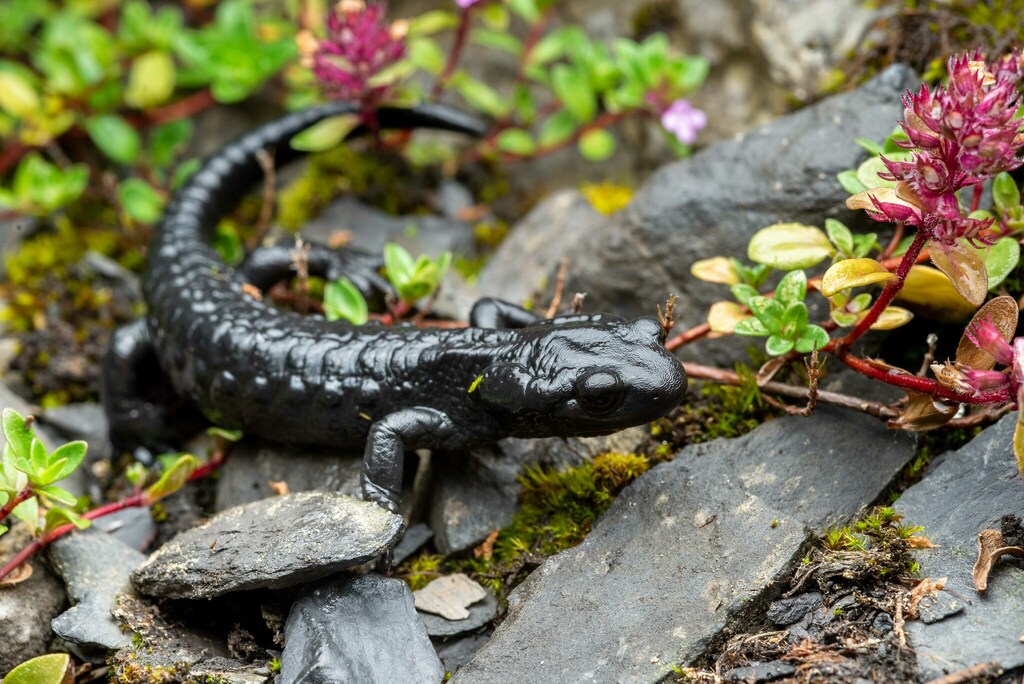
Alpine Salamander
Salamandra atra
The alpine salamander (Salamandra atra) is a black salamander that can be found in the Alps, and through the mountainous range in Europe. It is a member of the genus Salamandra. The species name, atra, is derived from the Latin ater, meaning dull black. The colour of salamanders has evolved over time, as some species are completely monochrome black, and others have yellow spotting and marks. Their life expectancy is at least 10 years. There are four subspecies of the alpine salamander, with varied distribution and physical colour. Unlike other salamanders, whose larvae develop in water, the alpine salamander and its subspecies are fully terrestrial species in life and gestation. They give birth to live young.
Alpine salamanders produce toxic compounds from their skin. These compounds may protect them from both predator and microbial threats.
From the article Alpine salamander on Wikipedia (CC BY-SA), quoted section by section
Description
Alpine salamanders are often small in size, and dark brown or black. Members of the subspecies are not wholly black or brown monochrome, but rather have mosaic or spotted patterns. Members of the subspecies Salamandra atra aurorae have bright splotches on its dorsal side and head. The colour is often bright yellow, but can range to shades of white or even grey. Distribution of the pigment is dependent on the distribution of certain cells, so may be smooth and even or patchy. Female S. atra tend to be larger than the males, and can grow up to 151 millimetres (5.9 in). Males will grow to around 144 millimetres (5.7 in); both measurements include the tail. Males have swollen, visible cloacae, and are slenderer than females. The salamanders have parotid glands posterior and lateral to their eyes, giving them an elongated head shape. They tend to have between 11 and 13 costal grooves along the sides of their bodies, and a double row of dorsal glands runs down their backs on either side of their spines, down to the tips of their tails.
Colour. Most alpine salamanders that are either completely black (melanistic) or predominantly black have the dark pigment as a baseline, but the evolution behind this dark colouring has a winding history. Scientists have studied the hypothesis of if the salamanders start completely black, or if they evolved like that over time. …
Range & habitat
As terrestrial organisms, these salamanders live on land. S. atra tend to live underneath stones or logs, or in rocky crevices in their mountainous habitat. They also are diurnal, and most active in the day with periods of inactivity, rest, or sleep at night. They will engage in nocturnal activity on a weather-dependent basis. Ideal weather for alpine salamanders is rainy or post-rain, at temperatures between 3 and 18 °C (37.4 and 64.4 °F).
Wikipedia: “Habitat”
What it does
They employ scent-marking techniques for territorial behaviour, and to mark their territories using faecal pellets so they can identify their own shelters. Scent-marking is an intra-species communication, where chemical signals convey specific messages to other S. atra individuals. Alpine salamanders can determine if a faecal pellet they find has been left by a member of their same sex and/or species. Thus, this technique serves a double purpose to warn other salamanders that that particular location has already been claimed. Females are more likely to return to their home site, while males are more emboldened to enter another male's territory. Their faecal pellets allow them to both participate in homing behaviour, or returning to their own site, and territoriality, and determine intruders on their territory or invade the spaces of others.
Wikipedia: “Territorial behaviour”
Listen
Looking for field recordings…
Where it lives
Recorded sightings
—
geo-referenced records in GBIF, from museums, herbaria and field observers.
Drag the globe to turn it. Dots are where records exist, not a range map; darker means more records.
In the stacks
Searching the stacks…
Every page naming Salamandra atra in the Biodiversity Heritage Library →
This page is assembled live from iNaturalist, GBIF, Wikipedia, the Source Library and the Internet Archive. It is not yet part of the hand-edited codex. iNaturalist taxon 27735.